Germany IT visa without a degree in 2026: The §19c route, salary needed, what 'IT experience' means
Yes, IT pros without a degree can get a German work visa in 2026. EU Blue Card IT specialist path, §19c backup, 2026 salary, and process.

Table of contents
Last updated: May 2026
TL;DR: Yes. In 2026 you can get a German work visa as an IT professional without a university degree. The main route is the EU Blue Card for IT specialists: 3 years of relevant IT experience in the last 7 years, a job offer paying at least €45,934.20 gross per year, no German language test required. The §19c standalone path is the backup when the Blue Card does not fit. This guide breaks down both, what counts as "IT experience", the salary math, and the application sequence.
If you are a self-taught developer, a sysadmin who never finished college, or a tester with a polytechnic diploma, the German work-visa system used to feel out of reach. Skilled Immigration Act 2.0 (live since November 2023) changed that. The degree gate moved aside for IT roles, and in 2026 the Blue Card route plus §19c together cover almost every credible IT profile that walks in the door.
This post sits inside our skilled worker visa pillar. It assumes you have read the EU Blue Card 2026 guide and the broader Skilled Worker Visa under §18a and §18b explainer. If you have not picked a path yet, the Blue Card vs Chancenkarte 2026 comparison is the better starting point. This post is for people who have shortlisted the IT-without-degree path and want the operational detail.
Yes, you can. Here is the short version.
Two visa types let an IT professional work in Germany without a university degree:
- EU Blue Card for IT specialists under §18g of the Aufenthaltsgesetz, applied via §6 of the Beschäftigungsverordnung. This is the primary 2026 route. You need a concrete job offer in IT, 3 years of relevant IT experience in the last 7 years, and a gross salary of at least €45,934.20 per year. No German language test. No ZAB recognition. Issued for up to 4 years.
- §19c (1) AufenthG, the Berufserfahrene route. This is the "skilled worker by experience" residence permit for non-academic specialists in any field, not just IT. It needs a vocational qualification of at least 2 years recognised as comparable to a German Berufsausbildung, plus 2 years of related work experience, plus salary at or above the federal contribution-assessment threshold (BBG-linked). It is more paperwork-heavy than the Blue Card and is mostly used when the Blue Card does not fit.
For most software engineers, data engineers, DevOps, security analysts, network admins, and product folks with engineering chops, route 1 is the cleaner answer. Route 2 sits behind it as a fallback.
§19c family vs Blue Card IT specialist: which one applies to you
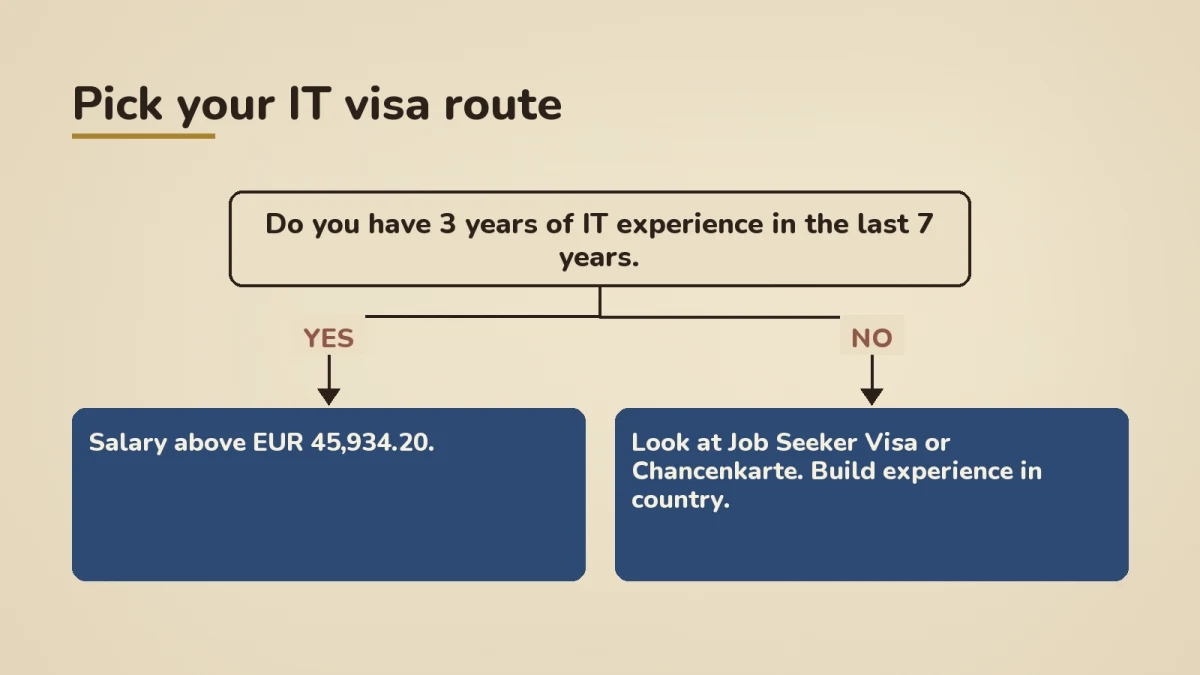
The legal text is fiddly. Here is the practical map.
What §19c actually is
§19c AufenthG is a basket. It covers several distinct residence-permit categories that share one trait: they sit outside the standard "skilled worker with degree" §18b track. Inside the basket:
- §19c (1) plus the Berufserfahrene rules in §6 BeschV. Vocational training plus 2 years of relevant experience. This is the path most non-IT skilled workers from outside the EU use today: chefs, mechanics, nurses, electricians.
- §19c (2) historically held the IT specialist standalone visa. Pre-November 2023 it required 3 years experience plus B1 German. SIA 2.0 reorganised the rules and the German-language requirement was scrapped for IT.
Today most lawyers and HR teams treat the IT-without-degree case under the Blue Card framework first because the Blue Card is faster to extend, gives easier permanent residency, and lets the spouse work without restrictions from day one. §19c stays as the backup.
Why most IT applicants land on the Blue Card route in 2026
| Question | Blue Card | §19c (1) Berufserfahrene |
|---|---|---|
| Degree required? | No, if 3 years of IT experience are documented | Vocational qualification needed (recognised by ZAB or in-country institution) |
| German language required? | No | No (since SIA 2.0) |
| 2026 salary floor | €45,934.20 (shortage / IT) | ~€45,630 (45% of the pension BBG, recalculated yearly) |
| First permit length | Up to 4 years | Up to 4 years |
| Spouse can work? | Yes, immediately, no restriction | Yes |
| Permanent residency timeline | 21 months with B1 German, 27 months with A1 | 36 months (SIA 2.0 cut from 48) |
| EU mobility (work in another EU state after 18 months)? | Yes, Blue Card EU mobility | Limited |
| Pre-approval by Bundesagentur für Arbeit needed? | Yes | Yes |
The Blue Card wins on PR speed and EU mobility. The only time §19c beats it is when your salary lands below the Blue Card floor but above the BBG-linked §19c floor, or when your qualification is a recognised non-degree vocational track like a Polish technikum or Indian polytechnic and the German embassy steers you that way.
2026 salary thresholds, exact numbers
Make-it-in-Germany and the German embassy publish these annually. The 2026 figures are:
| Path | 2026 gross annual salary | Monthly equivalent |
|---|---|---|
| EU Blue Card, general occupations | €50,700 | €4,225 |
| EU Blue Card, shortage occupations and IT specialists | €45,934.20 | €3,827.85 |
| §19c (1) Berufserfahrene (BBG-linked) | ~€45,630 | ~€3,802.50 |
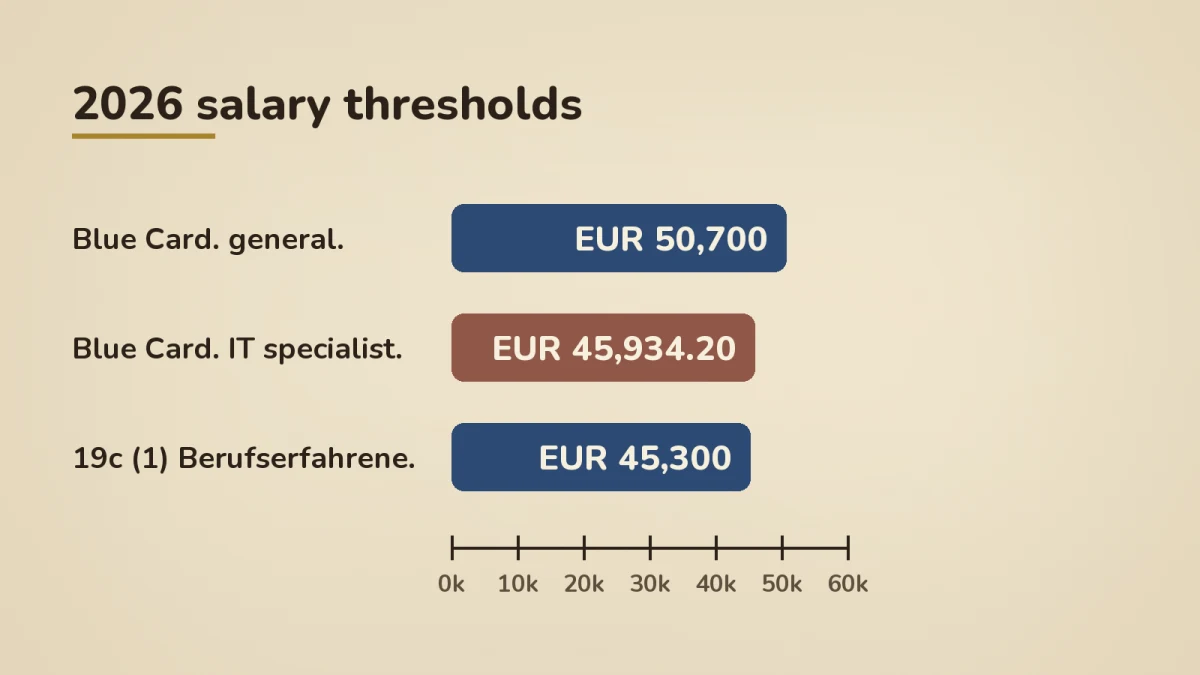
Two things that trip people up:
- The salary figure is gross annual fixed pay. Bonuses, RSUs, stock options, sign-on payments, and discretionary pay do NOT count toward the threshold. Only contracted base.
- The salary is checked against your contract, not your pay stub. If your contract says €45,000 and you actually earn €60,000 with bonuses, you fail the Blue Card check on paper.
When you negotiate the offer, push the base salary above the threshold even if it means trading away some bonus. The visa adjudicator looks at one number.
What counts as "IT experience"
Three years of "relevant IT experience in the last 7 years" is the soft language. The hard checks German embassies actually run:
- The role title and the role content match a recognised IT job family: software engineering, data engineering, DevOps, site reliability, cloud, security, network engineering, systems administration, IT consulting, technical product management with hands-on engineering, embedded systems, ML engineering. QA and testing usually qualify if the day-to-day is technical. Product owner without engineering, project manager without engineering, sales engineer, IT recruiter: borderline, often rejected.
- The experience is verifiable through documentation: signed employer references on letterhead, social-security or tax records, employment contracts, or notarised employment certificates. A LinkedIn export does not count.
- The 3 years is cumulative, not continuous: gaps are fine. A career-break sabbatical, a gig-economy interlude, a self-employed stretch are all OK as long as the total IT-employed time exceeds 36 months.
- Self-employment counts when documented: a registered freelance career with tax filings and client contracts counts. A side hustle with no paper trail does not.
- Internships rarely count: if it was paid, supervised, and full-time, it might. Most embassies discount student internships.
If you are short of 3 years, the Blue Card door is closed. §19c (1) needs only 2 years of relevant experience plus the vocational qualification, so it sometimes saves you. The other option is the Job Seeker Visa or the Chancenkarte points system to enter Germany and find a qualifying offer locally.
Application process, step by step
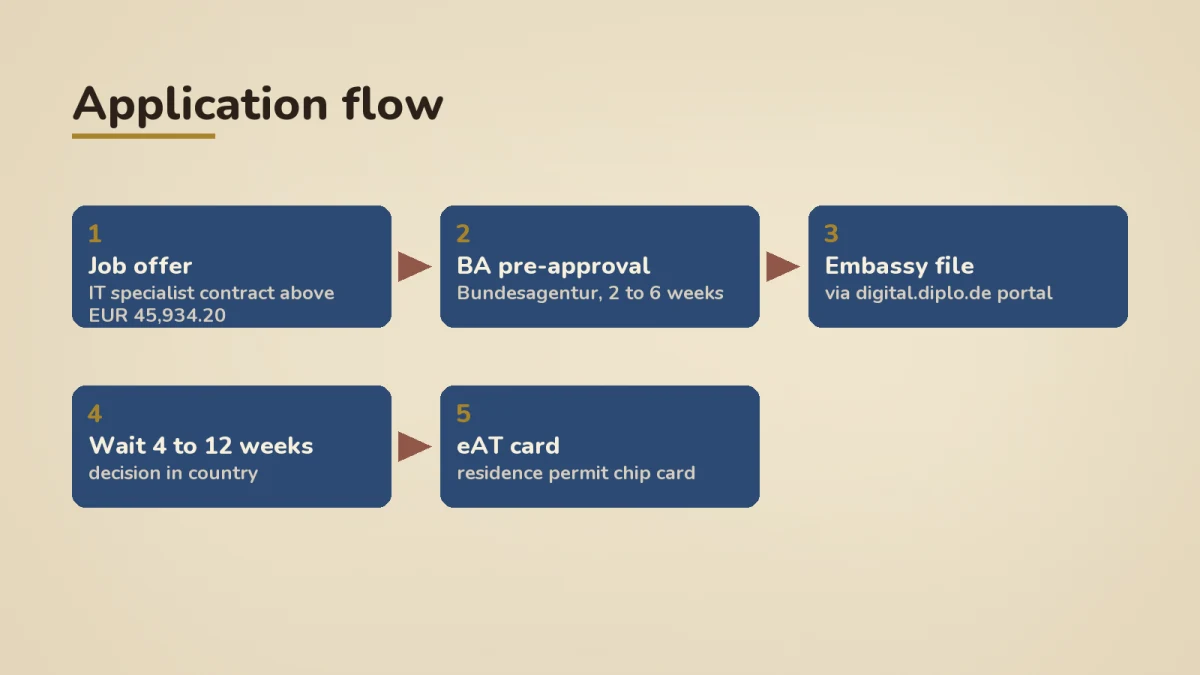
Assume you have a German job offer in hand. The sequence:
- Confirm the job is IT-coded. Ask HR to mark the role as a Blue Card IT specialist position in the contract. The job title alone is not enough; the contract must reference the IT specialist designation.
- Pre-approval (Vorabzustimmung) by Bundesagentur für Arbeit. Your employer requests this. It takes 2 to 6 weeks. Without it, the embassy will not issue the visa. The pre-approval is the single biggest delay risk in the IT-without-degree route, because the BA examiner reads the experience evidence carefully.
- Book the embassy appointment. Most South Asian and African candidates apply through the digital.diplo.de Auslandsportal now. Older missions still use Videx PDF; the portal is the default in New Delhi, Mumbai, Chennai, Bengaluru, Islamabad, Manila, Cairo and Tehran.
- File the visa application. The document set: passport, contract, BA pre-approval, employer reference letters covering 3 years, employment certificates, CV in EU format, biometric photos, health insurance proof for the entry period, visa fee €75. The IT specialist file does NOT need ZAB Anabin recognition.
- Wait 4 to 12 weeks for the decision. New Delhi runs hot in August and December; book outside those windows if you can.
- Enter Germany on the national visa. Within 90 days of arrival, register your address (Anmeldung) and convert the visa into the residence permit at the local Ausländerbehörde.
- Receive the eAT card (the chip-card residence permit) by post within 6 to 8 weeks of the Ausländerbehörde appointment.
Total wall-clock time from job offer to landing in Germany on a valid Blue Card: 3 to 5 months in the typical case. Faster if your embassy is uncongested and your employer's HR is responsive.
Common mistakes that get applications rejected
- Accepting an offer below the threshold and assuming bonuses fix it. The embassy reads the contract base, not the projected total comp. Renegotiate before you sign.
- Job title that signals "manager" but role content is IT. Consultancies sometimes give engineers a "Senior Consultant" title. The contract content must be unambiguously IT for the BA pre-approval to clear.
- Using a generic LinkedIn export as experience proof. It will not survive the BA examiner. Get signed letters on company letterhead.
- Trying §19c (1) when the Blue Card would clear. §19c (1) needs ZAB recognition of your vocational qualification, which adds 6 to 12 weeks. Use Blue Card first; fall back to §19c only if the Blue Card door closes.
- Letting the visa decision lag the start date by less than 2 months. Always start the BA pre-approval the moment the contract is signed. Do not wait for "everything else to be ready". The pre-approval is the bottleneck, not the embassy.
- Forgetting the spouse and kids. A Blue Card holder's spouse can work without restriction and the kids ride along on family reunion. File the whole family packet together; do not leave the spouse to do their own application 6 months later.
FAQ
Do I need German for the IT-without-degree visa in 2026?
No. Skilled Immigration Act 2.0 dropped the language requirement for IT specialists in November 2023. You can land in Germany with zero German for both the Blue Card IT specialist path and the §19c standalone path. German becomes useful for permanent residency: 21 months with B1 versus 27 months with A1 on a Blue Card.
Is "3 years experience" 3 years in any IT role, or 3 years in the role I am being hired for?
Three years in a recognised IT job family within the last 7 years. The role you are being hired for must reasonably match the experience profile. Hiring as a backend engineer with 3 years of QA experience is borderline; hiring as a backend engineer with 3 years of software engineering experience is a clean pass.
Can self-taught developers without any formal qualification get this visa?
Yes, on the EU Blue Card IT specialist path. The law no longer requires a vocational qualification for the Blue Card IT route, only the 3 years of documented experience and the salary threshold. §19c (1) Berufserfahrene does still require a vocational qualification, so if the Blue Card path closes you may be stuck.
What if my salary offer is €43,000, below the €45,934.20 threshold?
The Blue Card adjudicator will reject the application as filed. Either negotiate the base up to €45,934.20, or pivot to the §19c (1) Berufserfahrene path if you have the vocational qualification (which has the slightly lower BBG-linked floor, around €45,630 in 2026). Below €45,630 the IT-without-degree route is closed; you would need to look at the Chancenkarte points system for in-country job hunting instead.
How long until I can bring my family?
Family reunion is allowed from day one for Blue Card holders. The spouse files a separate visa, typically processed in 6 to 12 weeks once the principal Blue Card holder has registered an address in Germany. Spouse can work without restriction; A1 German is normally required for the family reunion visa, with limited exemptions covered in our bringing spouse to Germany on a student or work visa guide.
How does this compare to a Job Seeker Visa or the Chancenkarte?
The Blue Card IT specialist path requires a job offer in hand. If you do not have one, the Job Seeker Visa gives you 6 months in Germany to find one, and the Chancenkarte gives you 12 months under a points system. Both convert into the Blue Card or §19c the moment you sign the qualifying offer. They are entry vehicles, not destinations.
Can I switch employers once I am in Germany on this visa?
Yes, but with conditions. For the first 12 months you must inform the Ausländerbehörde of any employer change and the new employer must qualify under the same Blue Card rules. After 12 months the restriction lifts and you can change jobs freely within IT. Switching to a non-IT role within the first year typically requires a new visa.
Where does the §19c standalone path actually win?
Three cases. (1) Your salary lands between €45,630 (BBG-linked §19c floor) and €45,934.20 (Blue Card IT floor). (2) You have a recognised vocational qualification but only 2 years of experience. (3) Your job role is IT-adjacent but not core IT enough for the BA pre-approval to mark it as Blue Card IT specialist. In all three, §19c (1) Berufserfahrene rescues you.
Where to next
- EU Blue Card Germany 2026: salary thresholds, IT-without-degree route, faster PR for the full Blue Card mechanics.
- Skilled Worker Visa under §18a and §18b: which one fits your profile when you do have a degree but want to compare.
- Blue Card vs Chancenkarte 2026: speed, salary, family rules compared if you are still picking your entry vehicle.
- Job Seeker Visa Germany 2026: who actually qualifies and how to use the 6 months for the offer-not-yet-in-hand case.
- Top €50,000 salary cities in Germany compared for negotiating leverage when an employer pushes back on the threshold.
The IT-without-degree door has been open since late 2023 and the rules in 2026 are stable. The variables are your evidence quality, your salary number, and the speed of the BA pre-approval. Get those three right and the visa is administrative, not aspirational.
Continue reading
Career & Jobs·10 min read
Payscale in Germany: Average Gross Remuneration by Profession and Region
Discover the average gross remuneration in Germany by profession and region. Learn how much you can earn as a student or professional and work out your ROI. Explore the payscale in Germany and make an informed decision for your higher studies.
Read articleCareer & Jobs·15 min read
Chancenkarte Germany: Point system explained, real one-year results, who actually got in
Germany's Chancenkarte point system explained with a 6-point matrix, worked examples, and real one-year results from 2024 to 2025.
Read articleCareer & Jobs·14 min read
Why Germany has 1M jobs and zero callbacks (and how to fix your application)
Germany has over 1 million open jobs but most foreign applicants get silence. Here is why your applications fail and how to fix the stack.
Read articleReady to plan your Germany journey?
Explore our tools and resources to find the perfect university and program for your academic goals.