Blue Card Germany for IT professionals: Salary band, employer sponsorship, top hiring cities
How IT professionals qualify for the EU Blue Card in Germany 2026, salary thresholds, employer sponsorship rules, and the top hiring cities for tech.

Table of contents
Last updated: May 2026
TL;DR: IT professionals qualify for the EU Blue Card in Germany at a lower 2026 salary threshold of EUR 45,934.20 per year (versus EUR 50,700 for the standard route). Software engineers, data engineers, and most STEM IT roles count as shortage occupations, and IT specialists with three or more years of experience can qualify even without a university degree. Munich, Berlin, Hamburg, Frankfurt, and Stuttgart absorb the bulk of tech sponsorships, with Munich paying the highest median.
The EU Blue Card is the most direct visa route for IT professionals moving to Germany on an employer offer. The 2026 thresholds are now published, and most software roles fall under the reduced "shortage occupation" band, which lowers the salary bar by roughly 9 percent. For the full visa rulebook, see the EU Blue Card pillar guide.
What is the Blue Card for IT professionals in 2026?
The EU Blue Card (Blaue Karte EU, Section 18g of the Residence Act) is a residence title for non-EU professionals taking up qualified employment in Germany. For IT professionals, two tracks exist. The standard track requires a recognised university degree and a gross annual salary above the general threshold. The IT-specialist track, written into the law specifically because of Germany's tech labour shortage, allows non-graduates with comparable professional experience to qualify at the lower shortage-occupation salary.
The card is issued for the contract duration plus three months, capped at four years. Family reunification is simplified, and permanent residency follows in 21 months with B1 German or 27 months with A1, much faster than the 36-month route for other skilled workers. See our deep dive on permanent residency timelines for the comparison.
Salary thresholds for IT roles in 2026
The Federal Ministry of the Interior publishes Blue Card thresholds annually. The 2026 numbers, in force since 1 January 2026, are:
| Track | Gross annual salary (2026) | Approximate monthly (gross) | Federal Employment Agency approval? |
|---|---|---|---|
| Standard (any occupation) | EUR 50,700 | EUR 4,225 | Not required |
| Shortage occupations (incl. STEM, ICT) | EUR 45,934.20 | EUR 3,828 | Required |
| New graduates (degree within last 3 years) | EUR 45,934.20 | EUR 3,828 | Required |
| IT specialists without a degree | EUR 45,934.20 | EUR 3,828 | Required |
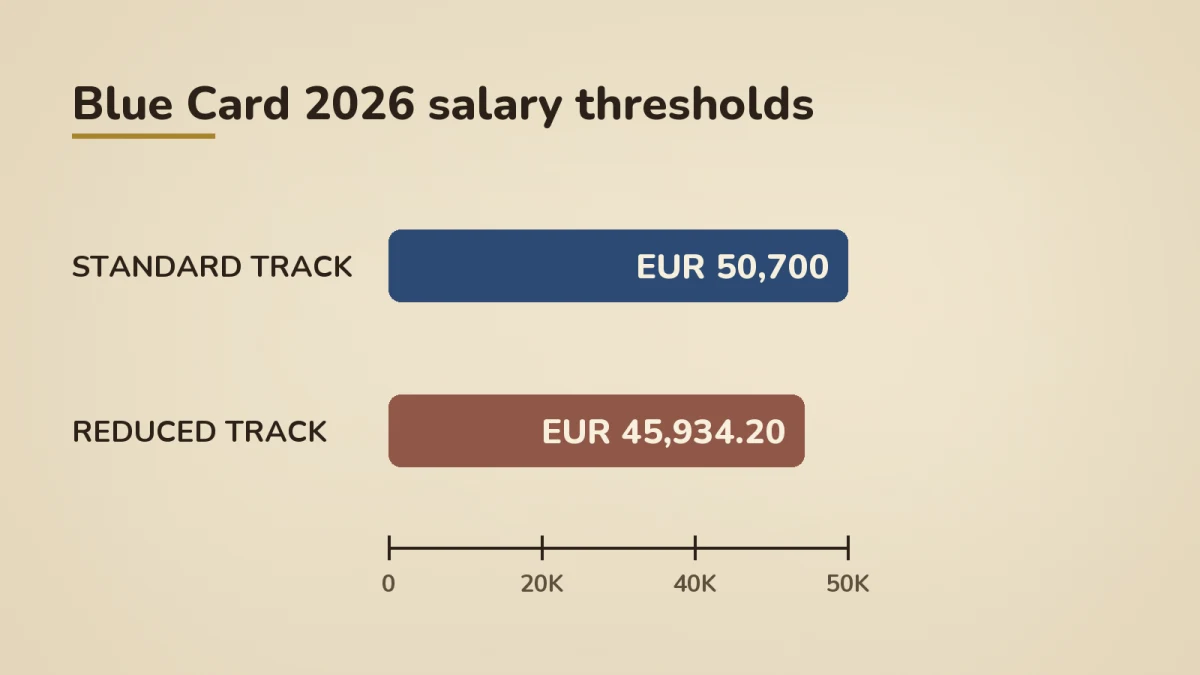
Most software, data, and infrastructure roles fall under the shortage band. The Federal Employment Agency lists "Information and communications technology service managers" and "Academic STEM professionals" on its official Mangelberufe list, which together cover the majority of software engineering, data engineering, DevOps, security, cloud, and ML roles.
The salary figure is gross base pay. Bonuses, stock, and one-off sign-on payments do not count toward the threshold for visa purposes. If your offer letter shows a base of EUR 44,000 plus a EUR 5,000 bonus, the visa officer reads it as EUR 44,000 and the application fails. Push for base-only above the line.
Can IT specialists get a Blue Card without a degree?
Yes. Section 18g of the Residence Act includes a carve-out for IT specialists without formal qualification. To qualify you need:
- A specific job offer in IT in Germany, with a contract of at least six months.
- A gross annual salary of at least EUR 45,934.20 (2026 figure).
- At least three years of professional IT experience at university graduate level, gained within the past seven years.
The "university graduate level" wording matters. The Federal Employment Agency reads it as work that an academic IT professional would typically do: software architecture, systems design, lead engineering, security, data engineering. Helpdesk and basic admin roles do not qualify even if you have ten years of experience. Make sure your CV documents technical depth.
This route was widened by the Skilled Immigration Act 2.0, which took effect in 2024 and is the basis for the current 2026 framework. Self-taught engineers, bootcamp graduates with strong portfolios, and senior contractors who never finished a degree are all eligible if they can document the experience.
How employer sponsorship works
The German Blue Card is sponsored by the employer, but the visa is issued to you and travels with you between jobs. The employer's role is to provide a contract that meets the requirements: matching qualification, six-month minimum, salary above threshold, and (for the reduced band) cooperation with the Federal Employment Agency check. There is no government-funded sponsorship cost paid by the employee.
The fast-track procedure (beschleunigtes Fachkräfteverfahren) cuts processing time roughly in half. The employer files the application with the local foreigners authority in Germany, the authority issues a pre-approval, and you collect the visa at a German mission abroad in three to four weeks. Many large German tech employers, including SAP, Siemens, BMW, Bosch, Deutsche Telekom, Allianz, and most Berlin-based scale-ups, run this process internally. Ask your hiring contact whether they use Fachkräfteverfahren before signing.
After moving in you have two weeks to register your address (Anmeldung); you then convert your entry visa into the Blue Card residence title at the foreigners authority. Job changes within the first 12 months must be reported, but no new visa is needed if the new role still meets the conditions.
Top hiring cities for tech in Germany
Tech sponsorship is concentrated in five metropolitan regions, each with a different sector profile and pay band. The Federal Employment Agency's Entgeltatlas and 2026 market reports point to the following spread for software engineering roles:
| City | Median software engineer salary (gross) | Senior pay band | Sector strength |
|---|---|---|---|
| Munich | EUR 78,000 to 80,000 | EUR 90,000 to 110,000 | Enterprise software, automotive tech, semiconductors, deep tech |
| Berlin | EUR 70,000 to 76,000 | EUR 75,000 to 95,000 | Startups and scale-ups, fintech, e-commerce, B2B SaaS |
| Hamburg | EUR 65,000 to 72,000 | EUR 75,000 to 90,000 | Logistics tech, media, e-commerce platforms |
| Frankfurt | EUR 70,000 to 78,000 | EUR 80,000 to 95,000 | Banking and capital markets tech, regulatory tech |
| Stuttgart | EUR 70,000 to 78,000 | EUR 80,000 to 100,000 | Automotive software, embedded systems, mobility |
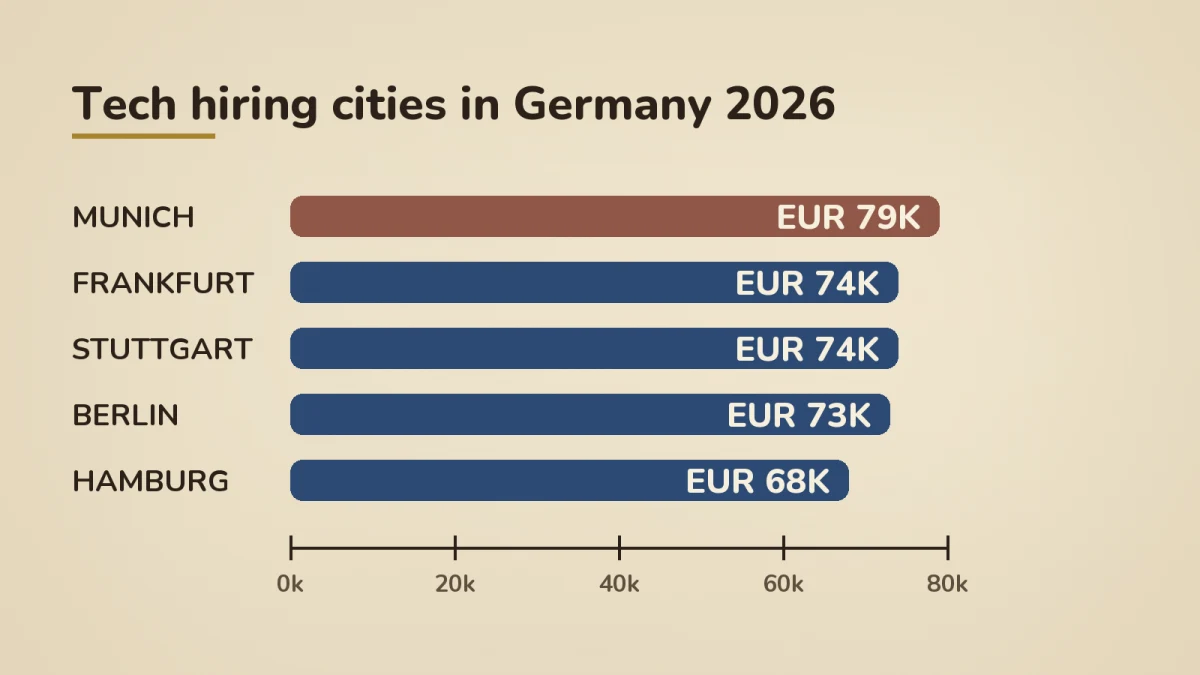
Munich pays the highest in absolute terms; Berlin remains the largest hiring market for non-German speakers since most startups operate in English. Frankfurt is the right pick for fintech depth, Stuttgart and Munich for automotive and embedded. Run our salary calculator for an after-tax estimate per city.
Common mistakes to avoid
Four errors come up repeatedly in our consultation queue:
- Counting bonuses toward the salary threshold. Only base pay qualifies. Negotiate base.
- Skipping the degree-equivalence step. If your degree is from outside Germany, check it against the Anabin database before signing. A degree marked H+ is recognised; H- needs a separate equivalence assessment.
- Mistaking the Opportunity Card for the Blue Card. The Chancenkarte (Opportunity Card) is for job seekers without an offer. Once you have an offer above threshold, the Blue Card is faster and gives you the 21-month PR track.
- Ignoring the language clock. A1 in 27 months and B1 in 21 months are deadlines for permanent residency, not goals. Start German lessons before you arrive.
Frequently asked questions
Does my IT job have to be on a specific shortage list?
Software engineering, data engineering, security, DevOps, cloud architecture, and ML roles are almost all covered under "Academic STEM professionals" or "ICT service managers" on the Mangelberufe list. The list is broad on purpose; the visa officer matches your role at application time.
How much does the Blue Card cost?
The visa fee at the German mission abroad is EUR 75 to 100. The residence title issued inside Germany costs another EUR 100. There is no separate sponsorship fee.
Can my spouse work on the Blue Card?
Yes. Spouses of Blue Card holders get an unrestricted work permit on arrival, with no separate job offer or German language requirement.
How long does the visa decision take?
Three to four weeks under the fast-track Fachkräfteverfahren. Six to twelve weeks via the standard route. Apply as soon as your contract is signed; biometric slots in Indian, Pakistani, and Nigerian missions are the bottleneck.
Can I switch employers on the Blue Card?
After 12 months, freely. Within the first 12 months, notify the foreigners authority; no new visa is needed if the new role still meets the threshold and qualification match.
Where to next
- EU Blue Card pillar guide for the full visa rulebook
- Detailed Blue Card guide for skilled professionals with country-specific application steps
- Payscale in Germany for salary benchmarks across professions and regions
- Salary calculator for after-tax monthly take-home estimates
- Opportunity Card overview if you do not yet have a job offer
Continue reading
Career & Jobs·14 min read
EU Blue Card Germany 2026: New salary thresholds, IT-without-degree route, faster PR
EU Blue Card Germany 2026 thresholds raised to €50,700 standard and €45,934.20 shortage. IT specialists qualify without a degree under §18g. PR in 21 months at B1, spouse joins with no German required. Full guide for working professionals.
Read articleCareer & Jobs·11 min read
Blue Card vs Chancenkarte: Which one should you actually apply for in 2026
EU Blue Card or Chancenkarte for Germany? The Blue Card is for those with a job offer; the Opportunity Card is for job seekers. Here is how to pick in 2026.
Read articleCareer & Jobs·10 min read
Payscale in Germany: Average Gross Remuneration by Profession and Region
Discover the average gross remuneration in Germany by profession and region. Learn how much you can earn as a student or professional and work out your ROI. Explore the payscale in Germany and make an informed decision for your higher studies.
Read articleReady to plan your Germany journey?
Explore our tools and resources to find the perfect university and program for your academic goals.