Germany shortage occupation list 2026: jobs that unlock the lower Blue Card salary threshold
Germany's shortage occupation list names the jobs that unlock the lower 2026 EU Blue Card salary threshold. Here is what is on it and how to use it.

Table of contents
Last updated: May 2026
TL;DR: Germany's official shortage occupation list (Engpassberufe), published annually by the Bundesagentur für Arbeit, currently identifies 163 occupations where qualified workers are critically short. If your profession is on it, the EU Blue Card salary threshold drops from €50,700 to €45,934.20 for 2026, and the BAMF skips the labour-market priority check on your visa.
If you are eyeing a move to Germany on a work visa, the EU Blue Card is usually the cleanest route. The conversation around it focuses on salary thresholds, but what quietly decides which threshold applies to you is whether your job sits on Germany's official shortage occupation list. The list is rebuilt every year by the Bundesagentur für Arbeit (BA) and is the same list the BAMF uses when it decides whether to fast-track your file.
This post explains what the list is, how it links to the Blue Card, which sectors dominate the 2025-2026 edition, and how to check whether your specific role qualifies. For the broader visa requirements, pair this with our full EU Blue Card guide for skilled workers.
What is Germany's shortage occupation list?
The shortage occupation list is the public output of the BA's annual Fachkräfteengpassanalyse, a statistical exercise that scores roughly 1,200 occupations on six labour-market indicators. The 2025 edition, published on 28 May 2025, lists 163 occupations as Engpassberufe (bottleneck professions). That is down from 183 in 2024, but still about one in every eight skilled occupations in Germany.
A separate 181 occupations sit on a watchlist. They are not officially short today, but they have moved enough on at least two indicators that the BA flags them as candidates for next year's list. Across both lists, almost half of the 439,000 skilled vacancies the BA tracked in 2024 were in bottleneck professions, while only a quarter of unemployed skilled workers were qualified for those same roles. That gap is what drives Germany's expat-friendly hiring stance.
The list lives behind one clean URL on arbeitsagentur.de and is the legal anchor referenced in §18g (1)(2) of the Aufenthaltsgesetz. Make-it-in-Germany republishes it in English with KldB occupation codes, which is what most expats actually read. The German-language version on statistik.arbeitsagentur.de is the legal source of truth; the English PDF lags by a few weeks.
How the list connects to the EU Blue Card threshold
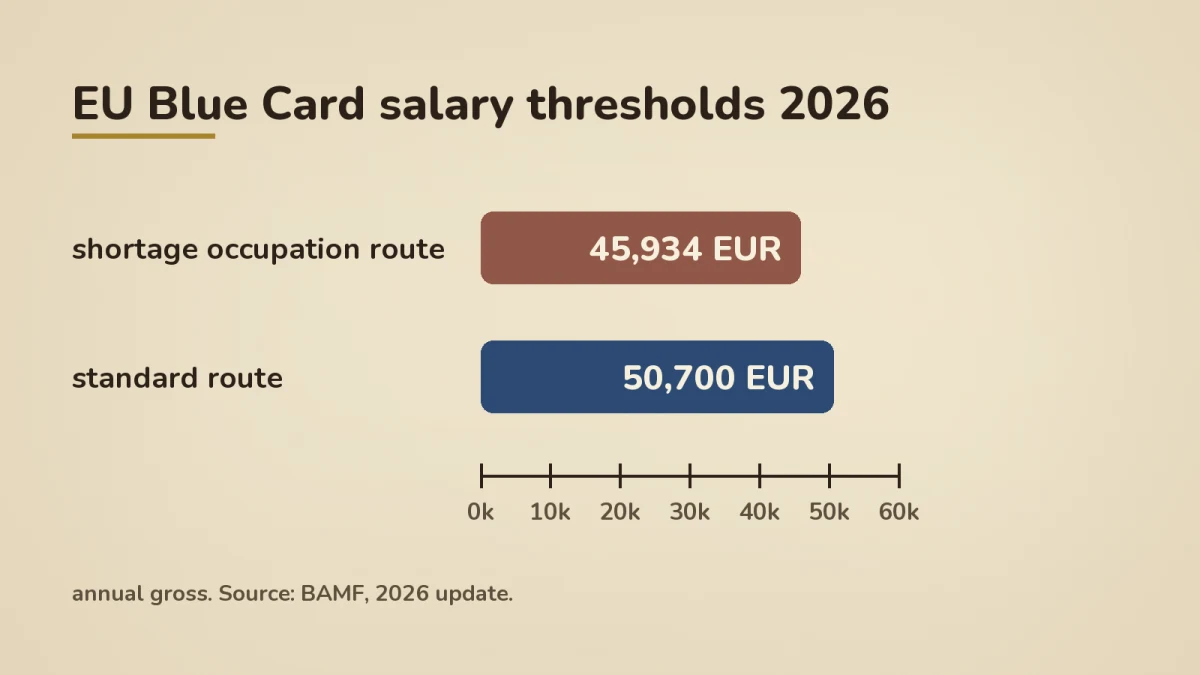
Germany sets two Blue Card salary minima each calendar year. For 2026:
| Track | Minimum gross salary 2026 | Who qualifies |
|---|---|---|
| Standard threshold | €50,700/year | Most degree holders in non-shortage occupations |
| Shortage / regulated / new entrant threshold | €45,934.20/year | Occupations on the BA's Engpassberufe list, regulated professions, recent graduates within three years of degree |
The lower threshold is the entire point of the shortage list for most readers. A software developer with €47,000 a year cannot get a Blue Card under the standard threshold. The same offer in a shortage occupation goes through. The German consulate or BAMF case officer will check the BA list when validating your salary; you do not have to file a separate proof.
A second perk you do not see on the salary line: shortage occupations skip the so-called Vorrangprüfung (labour-market priority check). For non-shortage roles, the BA can in principle test whether a German or EU candidate could do the job before approving a non-EU hire. For shortage occupations, that check is waived. In practice this shaves weeks off the timeline.
Which sectors dominate the 2025-2026 list?
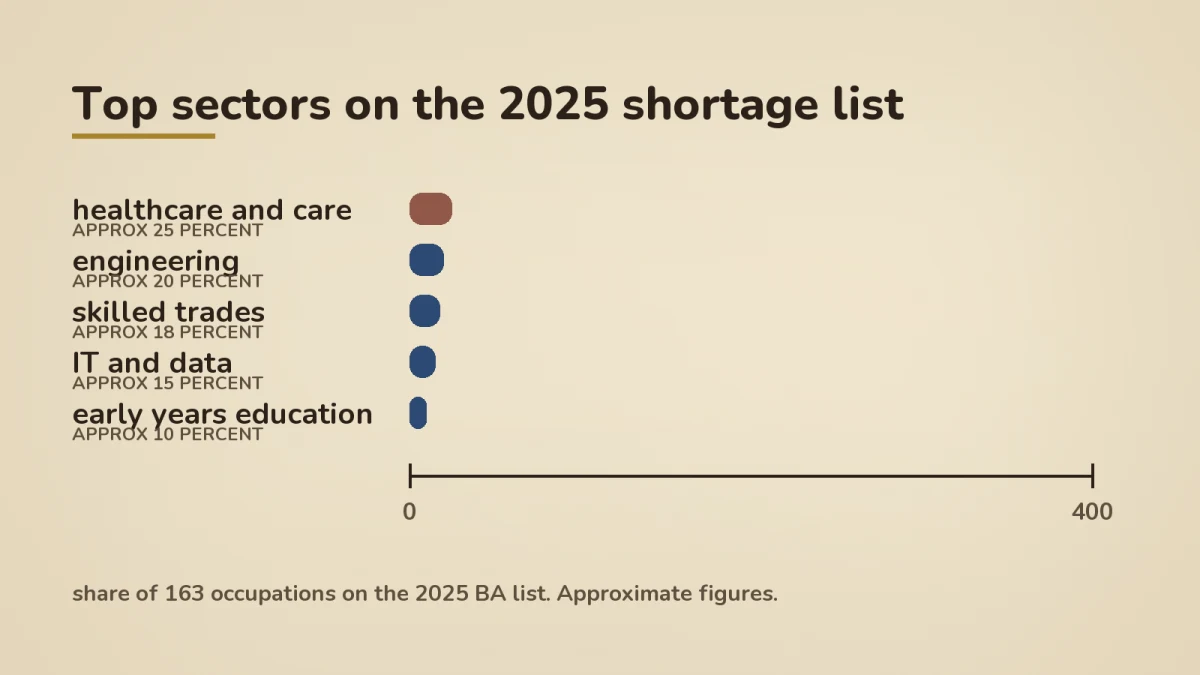
The BA does not slice the list by sector officially, but the press release for 2025 calls out the same five clusters every year, and they map cleanly onto the KldB codes:
Healthcare and care. Registered nurses (Gesundheits- und Krankenpfleger), geriatric carers (Altenpflege), midwives, paramedics, medical-technical assistants, and physiotherapists. Healthcare alone accounts for roughly a quarter of the list. The aging population plus a wave of post-pandemic retirements means the shortage here is structural, not cyclical.
IT and data. Software development, system administration, IT security, network engineering, data analysts, and cloud architects. The 2025 list expanded the IT cluster after the AI-driven hiring surge in 2023-2024, and Berlin, Munich, and Hamburg routinely report 30+ percent of their open Blue Card slots in IT roles.
Engineering. Mechanical, electrical, civil, automotive, mechatronics, and process engineers. The list also captures Tiefbau (civil/underground engineering) and Lokführer (locomotive drivers), which together cover most of the rail and infrastructure rebuild Germany committed to in the 2024 federal budget.
Skilled trades and crafts. Electricians, plumbing/HVAC fitters, roofers, carpenters, butchers (Fleischer), bakers, and metalworkers. These are the Ausbildung-track shortages, not Blue Card material directly, but the same shortage status feeds into the Skilled Worker Visa under §18a.
Early-years and special-needs education. Erzieher (early-years teachers) and Heilerziehungspfleger (special-needs carers). Germany legislated a federal childcare expansion in 2024 that did not come with enough trainees to staff it, so the list now includes both fields.
If your role does not fit any of these five buckets, do not assume you are out. The list also includes specific niche professions like train drivers, civil-engineering technicians, and air-traffic controllers. The clean way to check is the official PDF, not a third-party listicle.
How to check whether your specific job is on the list
Three legitimate ways. In ascending order of authority:
-
Make-it-in-Germany's English PDF. Updated within a few weeks of the German release. Lists each occupation in plain English plus its four-digit KldB code. Good for a fast yes/no.
-
statistik.arbeitsagentur.de Fachkräfteengpassanalyse. German-only but the legal source of truth. Includes the data appendix (the indicator scores per occupation) which lets you see how borderline a profession is. Useful if your role is in the 181-occupation watchlist and you want to forecast next year's list.
-
The Bundesagentur's interactive map at statistik.arbeitsagentur.de. Search by KldB code and see the regional breakdown. A profession can be on the federal list while easing in one Bundesland, and vice versa. The federal list is what counts for your Blue Card; the regional view is mostly relevant if you are choosing where to relocate within Germany.
Once you have your KldB code, hold on to it. The BAMF, the consulate, and your German HR contact will all reference it on your visa file.
How the BA decides who makes the list each year
The Engpassanalyse runs on six statistical indicators: time to fill a vacancy (longer means tighter), occupation-specific unemployment rate (lower means tighter), salary development (rising salaries flag a shortage), demographic pressure (retirement-heavy occupations age into shortage), foreign-trained workforce share, and vocational training participation.
A profession enters the list when it scores above threshold on at least four of the six. It drops off when at least four ease for two consecutive years. That is why the list shrank from 183 to 163 in 2025: weak hiring in early 2024 eased the time-to-fill metric in some engineering and trade subfields, even though structural demand stayed high.
The next list will be published around May or June 2026. If you are planning a 2027 move, do not anchor on the current edition as if it is permanent.
Common mistakes expats make
Confusing the shortage list with the regulated-profession list. Regulated professions (doctors, lawyers, teachers, certain engineering subfields) get the lower Blue Card threshold by default, regardless of the shortage list. The two lists overlap heavily but are not the same. If your role is regulated, your priority is recognition (Anerkennung) of your foreign qualification before you even worry about Engpassberufe.
Assuming the list updates retroactively. The list that applies to your application is the one in force on the date the BAMF or consulate processes your file. If your role drops off the list between offer and decision, the lower threshold does not apply and the consulate can reject for salary. Apply within a few months of the offer, not a year later.
Reading a listicle instead of the BA PDF. Third-party blogs sometimes scrape an old edition and forget to update. Always cross-check against the make-it-in-Germany PDF or the BA statistik portal, not a generic SEO page.
Not getting the foreign degree recognised when needed. For non-regulated occupations, the EU Blue Card accepts a recognised university degree from your home country plus a job offer that matches it. For regulated roles (most healthcare, teaching, some engineering), you need a recognition decision before the visa works. The Anerkennung process is its own pipeline; start it the moment you have the offer.
Forgetting the 12-month employer-change rule. Even on a Blue Card, the first 12 months are tied to the employer that sponsored you. After that you can move freely, but a job change in the first year requires BAMF approval and the new role still has to clear the salary threshold. Plan accordingly.
FAQ
Is the 163-occupation list the same as the priority occupation list?
No. The 163 figure is from the 2025 Fachkräfteengpassanalyse and applies to civilian Blue Card decisions and the Skilled Worker Visa. The priority occupation list is a smaller subset that the EU separately maintains for the directive level. For practical purposes in Germany, only the BA list matters.
Does the shortage list affect the Opportunity Card (Chancenkarte)?
Indirectly. The Opportunity Card is a points-based job-seeker visa, not a work visa. Working in a shortage occupation gives you bonus points on the application, but the actual hiring decision and visa class is separate. Most Opportunity Card holders convert to a Blue Card or §18a Skilled Worker Visa once they land an offer.
My job title is in English. How do I find the right KldB code?
The KldB is a German classification, so titles like "DevOps engineer" or "data scientist" do not exist verbatim. Map your role to the closest German job family using the make-it-in-Germany PDF or the arbeitsagentur job database. Most software roles fall under KldB 4313 (software development) or 4314 (IT system support). Your German employer's HR will normally do this for you on the visa application.
What if my profession is on the watchlist (181 occupations) but not the official list?
Watchlist occupations do not get the lower Blue Card threshold. They are flagged because the BA expects them to qualify next year, but until they cross the line, your salary needs to clear the standard €50,700. Push for a higher offer or wait for the next list update.
Does the shortage list change the family-reunion rules?
No. Family reunion under the Blue Card is the same regardless of whether your role is on the shortage list. Your spouse can come with you immediately and work without restriction; minor children get joint residence permits. The shortage list only changes salary threshold and BAMF priority check, nothing else.
Can I get a Blue Card without German language skills if I work in a shortage occupation?
Yes. The Blue Card itself does not require German at issue. You will need at least B1 within the first three years if you want to convert to permanent residence faster (21 months instead of 27), but the initial visa goes through on English alone. Many shortage-occupation employers, especially in IT, run their internal language entirely in English.
How often does the list actually change?
Annually, with a publication window of late May to early June. The shifts are usually small (10-30 occupations on or off), but specific subfields can swing harder if their indicator scores cross threshold. If your field is borderline this year, expect to recheck before any 2027 application.
Where to next
If your role is on the list, the next step is the EU Blue Card track itself: read the EU Blue Card guide for skilled workers in Germany for the full document checklist and timeline. If you are still exploring, the Opportunity Card explainer covers the job-seeker route into Germany if you do not have an offer yet. For the wider context of the work-visa landscape, our /work/blue-card pillar brings together every salary threshold, ICT route, and family rule in one place.
Once you have an offer in hand, anchor every decision (location, contract length, start date) on the BA list edition that will be in force when your file is processed, not the one in force when you started reading.
Continue reading
Career & Jobs·11 min read
Blue Card vs Chancenkarte: Which one should you actually apply for in 2026
EU Blue Card or Chancenkarte for Germany? The Blue Card is for those with a job offer; the Opportunity Card is for job seekers. Here is how to pick in 2026.
Read articleCareer & Jobs·10 min read
Payscale in Germany: Average Gross Remuneration by Profession and Region
Discover the average gross remuneration in Germany by profession and region. Learn how much you can earn as a student or professional and work out your ROI. Explore the payscale in Germany and make an informed decision for your higher studies.
Read articleCareer & Jobs·15 min read
Chancenkarte Germany: Point system explained, real one-year results, who actually got in
Germany's Chancenkarte point system explained with a 6-point matrix, worked examples, and real one-year results from 2024 to 2025.
Read articleReady to plan your Germany journey?
Explore our tools and resources to find the perfect university and program for your academic goals.