Bringing your spouse to Germany on a student or work visa: Documents, A1 requirement, processing
Complete 2026 guide to Germany's spouse visa on student or work residence permits. A1 German rules, exemptions, documents, fees, and processing time.

Table of contents
Last updated: May 2026
TL;DR: Your spouse can join you in Germany on a Family Reunion Visa (Visum zum Ehegattennachzug). A1 German is mandatory for most spouses, but waived if you hold an EU Blue Card, ICT card, residence permit for skilled employment, settlement permit, or are a researcher. The visa fee is EUR 75, official processing is 1 to 3 months, and the realistic end-to-end wait once A1 is submitted is 6 to 9 months. Apply through the digital.diplo.de Consular Services Portal in your country.
If you are studying or working in Germany on a non-EU passport and want your husband or wife to live with you, this is the post that explains how. It covers who qualifies, when the A1 German requirement kicks in (and when it does not), the documents the embassy actually checks, fees, processing time, and what happens after your spouse lands. For the broader pillar on residence titles, see the Germany visa types overview. For the legacy long-form guide that also covers children and parents, see our German Family Reunion Visa guide.
The rules below apply to non-EU spouses. EU and EEA spouses do not need a visa at all, just a valid ID card and an Anmeldung within two weeks of arrival.
Who can bring a spouse to Germany, and what is the visa called
Anyone holding a valid German residence title can sponsor a spouse, including students on a §16b residence permit, employees on a §18a or §18b residence permit, EU Blue Card holders, settlement-permit holders, ICT card holders, researchers on §18d, and Chancenkarte (Opportunity Card) holders who have transitioned to a work permit. Self-employed and freelance permit holders qualify too. Asylum applicants and short-term Schengen visitors do not.
The official name is Visum zum Ehegattennachzug (visa for spousal reunification), governed by §30 of the German Residence Act (Aufenthaltsgesetz). It is a national long-stay visa (D-visa), valid for 90 days at entry, after which your spouse converts it into a residence permit (Aufenthaltserlaubnis) at the local Ausländerbehörde. The residence permit is initially issued for 1 to 3 years, then renewed.
Three baseline conditions apply to every applicant: both spouses must be at least 18, the marriage must be legally recognised under German law (registered, not just religious), and you must show enough income and accommodation in Germany to support your spouse. Accommodation rule of thumb is at least 12 square metres per adult plus a separate sleeping room.
Do you need A1 German?
The exemption table you actually want
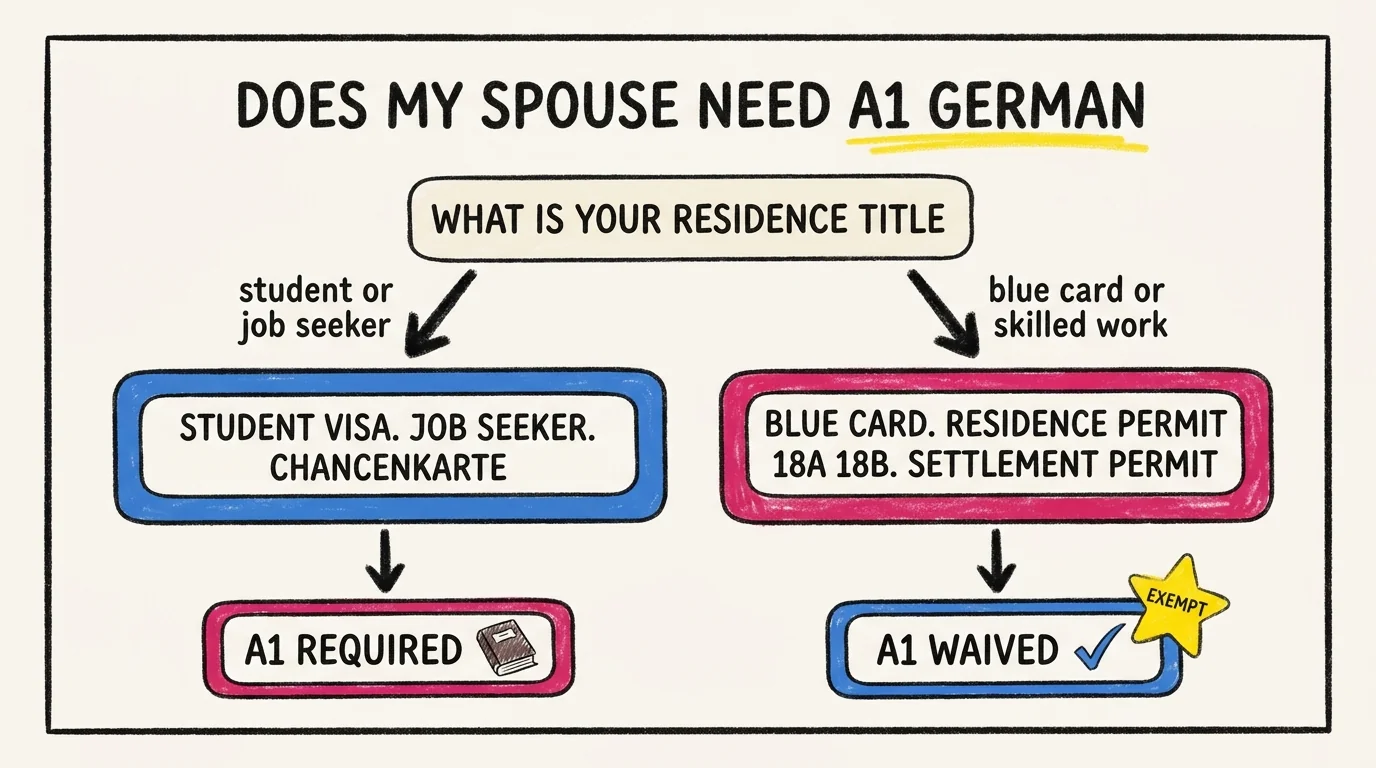
The A1 requirement is the biggest source of confusion in the spouse-visa process, mostly because the rules changed under the Skilled Immigration Act 2.0 in March 2024 and again in mid-2024. As of 2026, here is the actual map:
| Sponsor's residence title in Germany | Spouse needs A1 German? |
|---|---|
| Student visa (§16b) | Yes |
| Language course visa (§16f) | Yes |
| Job seeker visa (§20) | Yes |
| Chancenkarte (Opportunity Card) before converting to a work permit | Yes |
| Residence permit for qualified employment (§18a, §18b) | No |
| EU Blue Card (§18g) | No |
| ICT card (§19) | No |
| Researcher permit (§18d) | No |
| Self-employed (§21) | No |
| Settlement permit (Niederlassungserlaubnis) | No |
| German citizen | Yes (unless the spouse is from a visa-exempt country, see below) |
Always exempt regardless of A1, on nationality grounds: spouses holding passports of Australia, Brazil, Canada, El Salvador, Honduras, Israel, Japan, Monaco, New Zealand, San Marino, South Korea, the United Kingdom, or the United States. They can enter Germany visa-free and apply for the residence permit directly at the Ausländerbehörde after arrival.
Also exempt: spouses with a recognised disability that prevents them from passing the test, spouses from countries where there is no Goethe or telc test centre within reasonable reach, and cases where learning A1 would clearly be a hardship (rarely accepted; you need medical or geographic evidence).
If A1 is required, your spouse must pass before the visa is granted. The accepted certificates are Goethe-Zertifikat A1 Start Deutsch 1, telc Deutsch A1, ÖSD Zertifikat A1, or TestDaF A1. The Goethe-Zertifikat A1 is the most widely accepted at German missions and the de-facto default. The 2024 A1 pass rate at exam centres was around 62 percent, down from 65 percent in 2023, so plan for at least one retake in the timeline.
If you are a student today and plan to switch to a skilled-employment permit after graduation, the A1 requirement is tied to your residence title at the moment your spouse applies. Many couples wait for the post-study work transition specifically to skip A1.
Documents your spouse needs (the actually-checked list)
Every German mission has its own checklist on its website, but the core stack is consistent across the major Indian, Pakistani, Filipino, Nigerian, and Egyptian missions:
- Two completed application forms (printed from digital.diplo.de after the online application).
- Two recent biometric passport photos (35 x 45 mm, white background).
- Spouse's passport, valid for at least 12 months beyond expected entry, with at least two blank pages.
- Marriage certificate, originals plus one copy. If issued outside Germany, it must be apostilled (Hague Convention countries) or legalised by the German embassy (non-Hague countries) and translated by a sworn translator.
- Both spouses' birth certificates, similarly apostilled and translated.
- A1 German certificate (Goethe / telc / ÖSD / TestDaF), if not exempt.
- Sponsor's residence title in Germany (copy of the residence-permit card or visa sticker).
- Sponsor's last 3 to 6 months of payslips or, for students, blocked-account statement plus enrolment certificate (Immatrikulationsbescheinigung).
- Anmeldung (registration of address) for the sponsor in Germany.
- Proof of accommodation in Germany meeting the 12 sqm-per-person rule. Either rental contract plus floor plan or a Wohnungsgeberbestätigung from your landlord.
- Health insurance for the spouse, valid from the date of arrival. Travel insurance is fine for the entry phase; long-term, your spouse switches to public (gesetzliche Krankenversicherung) or private cover within 90 days.
- Visa fee of EUR 75, paid at the appointment in local currency at the embassy's exchange rate.
Two practical traps worth flagging. First, marriage certificates from India, Pakistan, Bangladesh, and Nigeria are routinely sent for verification by the German mission, which can add 4 to 8 weeks on top of the standard processing time. Second, students who are still on the blocked-account stage rather than full income often run into "insufficient means of subsistence" rejections; the threshold is the standard rate of EUR 1,027 per month per adult plus the spouse's share of housing.
How long does it take, and what does it cost
| Item | 2026 figure |
|---|---|
| Visa application fee (national D-visa) | EUR 75 |
| Residence permit fee on arrival | EUR 100 |
| Goethe-Zertifikat A1 exam | EUR 100 to EUR 130, varies by country |
| Marriage certificate translation and apostille | EUR 80 to EUR 200 |
| Health insurance starter (3 months) | EUR 110 to EUR 250 |
| Embassy biometrics and photo | EUR 8 to EUR 12 |
End-to-end timeline is the part most couples underestimate. Official Auswärtiges Amt language says "1 to 3 months" for processing the visa application. The realistic wait, including A1 prep, document apostille, and the embassy's verification step, is 6 to 9 months. Some missions (Bangladesh, Pakistan, Iran) explicitly publish "minimum 8 months" on their consular pages. New Delhi, Mumbai, Chennai, and Bengaluru are running at roughly 4 to 6 months in 2026 once a complete file is submitted.
The application process step by step
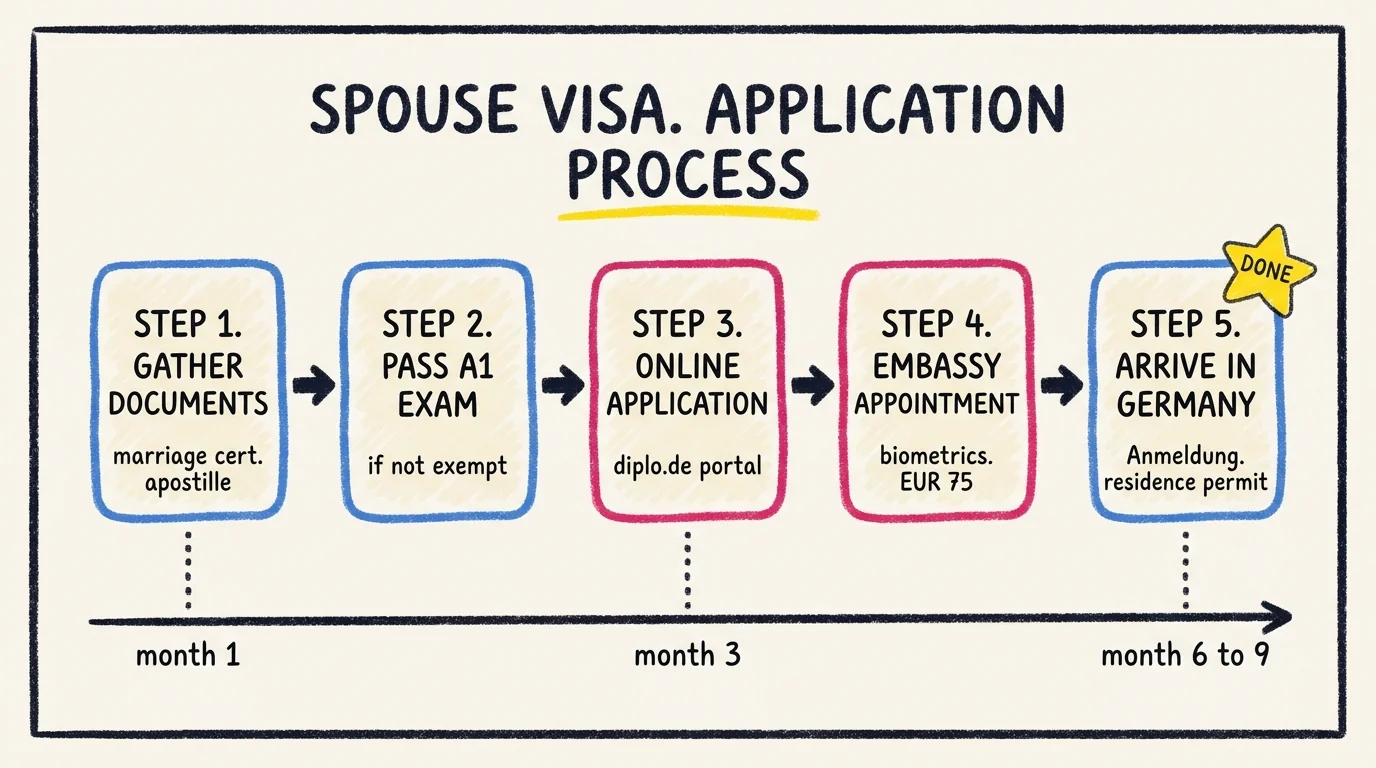
- Sponsor side. Confirm your residence title is one that allows family reunification. If you are on a Chancenkarte and have not yet started a job, wait until you have the §18a/18b residence permit before your spouse files; that switch alone removes the A1 requirement and shortens the file.
- Marriage paperwork. Get the marriage certificate apostilled and translated by a sworn (vereidigt) translator. Allow 4 to 8 weeks; some apostille offices in India, Pakistan, and the Philippines run a 6-week queue in 2026.
- A1 exam (if needed). Book a Goethe / telc / ÖSD test in your country. Pass marks have not changed, but study materials have. Plan for one retake; budget 3 to 4 months including study time if your spouse is starting from zero. See our German language for studies guide for prep tips.
- Online application. Lodge the application via digital.diplo.de/ehegattennachzug. The portal is mandatory or default in 130+ German missions including all four Indian missions, Mumbai, Chennai, Bengaluru, and the Mission in Manila, Karachi, and Cairo. The legacy Videx PDF route is being phased out.
- Appointment. Book a biometrics appointment at the German mission. Slots are scarce in New Delhi and Islamabad; book the moment the online application is submitted.
- Submit. Bring the complete document stack plus EUR 75 to the appointment. Biometrics (fingerprints, photo) are taken on the spot.
- Wait. The embassy forwards the file to the Ausländerbehörde of the city where you (the sponsor) live. The Ausländerbehörde approves or rejects, and the embassy issues the visa. This is the slowest step; expect 4 to 12 weeks.
- Travel. Once stamped in the passport, your spouse has 90 days to enter Germany.
After arrival:
Anmeldung, residence permit, work rights
Within two weeks of moving in, your spouse must register their address at the Bürgeramt (Anmeldung). They need the rental contract and a Wohnungsgeberbestätigung from the landlord. The Anmeldung is the gateway to everything else, including the residence permit appointment, German health insurance, a tax ID, and a German bank account. See our Anmeldung guide for the appointment booking trick that works in Berlin, Munich, and Hamburg.
Before the 90-day visa expires, your spouse books an appointment at the Ausländerbehörde to convert the visa into a residence permit. The card is issued for 1 to 3 years and is automatically tied to your status. If you change residence titles (graduation, switch to Blue Card, settlement permit), your spouse's permit is renewed in line with yours.
The residence permit grants unrestricted access to the German labour market from day one. There is no separate work permit, no employer-sponsorship step, and no minimum-wage threshold. Your spouse can work full-time, part-time, freelance, or open a business immediately. Health insurance is mandatory; if you are publicly insured, your spouse joins your plan as a family-insured dependent at no extra cost as long as they earn under EUR 538 per month (2026 mini-job ceiling). Above that, they need their own public or private cover.
If you hold an EU Blue Card and have been in Germany for 27 months on B1 German (or 21 months on B2), you are eligible for a settlement permit, and your spouse becomes eligible for one alongside you. See our EU Blue Card guide for the fast-track timeline.
Common mistakes to avoid
- Filing while on the Chancenkarte before starting work. A1 is required, and the file is weaker on income. Wait for the §18a/18b permit if you can.
- Submitting an unapostilled marriage certificate. Embassies reject the file outright; you lose the appointment slot and start over.
- Using a non-sworn translator. Court-sworn (vereidigt) translators only. Online cheap translations get rejected.
- Booking the embassy appointment before the A1 result. If A1 fails, you waste the slot. Wait for the certificate, then book.
- Assuming the official "1 to 3 months" timeline. It is the embassy's processing window only and does not include the Ausländerbehörde approval step in Germany. Plan for 6 months minimum, and longer if you face discriminatory handling at the Ausländerbehörde.
- Forgetting accommodation proof. A 1-room apartment with a partner already living in it fails the 12 sqm-per-person test. Move first, then file.
- Mini-job thinking. Family insurance covers spouses earning up to EUR 538 per month. Earning above that without separate insurance is a permit issue, not just a tax issue.
FAQ
Does the A1 requirement apply if I am on a German student visa?
Yes. Students on a §16b residence permit must show that the spouse passed A1 before the visa is granted. The exemption applies once you transition to a §18a or §18b skilled-employment permit after graduation. Many couples specifically time the spouse application for after the post-study work permit comes through to avoid the A1 step.
Can my spouse work in Germany on a Family Reunion Visa?
Yes, immediately upon receiving the residence permit at the Ausländerbehörde. There is no separate work authorisation, no employer-sponsorship step, and no minimum salary. They can take any job, freelance, or start a business.
How much income do I need to show as the sponsor?
The threshold is the standard rate (Regelbedarf) of EUR 1,027 per month per adult plus your spouse's share of rent. For a couple, the embassy typically wants to see net income of at least EUR 1,400 to EUR 1,800 per month after rent, depending on city. Students on a blocked-account budget alone often struggle here; a part-time job (Werkstudent or mini-job) usually closes the gap.
What if our marriage was registered abroad?
It must be apostilled (Hague Convention countries: India, Pakistan, the Philippines, most South American and African states) or legalised by the German embassy in the country of issue (non-Hague countries: UAE, Saudi Arabia, Vietnam). Then translated by a court-sworn translator into German. Both steps before the embassy appointment.
Do same-sex spouses qualify?
Yes. Same-sex marriages registered abroad are recognised under German law since 2017 and qualify for spousal reunification on the same terms. Civil partnerships registered in their country also count if they create binding legal obligations comparable to a German Lebenspartnerschaft.
Can my parents or in-laws also come?
Only if you got your residence title for gainful purposes for the first time on or after 1 March 2024 (a new option introduced under the Skilled Immigration Act 2.0). Otherwise, parental reunification is restricted to humanitarian grounds. Children under 18 follow the spouse-reunification rules and never need A1 themselves.
What happens to my spouse's residence permit if we divorce?
If the marriage lasted at least 3 years in Germany, your spouse keeps an independent residence permit (§31 AufenthG). If less than 3 years, the permit usually lapses unless your spouse has switched to a different permit category (employment, study, self-employment) before the divorce.
Where to next
Continue reading
Visa & Immigration·10 min read
German Family Reunion Visa, A Comprehensive Guide for International Students
Need to bring your family to Germany while studying? Our comprehensive guide on the German Family Reunion Visa covers all eligibility criteria, application steps, and required documents.
Read articleVisa & Immigration·15 min read
Germany's new immigration rules in 2026: changes that affect you
Germany's immigration rules tightened across 2025 and 2026. Citizenship, family reunification, Bürgergeld, EES, ETIAS: what changed and who it affects.
Read articleVisa & Immigration·14 min read
German citizenship 2026: 5-year track, dual citizenship, and the scrapped 3-year fast-track
Germany's 2026 citizenship rules: 5 years legal residence, B1 German, the test, and dual citizenship. The 3-year fast-track was scrapped.
Read articleReady to plan your Germany journey?
Explore our tools and resources to find the perfect university and program for your academic goals.