EES is live: Every non-EU traveller arriving in Germany in 2026 needs to know this
EES went live at all Schengen borders on 10 April 2026. What every non-EU traveller arriving in Germany needs to know: biometrics, exemptions, airport queues.

Table of contents
Last updated: May 2026
TL;DR: The EU Entry/Exit System (EES) became fully operational on 10 April 2026. Every non-EU traveller arriving in Germany on a short stay is now biometrically registered (4 fingerprints, facial photo) on first entry, and the 90/180-day Schengen counter runs automatically. Holders of a valid German residence permit (Aufenthaltstitel, Blue Card, eAT) are exempt.
If you are flying into Frankfurt, Munich, Berlin BER, Hamburg, or Düsseldorf this summer with a non-EU passport, the border process is no longer the one you remember. Passport stamps are gone. A biometric kiosk is in. This guide walks through what EES is, who it applies to, what gets recorded, and how to clear immigration without losing 40 minutes you did not budget. For the bigger picture of how German visas and residence permits fit together, start with the visa types pillar.
EES was years in the making (the EU regulation dates to 2017), but the rollout only began on 12 October 2025 and full operation kicked in on 10 April 2026 across every Schengen external border. By May 2026 every major German airport is processing arrivals through the system.
What is EES and what changed at German airports on 10 April 2026?
EES is an automated EU-wide IT system that registers every non-EU national who enters or leaves the Schengen area for a short stay. It replaces the manual passport stamp with a digital record held centrally by eu-LISA. Each entry and exit is logged with your name, travel document, biometric data, date, and airport.
The practical changes for travellers landing in Germany:
- No more ink stamps in your passport. The border officer or the kiosk creates a digital entry record instead.
- On your first crossing into the Schengen area you give 4 fingerprints and have a facial photo taken. The data is then reused on subsequent trips for 3 years.
- The 90/180-day rule (max 90 days inside Schengen in any rolling 180-day window) is now policed by the system, not by a stamp count. Overstays are flagged automatically.
- Some German airports route you to a self-service kiosk first to pre-register, then to a manned booth for verification. Others still register you fully at the booth. Both are EES.
The shift is administrative, not legal. The 90/180-day rule was already there. EES just makes it auditable.
Who EES applies to, and who is exempt
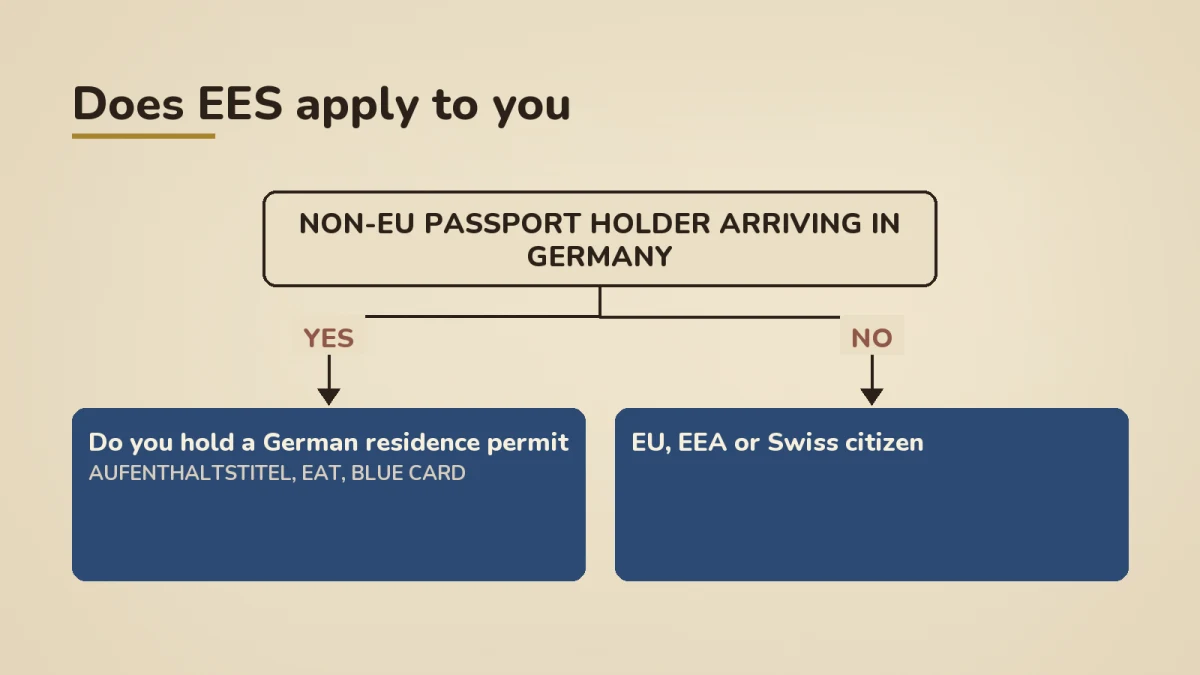
EES applies if you are a non-EU national arriving in Germany for a short stay (up to 90 days in any 180-day window), regardless of whether you need a Schengen visa or are visa-exempt. So:
- Indian, Pakistani, Nigerian, Filipino, Egyptian, Iranian and other visa-required nationals coming for tourism, business, conferences, family visits or short courses: EES applies.
- US, Canadian, Brazilian, UK, Australian, Japanese, Singaporean and other visa-exempt nationals on short stays: EES applies.
- A traveller transiting through Frankfurt to a non-Schengen onward flight without leaving the international zone: EES does not apply (no Schengen entry).
You are exempt from EES if any of the following is true:
- You are an EU, EEA (Iceland, Norway, Liechtenstein) or Swiss citizen.
- You hold a valid German residence permit. This includes the eAT card (elektronischer Aufenthaltstitel), an EU Blue Card, a settlement permit (Niederlassungserlaubnis), or any equivalent issued by another Schengen state.
- You hold a long-stay national D visa for Germany and you are using it for its purpose (entering to live, study, work). The first entry on a D visa is generally not registered as a short-stay event. After arrival you collect your eAT at the Ausländerbehörde, and that card is your EES exemption going forward.
- You are a UK national covered by the Withdrawal Agreement and live in an EU member state with the appropriate residence card.
The single most common confusion: a first-time student or skilled worker arriving on a D visa is not a short-stay traveller, even though they have not yet collected an eAT. Bring the visa vignette in the passport and your university or employer admission documents. Border officers process these cases manually outside EES.
What the system records on first entry
On your first crossing under EES, the kiosk or officer captures:
| Data field | Detail |
|---|---|
| Travel document | Passport scan, document number, expiry, nationality |
| Facial image | Live capture, not the passport photo |
| Fingerprints | 4 fingers, flat scan |
| Entry record | Date, time, airport (e.g., FRA, MUC, BER, HAM, DUS) |
| Visa data (if applicable) | Schengen visa number cross-checked against VIS |
On subsequent entries within the next 3 years the system pulls up your existing record by passport scan and facial recognition. Fingerprints are not retaken every time.
Data retention rules under EES Regulation 2017/2226:
- Biometric and identity data: 3 years from the last exit.
- Overstay records and refusal-of-entry records: 5 years.
- Records linked to a serious immigration offence or an entry ban: longer, until the underlying decision is closed.
If you are refused entry, the refusal is logged with a reason code. That is visible to every Schengen border officer the next time you fly in.
How EES checks actually work at German airports
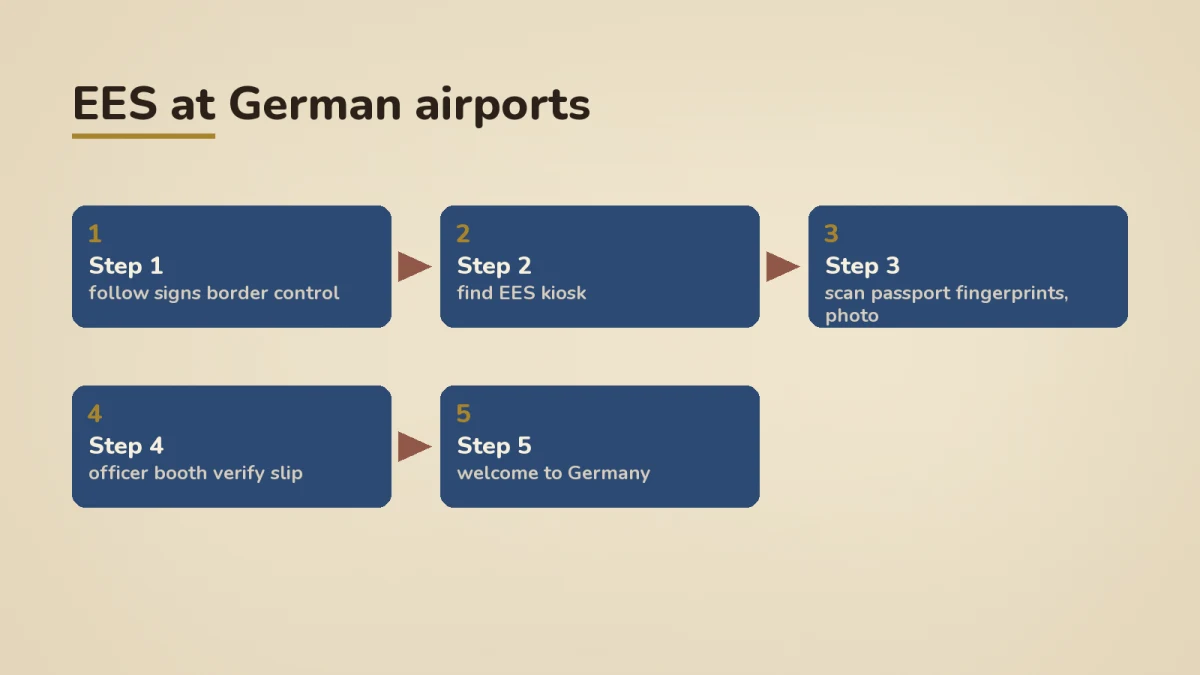
Each German airport has rolled out at its own pace. The framework is the same: a self-service kiosk pre-registers your biometrics, then a manned booth verifies and stamps you in digitally.
| Airport | EES rollout | What to expect on arrival |
|---|---|---|
| Munich (MUC) | Terminal 1 from 11 November 2025; Terminal 2 from 18 November 2025; full from April 2026 | Self-service kiosks in the arrivals corridor, then booth verification |
| Berlin Brandenburg (BER) | Phased from 2 December 2025; full from April 2026 | Pre-registration kiosks before the booth |
| Frankfurt (FRA) | Phased Q1 2026; full from April 2026 | Mix of kiosks and manned booths; e-gates retained for residence-permit holders |
| Hamburg (HAM) | Full from April 2026 | Booth-led registration |
| Düsseldorf (DUS) | Full from April 2026 | Booth-led registration |
What this looks like on the ground for a non-EU short-stay traveller landing for the first time:
- After leaving the aircraft, follow signs to "Border Control" or "All Passports".
- Look for a row of self-service EES kiosks before the booths. If you see them, use them.
- The kiosk asks for your passport (lay it on the scanner), then prompts for a facial photo and 4 fingerprints. The interface is multilingual.
- The kiosk prints a slip or sends you to a green or blue queue.
- The officer at the booth verifies the slip, asks the standard short-stay questions (purpose of visit, duration, accommodation), and admits you.
If you have a German residence permit, you bypass the EES kiosk. Tap "I have a residence permit" on the kiosk if it asks, scan your eAT, and proceed to the residence-permit lane. Bring the physical eAT card; an Anmeldung confirmation does not count.
Plan for an extra 20 to 40 minutes on first arrivals at peak times during summer 2026. The system is new, the queues are longer, and not every traveller in front of you knows the routine yet.
The 90/180-day rule, now policed automatically
Schengen short stays have always been capped at 90 days within any rolling 180-day window. Until April 2026 this was enforced by counting passport stamps, which border officers did inconsistently and travellers often miscalculated. EES does the math for you.
The rolling-window logic:
- The 180-day window is always measured backward from the day you are checked.
- Every day you are physically inside the Schengen area counts as one of your 90.
- Time spent outside Schengen does not count, and partial days at entry or exit count as full days.
A worked example: you arrive in Frankfurt on 1 May 2026 and stay 30 days. You leave on 30 May. You return for another 60 days from 1 August. By 30 September you have used 90 days inside the previous 180. You must wait until enough days roll off the back of the window before you can re-enter on a short stay.
Use the official Schengen short-stay calculator before booking a return trip if you are close to the limit. Under EES, an overstay of even one day is recorded and is visible to every Schengen border for years.
EES vs ETIAS: don't confuse them
EES and ETIAS are two separate systems and they are often confused in news coverage. They do different things, apply to different travellers, and went live at different times.
| Feature | EES (live) | ETIAS (later 2026) |
|---|---|---|
| What it is | Border registration system at entry/exit | Pre-travel authorisation, applied for online before flying |
| Live since | 10 April 2026 | Expected Q4 2026 |
| Who needs it | All non-EU short-stay travellers (visa-required and visa-exempt) | Visa-exempt nationals only (US, UK, Canada, Brazil, Australia, Japan, etc.) |
| Action by traveller | None before travel; biometrics taken at the airport | Apply online, fee EUR 20, valid 3 years |
| What it costs | Free | EUR 20, free for under 18 and over 70 |
| Where it applies | All Schengen external borders | All Schengen external borders, plus Cyprus once it joins |
Two travellers, same flight from New York to Munich in late 2026:
- A US passport holder: needs an approved ETIAS authorisation before boarding, and is also registered into EES on arrival.
- A Schengen visa holder from India: does not need ETIAS (already has a visa), but is still registered into EES on arrival.
Apply for ETIAS via the official portal only (links will be published at travel-europe.europa.eu nearer launch). Avoid the lookalike domains charging inflated fees.
What changes for German residents and long-stay visa holders
If you live in Germany under a residence permit, EES is largely invisible to you. A few practical points:
- Carry your eAT card (or vignette in passport) on every international trip. The kiosk needs it to confirm you are exempt.
- Trips to non-Schengen destinations (Turkey, UK, US, Dubai, India) are recorded on re-entry as the resumption of your stay, not as a new short-stay event. There is no 90-day limit on you.
- Your Anmeldung is irrelevant to EES. Border officers cannot see it. Only the residence permit document matters.
- If your residence permit is in process and you have a Fiktionsbescheinigung (interim certificate), check with your Ausländerbehörde before any international travel. The certificate's travel rights vary by sub-type.
For new arrivals on a post-study work visa or a Chancenkarte (Opportunity Card), the first entry on the D visa happens outside EES. Once your eAT is issued at the Ausländerbehörde, you are an EES-exempt resident from then on.
Common mistakes to avoid
A short list of things that have cost arriving travellers an hour at the border in the first month of EES:
- Joining the EU/Schengen lane with a non-EU passport. The booth will turn you back to the EES queue.
- Skipping the self-service kiosk because you didn't see it. The booth officer will send you back; the queue resets.
- Arriving on a D visa without proof of purpose. Bring the university admission letter, employment contract, or family-reunification papers in carry-on.
- Bringing an expired or damaged passport. Biometrics fail and the manual override takes time.
- Carrying an eAT card and forgetting to mention it. Tell the kiosk or officer immediately so they route you to the correct lane.
- Booking a tight transfer in Frankfurt or Munich during the first weeks. Allow 90 minutes minimum if EES is your first entry.
Frequently Asked Questions
Will I still get a passport stamp at German airports in 2026?
No. From 10 April 2026 the EU has replaced passport stamps with digital EES records at every Schengen external border. Your entries and exits are stored centrally and visible to any Schengen border officer. If a passport stamp is required for a non-Schengen visa application later, the relevant consulate will accept an EES extract printed at the airport on request.
Do I need to register for EES before I fly?
No. EES registration happens at the airport on arrival. You cannot pre-register from outside Schengen. The system you might be thinking of is ETIAS (a pre-travel authorisation for visa-exempt nationalities), which is a separate scheme launching later in 2026.
Does EES apply if I have a German Blue Card or eAT residence permit?
No. Holders of a valid Aufenthaltstitel, EU Blue Card, settlement permit, or any other Schengen-state residence card are exempt. Carry the physical card on every international trip and present it at the border. You bypass the EES kiosk and use the residence-permit lane.
What if I'm flying in for the first time on a national D visa for studies or work?
You are not an EES short-stay traveller. The border officer processes your D-visa entry manually, you collect your eAT card at the Ausländerbehörde within the first few weeks, and after that you are an EES-exempt resident. Bring your visa vignette, university or employer admission letter, and proof of accommodation in carry-on luggage.
How long is my biometric data kept under EES?
Biometric and identity data is retained for 3 years from your last exit from Schengen. Overstay records and refusal-of-entry records are kept for 5 years. Records tied to a serious immigration offence or an active entry ban are kept until the underlying decision is closed. The legal basis is EU Regulation 2017/2226.
What is the difference between EES and ETIAS?
EES is automatic biometric registration at the border, live since 10 April 2026, applies to every non-EU short-stay traveller, and is free. ETIAS is a pre-travel authorisation that only visa-exempt nationals (US, UK, Canada, Brazil, Australia, Japan, etc.) need to apply for online before boarding, costs EUR 20, and is valid for 3 years. ETIAS is expected to go live in late 2026. Most travellers will end up using both.
Will EES make airport queues at Frankfurt and Munich longer?
Yes, in the short term. The EU's own assessment is that wait times will rise during the rollout summer of 2026 as travellers learn the kiosks and as biometric capture is enrolled for first-time arrivals. By 2027 most travellers will have a 3-year cached record and the kiosk step is faster. Plan an extra 30 to 60 minutes for first arrivals at peak hours through 2026.
What happens if I overstay 90 days under EES?
The system flags it automatically the moment you try to leave or re-enter. Consequences range from a fine and a warning on a first short overstay to a Schengen-wide entry ban for repeated or longer breaches. The record is visible across all 29 Schengen states for at least 5 years. If you are mid-application for a long-stay German visa, an EES overstay can sink it.
Where to next
- Visa types overview for the long-stay options that take you out of EES short-stay rules entirely.
- German student visa guide if you are arriving on a study D visa for the first time.
- Opportunity Card explained for the Chancenkarte route, which leads to an eAT and EES exemption.
- EU Blue Card guide if you are coming to Germany on a qualified employment offer.
Continue reading
Visa & Immigration·20 min read
German Student Visa for Bachelor’s in Germany
This guide provides a step-by-step process for obtaining a German student visa for bachelor's aspirants. From eligibility criteria to document requirements, visa application submission, and interview preparation, this comprehensive guide covers everything you need to know to navigate the visa application journey with confidence and secure your place in a German university.
Read articleVisa & Immigration·17 min read
German Student Visa for Master’s in Germany: A Complete Guide
Learn the step-by-step process to acquire your German student visa to head to Germany for your Master’s.
Read articleVisa & Immigration·14 min read
German citizenship 2026: 5-year track, dual citizenship, and the scrapped 3-year fast-track
Germany's 2026 citizenship rules: 5 years legal residence, B1 German, the test, and dual citizenship. The 3-year fast-track was scrapped.
Read articleReady to plan your Germany journey?
Explore our tools and resources to find the perfect university and program for your academic goals.