German grade conversion explained: Bavarian formula, modified Bavarian, GPA to German scale
How German universities convert your GPA, CGPA, or percentage to the 1.0 to 5.0 German scale using the modified Bavarian formula, with worked examples.

Table of contents
Last updated: May 2026
TL;DR: German universities convert foreign grades to the 1.0 to 5.0 German scale using the modified Bavarian formula: German grade = 1 + 3 × (Nmax − Nd) / (Nmax − Nmin). Plug in your maximum grade, your minimum passing grade, and your actual grade. The result is what uni-assist and most German universities use on your application. Run the math yourself with the German grade calculator.
If you are applying to a German Bachelor's or Master's, your transcript will be evaluated on the German 1.0 to 5.0 scale, where 1.0 is the best and 4.0 is the lowest passing grade. That part is well known. What is less obvious is which formula does the conversion, why two formulas exist, and why the number on your uni-assist VPD sometimes does not match what you calculated yourself. This guide unpacks all three.
For the conceptual background on what the German grades mean inside university coursework, read Understanding the German grading system. This post is the practical companion: how the math actually runs and how to apply it to your own transcript.
How the German grading scale works
The German grading scale is inverted compared to most international systems. Lower is better.
| German grade | Meaning (German term) | English equivalent |
|---|---|---|
| 1.0 to 1.5 | sehr gut | Very good (excellent) |
| 1.6 to 2.5 | gut | Good (well above average) |
| 2.6 to 3.5 | befriedigend | Satisfactory (average) |
| 3.6 to 4.0 | ausreichend | Sufficient (passing with deficiencies) |
| 4.1 to 5.0 | nicht ausreichend | Fail |
Universities use intermediate grades in 0.3 steps (1.0, 1.3, 1.7, 2.0, 2.3, 2.7, 3.0, 3.3, 3.7, 4.0). The grades 0.7 and 5.3 are excluded. So the practical scale goes 1.0, 1.3, 1.7, 2.0, 2.3, 2.7, 3.0, 3.3, 3.7, 4.0, then 5.0 for fail. That is the system you will be measured against, regardless of where you studied.
What the Bavarian formula actually is
The Bavarian formula (German: Bayerische Formel) is a linear interpolation that maps your grade onto the 1.0 to 4.0 German pass band. It was first adopted by Bavarian universities, picked up by the Kultusministerkonferenz (KMK, the standing conference of state education ministers), and is now used across Germany. The KMK formally calls the current version the modifizierte bayerische Formel, the modified Bavarian formula.
The "modified" part matters because there used to be a regional debate about whether to use a stepped lookup table (older Bavarian approach) or a continuous formula. The KMK resolution settled it: the linear formula won, and that is what uni-assist and almost every public German university uses today. When German universities or admissions services say "Bavarian formula", they almost always mean the modified version.
The official KMK source is the GesNot05 resolution (German PDF), and it is referenced directly by TUM's grade-conversion page.
The modified Bavarian formula, step by step
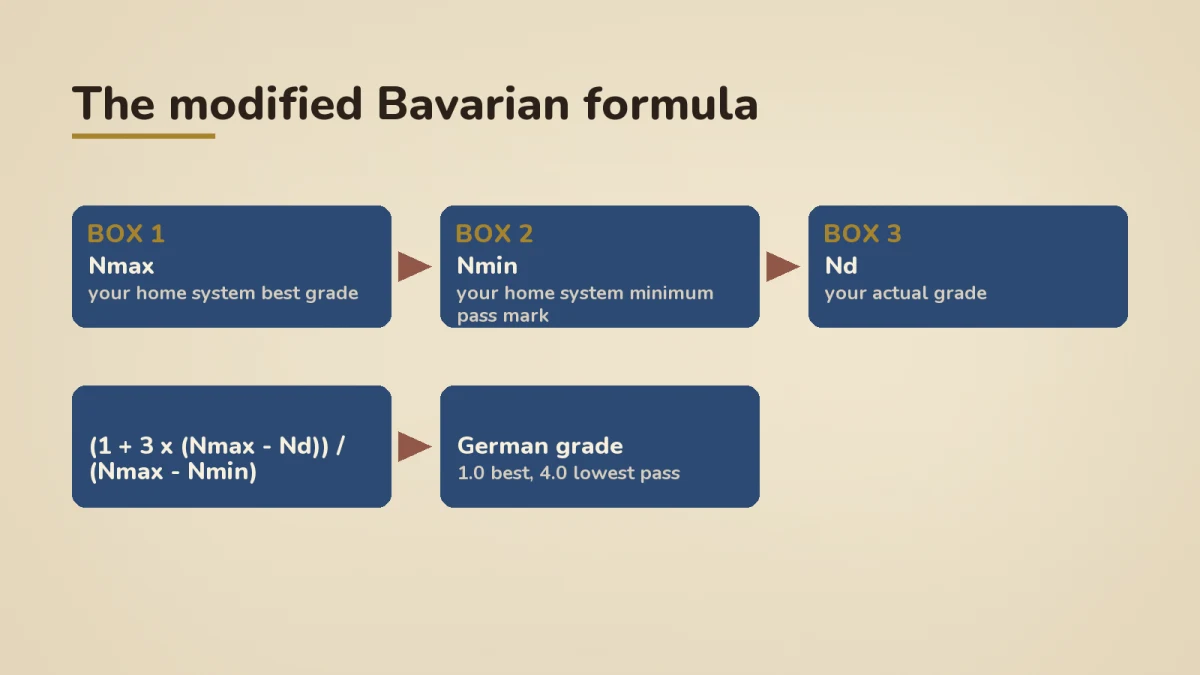
Here is the formula in its most common form:
German grade = 1 + 3 × (Nmax − Nd) / (Nmax − Nmin)
Three inputs:
- Nmax is the highest possible grade in your home grading system (the best grade a perfect student could get).
- Nmin is the minimum passing grade in your home system (the lowest grade that still counts as a pass, not the absolute lowest grade on the scale).
- Nd is your actual grade (the one you want to convert).
Three things to be careful about:
- "Highest" depends on your scale's direction. If your scale goes 0 to 100 (higher is better), then Nmax is the top of the scale (e.g., 100). If your scale goes 1.0 to 6.0 like the German school system (lower is better), the same letter "Nmax" still means the best grade, which is the lowest number. The formula always uses the best-possible grade for Nmax.
- Nmin is the pass mark, not the floor. If your university grades from 0 to 100 with 33 as the lowest passing mark, Nmin is 33, not 0. Using 0 inflates your German grade.
- The formula caps at 1.0 and 4.0. Anyone scoring exactly the maximum gets 1.0. Anyone scoring exactly the minimum pass gets 4.0. Below the pass mark, you do not get a German grade at all (the course is a fail in your home system, so it stays a fail).
Worked through with a single example: an Indian student with a 70 percent average from a university where 100 is the maximum and 33 is the pass mark.
German grade = 1 + 3 × (100 − 70) / (100 − 33)
             = 1 + 3 × 30 / 67
             = 1 + 1.343
             = 2.34, rounded to 2.3
That is "good" on the German scale.
How to convert your GPA to the German scale
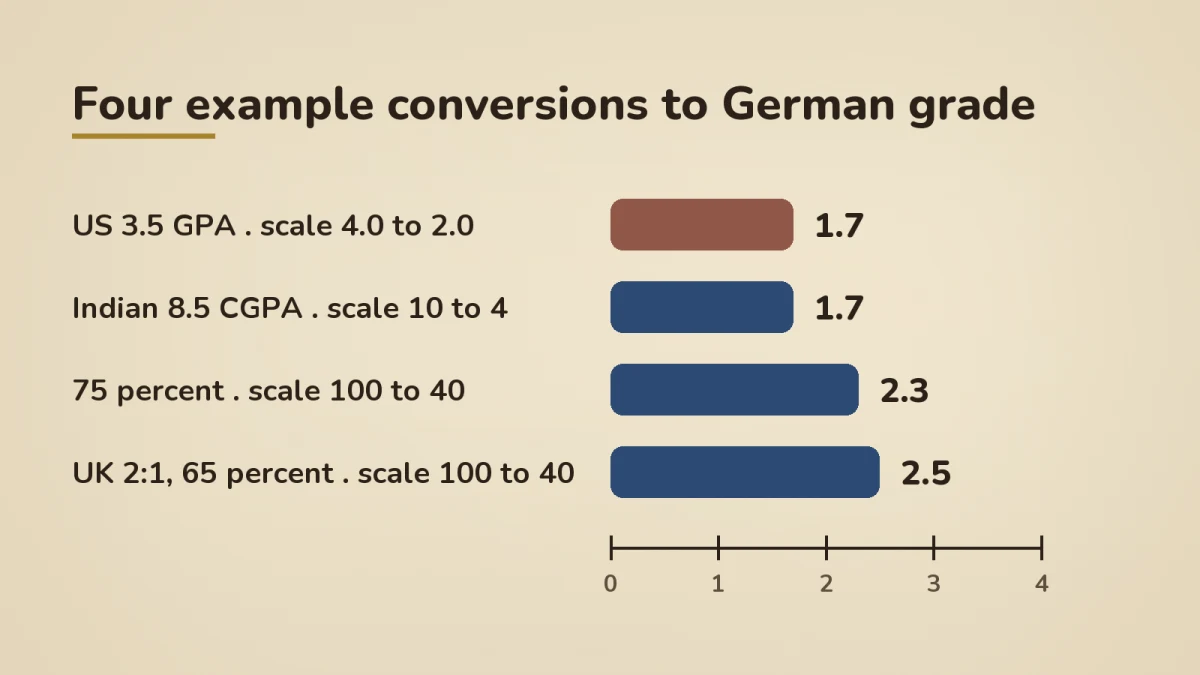
The formula stays the same. Only the inputs change. Here are the four most common foreign systems we see at MS in Germany.
4.0 GPA scale (US, Canada)
- Nmax = 4.0
- Nmin = 2.0 (most US universities count 2.0 as the minimum passing GPA for an undergraduate degree; some count 1.0, check your transcript footer)
- Nd = your cumulative GPA
A 3.5 GPA from a 4.0 / 2.0 system: 1 + 3 × (4.0 − 3.5) / (4.0 − 2.0) = 1 + 0.75 = 1.75, rounded to 1.7. A 3.0 GPA: 1 + 3 × (4.0 − 3.0) / (4.0 − 2.0) = 1 + 1.5 = 2.5. A 2.5 GPA: 1 + 3 × (4.0 − 2.5) / 2.0 = 1 + 2.25 = 3.25, rounded to 3.3.
10.0 CGPA scale (Indian engineering, IITs, NITs)
- Nmax = 10.0
- Nmin = 4.0 in the most common Indian engineering grading system (some institutions use 5.0; check your grade card)
- Nd = your CGPA
A CGPA of 8.5 from a 10 / 4 system: 1 + 3 × (10 − 8.5) / (10 − 4) = 1 + 0.75 = 1.75, rounded to 1.7. A CGPA of 7.0: 1 + 3 × (10 − 7) / 6 = 1 + 1.5 = 2.5. A CGPA of 6.0: 1 + 3 × (10 − 6) / 6 = 1 + 2.0 = 3.0.
Percentage (Indian boards, Pakistani universities, many South Asian systems)
- Nmax = 100
- Nmin = 33, 35, 40, 45, or 50 depending on the institution. Indian boards typically use 33 or 35. Many Indian engineering colleges use 50. Check your university's official policy before plugging in.
- Nd = your percentage
A 75 percent from a 100 / 40 system: 1 + 3 × (100 − 75) / (100 − 40) = 1 + 1.25 = 2.25, rounded to 2.3. The same 75 percent from a 100 / 50 system: 1 + 3 × (100 − 75) / (100 − 50) = 1 + 1.5 = 2.5. The pass mark moves your German grade noticeably, which is why every comparison post that lists "75 percent equals German 2.3" without specifying the pass mark is incomplete.
UK degree class
The Bavarian formula is rarely applied directly to UK degree classes because there are only four pass bands. Most German universities use a published lookup table (or uni-assist's internal grid) rather than the formula. As a working approximation:
| UK class | Typical German grade |
|---|---|
| First (70%+) | 1.0 to 1.3 |
| Upper second (2:1, 60 to 69%) | 1.7 to 2.5 |
| Lower second (2:2, 50 to 59%) | 2.7 to 3.3 |
| Third (40 to 49%) | 3.7 to 4.0 |
If your UK transcript shows a percentage rather than just a class, run the formula with Nmax = 100, Nmin = 40, and your overall percentage.
Why uni-assist's number sometimes differs from yours
Uni-assist runs the modified Bavarian formula on the cumulative grade printed on your final transcript. Three things commonly cause a mismatch with your own calculation.
First, uni-assist uses your university's official minimum passing grade, not yours. If your transcript footer says the pass mark is 50 percent and your home university actually counts 40 percent as a pass for some courses, uni-assist will use 50. The Anabin database (the German equivalency database) holds the official figure for many institutions, and uni-assist reads from there.
Second, uni-assist applies the rounding convention from the KMK resolution: results are typically rounded to the nearest 0.1, then snapped to the closest valid German step (1.0, 1.3, 1.7, 2.0, etc.). Different calculators round differently, so your in-house number can land on a different step.
Third, uni-assist may exclude failed courses or repeat attempts depending on what your transcript shows. If your transcript shows only the best attempt of a repeated course, your input grade is already cleaned. If it shows every attempt, uni-assist may average them. There is no universal rule here, and it pays to read the cover page of the VPD (preliminary documentation) when it arrives.
If your VPD grade looks materially worse than your own calculation, the appeal route is to write to the uni-assist info team within the deadline on the VPD itself, attach a transcript clarification from your home university, and ask for a recalculation. Universities in Germany rarely overrule uni-assist's grade on their own.
How the German grade matters for admissions
The grade is one input. It is not the whole story.
- Numerus clausus (NC) programs, mostly competitive Bachelor's like medicine, psychology, and law, set a German-grade cutoff per intake. The cutoff drifts each semester based on the applicant pool.
- Master's programs weight the German grade alongside CV, motivation letter, language scores, and program-specific fit. A 2.3 with strong research output often beats a 1.7 with no portfolio.
- Open-admission (zulassungsfrei) programs accept anyone with a recognised qualification regardless of the German grade.
For the full breakdown of what feeds an admission decision beyond the grade, see our APS guide (relevant for Indian, Chinese, and Vietnamese applicants) and our ECTS credit guide.
Common mistakes to avoid
- Using 0 as the pass mark for percentage scales. The formula expects the minimum passing grade, not the floor of the scale. Using 0 instead of 33 or 40 will inflate your German grade by half a band.
- Mixing best and worst. If your scale is "lower is better" (German school 1.0 to 6.0, or some Italian and Eastern European systems), Nmax is still the best possible grade, which is the lowest number. Read the formula carefully before you assume which value is which.
- Forgetting that 4.0 is the German pass mark, not the cap. A score of 5.0 in Germany is a fail. People coming from US systems sometimes assume the German 4.0 maps to a US 4.0; it does not. A US 4.0 maps to a German 1.0.
- Trusting a comparison table without the pass mark. Tables that say "75 percent equals 2.3" are only correct for one specific Nmin value. Always verify which pass mark the table assumed.
- Calculating before the transcript is final. Running the formula on a partial transcript before all grades are in produces a number that uni-assist will not match. Wait until your CGPA or final percentage is locked.
- Quoting the German grade to two decimals. The KMK convention rounds to one decimal (and to the nearest valid 0.3 step). Saying "2.34" is more precise than the system actually allows.
FAQ
What is the modified Bavarian formula?
It is the linear formula German grade = 1 + 3 × (Nmax − Nd) / (Nmax − Nmin), adopted by the German Kultusministerkonferenz to convert foreign grades onto the German 1.0 to 4.0 scale. Nmax is your home system's best grade, Nmin is its minimum passing grade, and Nd is your actual grade. It is the standard used by uni-assist and most German universities.
What is the difference between the Bavarian formula and the modified Bavarian formula?
In current usage they refer to the same thing. The "modified" version is the linear formula now standardised by the KMK. Older sources sometimes refer to a stepped lookup table as the "original Bavarian" approach, but every major German university and uni-assist now uses the linear modified version. If a German official source says "Bavarian formula", treat it as the modified one.
What German grade do I need for a Master's in Germany?
There is no universal cutoff. Many public Master's programs require around 2.5 (the upper end of "good") or better. Top engineering programs at TU Munich, RWTH Aachen, or KIT often expect 2.0 or better. Some programs publish explicit cutoffs in their admission regulations; many evaluate the grade alongside the rest of your file. Check the program-specific FAQ before assuming a number.
Does uni-assist always use the modified Bavarian formula?
For most Bachelor's and Master's applications routed through uni-assist, yes. The formula is the default for the VPD (Vorpruefungsdokumentation) that uni-assist issues. Some specialised programs (medicine via Hochschulstart, art and music academies, double-degree programs) use their own conversion logic, so always read the program's admission notice.
My CGPA scale tops out at 10. What is Nmin?
For most Indian engineering programs, Nmin is 4.0 (the standard pass-out CGPA at IITs, NITs, and most state engineering universities). A few institutions use 5.0. Check the back of your grade card or the academic regulations document for the exact figure. Using the wrong Nmin will throw off your German grade by 0.2 to 0.4.
Can I improve my German grade after admission?
The grade on your VPD is fixed. What can change is the version of your transcript you submit. If you have a chance to retake courses or finish a higher-grade thesis before applying, do that first; the formula runs on whatever cumulative grade is on the document. After admission, your German grade only matters for things like scholarships and PR fast-tracks tied to academic performance.
Why does my friend have the same percentage but a different German grade?
Because their university's pass mark is different from yours. A 75 percent from a 100 / 40 system converts to 2.25; the same 75 percent from a 100 / 50 system converts to 2.5. The pass mark is the second hidden variable that most informal comparisons skip.
Does Germany use letter grades like A, B, C anywhere?
Inside German universities, no. The 1.0 to 4.0 scale is the rule. ECTS letter grades (A through F) are sometimes added on transcripts to help with international comparison, but they are a layer on top of the 1.0 to 5.0 system, not a replacement for it. A German 1.0 maps to ECTS A, German 2.0 to B, and so on.
Where to next
- Run your numbers through the German grade calculator for an instant conversion that uses the same modified Bavarian formula.
- Read Understanding the German grading system for what the German grades actually mean inside coursework.
- For Indian applicants, the APS certificate guide explains how your transcript gets verified before grades are even calculated.
- If you are converting credits as well as grades, the ECTS credit guide covers how German universities count your home-system course load.
- For step-by-step conversion of Indian, US, or UK credits to ECTS specifically, our ECTS credits conversion guide walks through the workload formulas and uni-assist conversions.
Continue reading
Study in Germany·7 min read
Understanding the German Grading System - A Complete Overview
Learn how the German grading system works, compare it with other systems, and understand your academic performance better with this detailed guide.
Read articleStudy in Germany·12 min read
Master's in Germany for International Students with a Low GPA
Discover how to pursue a Master's in Germany with a low GPA. Our comprehensive guide offers tips on selecting the right universities, enhancing your application, and turning your academic dreams into reality.
Read articleStudy in Germany·16 min read
Why is university free in Germany? The full 200-year story (and the hidden costs)
Tuition is 0 euros at most German public universities thanks to a 200-year philosophy of education as a public good. Full story, hidden costs.
Read articleReady to plan your Germany journey?
Explore our tools and resources to find the perfect university and program for your academic goals.