ECTS credits explained: How to convert your Indian, US, UK credits to ECTS for Germany
How ECTS credits work and how to convert Indian, US, and UK credits to ECTS for German university applications, including the formulas uni-assist uses.

Table of contents
Last updated: May 2026
TL;DR: ECTS is a workload standard (1 ECTS = 25 to 30 study hours, 60 ECTS per academic year). To estimate your conversion: Indian credits multiply by roughly 2 (one Indian credit equals about 2 ECTS); US semester credits multiply by 2 (1 US semester credit equals 2 ECTS); UK CATS credits divide by 2 (2 UK credits equal 1 ECTS). The actual number used by German universities is set by uni-assist or the international office, not by you, and a 4-year Indian Bachelor can still come out as 180 ECTS instead of 240, depending on subject and university.
The Indian transcript shows credit hours, the US transcript shows semester credits, the UK transcript shows CATS points, and Germany expects a different number entirely. This post explains what ECTS measures, the formulas German universities use to convert your credits, and the traps that catch international applicants every year. For the broader admissions picture, see the Bachelor's in Germany guide and the admission requirements walkthrough. For history and grading scales, the older ECTS credit system post is the conceptual companion.
What is ECTS, in one paragraph
ECTS stands for the European Credit Transfer and Accumulation System. It is a workload measure, not a contact-hour measure. One ECTS credit equals 25 to 30 hours of student work, including lectures, lab time, self-study, exam prep, and the exam. A full academic year is 60 ECTS, which is 1,500 to 1,800 hours of work. A Bachelor's is 180 ECTS for a 3-year program or 240 ECTS for a 4-year program. A Master's is 60, 90, or 120 ECTS. The system covers all 49 countries of the European Higher Education Area, which is why your German university wants your credits in this format. The definition lives at the European Commission's ECTS page and in uni-assist's glossary.
The conversion you actually want
Use this table as a starting point. The formulas come from the workload assumptions each system makes, not from arbitrary multipliers.
| Your transcript says | Your country | Roughly equals (in ECTS) | Why |
|---|---|---|---|
| Indian credits (UGC framework) | India | 1 Indian credit = ~2 ECTS | Indian UGC counts a credit as roughly 30 work hours; ECTS counts 25 to 30. Close to a 1 to 2 ratio in practice for most engineering and science programs. |
| US semester credit hours | United States | 1 US semester credit = 2 ECTS | A US semester credit is ~15 contact hours plus self-study, totalling around 45 to 50 hours of workload, which maps to about 2 ECTS. |
| UK CATS credits | United Kingdom | 2 UK CATS = 1 ECTS | UK CATS counts 10 work hours per credit, ECTS counts 25 to 30, so two UK credits sit inside one ECTS. |
| Australian credit points | Australia | Varies (most universities: 1 AU credit = 0.5 ECTS) | Australian universities differ; check the international office for the exact ratio. |
| Canadian semester credits | Canada | 1 Canadian credit = 2 ECTS | Same logic as the US system. |
The cleanest formula, used by uni-assist and most German international offices, works backwards from the total program length:
ECTS estimate = (credits earned in your degree / total credits in your degree) × 60 × years of degree
If your 4-year Indian B.Tech is 160 credits total and you have completed 80 credits so far, the estimate is (80 / 160) × 60 × 4 = 120 ECTS. The same B.Tech, when complete, lands at 240 ECTS. This is the number German admissions use, not the raw credit count on your transcript.
How Indian credits convert (and where uni-assist disagrees)
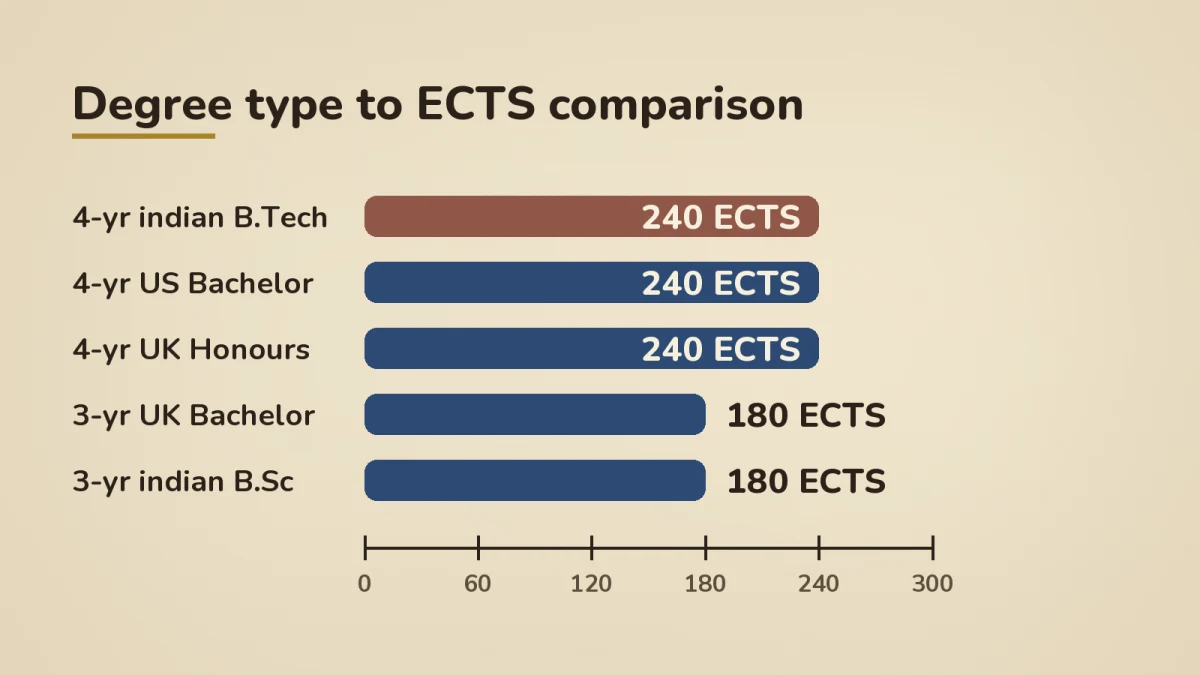
A 4-year Indian Bachelor (B.Tech, B.E., Integrated 5-year) is normally accepted as 240 ECTS. A 3-year Indian B.Sc, B.Com, B.A., or BBA usually comes out at 180 ECTS, which is the minimum for direct Master's admission only at universities that still accept 180 ECTS Bachelor's. Many German universities now require 210 or 240 ECTS for Master's, which is why an Indian 3-year Bachelor often needs a postgraduate diploma or a 1-year top-up first.
Even 4-year Indian degrees occasionally get downgraded if the subject mix is weighted toward general electives rather than core courses. Computer science programs with a heavy elective load have been re-mapped to 180 ECTS, as documented in applicant reports on r/studying_in_germany. The fix is not to argue with the conversion. Apply to programs that accept your evaluated total, or add a Studienkolleg year or top-up if you are short. The APS verification certifies the underlying transcript before uni-assist runs the conversion. APS does not change the ECTS count.
How US credits convert
The US semester credit is the cleaner case because the workload assumption is similar to ECTS. A 4-year US Bachelor's of 120 to 130 semester credits typically converts to 240 to 260 ECTS. A 4-year engineering degree at 130 credits sits at roughly 260 ECTS, comfortably above the 240 bar. Quarter credits are different: multiply by 0.667 first to get semester equivalents, then multiply by 2 to get ECTS. A 180-quarter-credit degree is 180 × 0.667 × 2 = 240 ECTS.
How UK credits convert
UK undergraduate degrees are usually 360 CATS credits over 3 years, which converts to 180 ECTS. A 4-year Honours degree (common in Scotland and for sandwich years) is 480 CATS, which is 240 ECTS. A UK Master's at 180 CATS is 90 ECTS, matching the German taught-Master's range. The catch: a UK 3-year Bachelor's at 180 ECTS clears some German Master's programs but not all. Programs that demand 210 or 240 ECTS will not accept a UK 3-year Bachelor's alone, and a postgraduate certificate or diploma is the usual bridge.
The mistakes that cost applicants admission
- Calculating the conversion yourself and ignoring uni-assist. Your number is an estimate; the number that goes on the German university's decision is the one uni-assist returns. If you doubt the official conversion, request the Vorprüfungsdokumentation (VPD) before applying, not after rejection.
- Confusing ECTS with grades. ECTS measures workload. Your German grade is computed separately using the Modified Bavarian Formula. Treat them as two independent numbers.
- Assuming all 4-year Bachelor's degrees are 240 ECTS. A 4-year B.Sc with weak core credit weighting can come back at 180. The actual number depends on the curriculum's distribution, not just the duration.
- Submitting partial transcripts. If your transcript shows only earned credits and not the program total, uni-assist cannot run the formula. Always include the official credit summary or curriculum sheet.
- Treating the conversion as fixed across universities. Each German university's international office has discretion. The 240 ECTS figure that one university accepts as equivalent may be 230 at another. Read the program's specific admission notice.
How to actually do this for your application
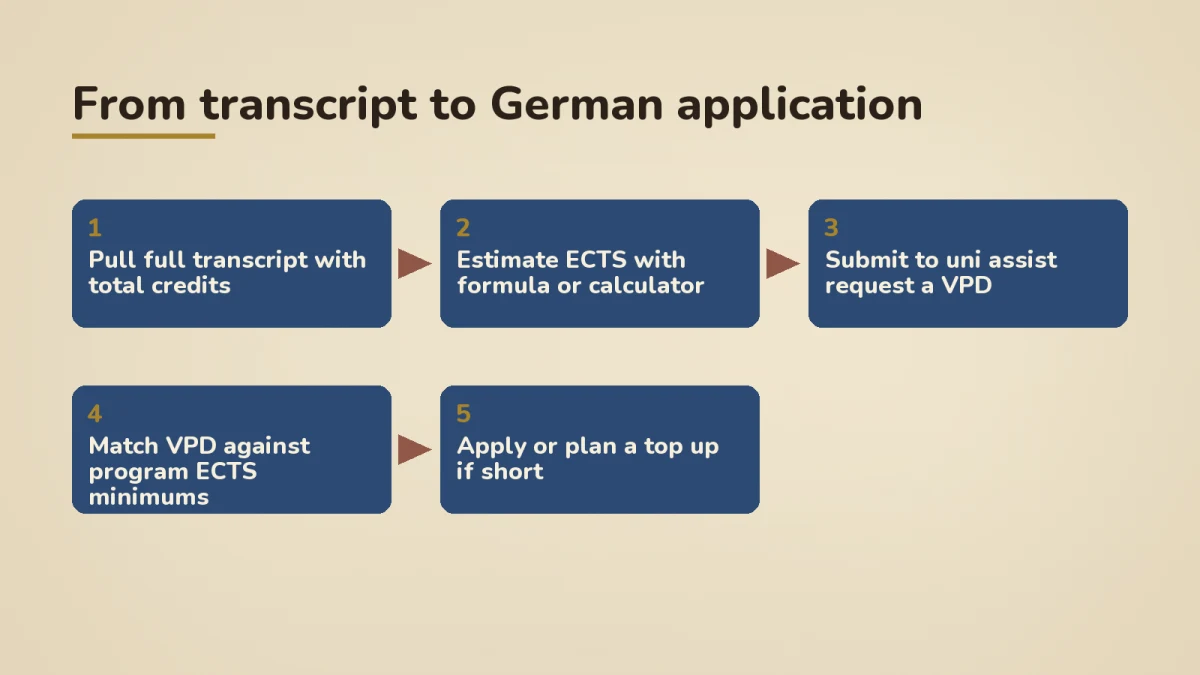
- Pull your full transcript and program structure. You need both the credits earned and the total program credits.
- Estimate ECTS using the formula above. This is your working number; do not put it on the application.
- Submit to uni-assist (if the university requires it) and request a VPD. The €75 fee buys you the official conversion before you apply, valid for that intake.
- Match the VPD against each program's published ECTS minimum. If you are short, look at programs accepting your actual count, or plan a Studienkolleg or 1-year top-up.
- Save the ECTS credit calculator link to your dashboard. The tool runs the same formula and gives you a sharable result for advisors.
For a working calculator that handles all three credit systems and the year-of-degree adjustment in one place, the in-house ECTS credit calculator is the fastest path. Save your inputs to your dashboard so the result stays attached to your university shortlist.
FAQ
Is the ECTS conversion automatic when I apply?
No. Uni-assist or the German university's international office runs the conversion when you submit your transcripts. You do not enter ECTS yourself; you enter your raw credits and let the conversion happen on their side.
Can I challenge a uni-assist conversion if I think it is wrong?
You can submit a clarification request, but uni-assist's working assumption is that subject-specific qualifications go through expert review. The faster route is usually to choose a program whose minimum matches your actual evaluated count.
Does my Indian B.Sc qualify for a German Master's?
Sometimes. A 3-year Indian B.Sc converts to roughly 180 ECTS, which is below the cutoff at many German universities (210 or 240 ECTS). Some programs accept 180 ECTS plus relevant work experience or a postgraduate diploma. Always check the program-specific admission rules.
How are ECTS grades different from ECTS credits?
ECTS credits measure workload (number of hours of work). ECTS grades, when used, are a relative ranking on an A through E scale. German universities almost always use the German grade scale (1.0 to 5.0) directly, not the ECTS grade scale, so this distinction matters less in practice.
Do German universities accept the ECTS calculation from a third-party calculator?
No. Calculators give you an estimate to plan your applications; the binding number is the one uni-assist or the university's international office produces. Use the calculator before you apply, not as evidence during your application.
Does a Master's in Germany always require 240 ECTS in the Bachelor's?
No. Many programs accept 180 ECTS, especially in the humanities and social sciences. Engineering and computer science programs more often demand 210 or 240 ECTS. The program page is the source of truth.
What about online or distance Bachelor's degrees?
Recognised online Bachelor's degrees from accredited universities are evaluated using the same ECTS formula. Diploma mills and unaccredited online programs are not recognised at all, regardless of the credit count claimed.
Where to next
- ECTS credit calculator. Run your numbers in 30 seconds.
- Mastering the ECTS credit system. The conceptual companion to this post.
- Admission requirements for Bachelor's in Germany. The bigger admissions picture.
- Transcripts for studying in Germany. What your transcript needs to show before uni-assist can convert it.
- Shortlisting universities for Master's in Germany. Pick programs that match your evaluated ECTS, not your raw credits.
Continue reading
Study in Germany·8 min read
Bachelor’s Degree Requirements for Master's in Germany
Ensure how you are eligible based on bachelor’s degree requirements for Master’s in Germany. Learn about Anabin H+ status, ECTS credits, and CGPA expectations.
Read articleStudy in Germany·11 min read
Mastering the ECTS Credit System for Studying MS in Germany
Learn how the ECTS credit system works for Master's in Germany. Discover its benefits, how to manage your credits, and ensure your academic success.
Read articleStudy in Germany·8 min read
A Guide to Anabin Database
Plan your study in Germany with the Anabin Database! Learn about degree recognition, H+, H-, and H+/H- statuses, and streamline your admission and visa process.
Read articleReady to plan your Germany journey?
Explore our tools and resources to find the perfect university and program for your academic goals.