13 things about German universities that sound fake but aren't
Student prisons, desk knocking instead of clapping, free degrees, and unconstitutional attendance: 13 quirks of German universities that sound fake but aren't.

Table of contents
Last updated: May 2026
TL;DR: German universities have habits that read like satire. Students knock on desks instead of clapping, mandatory attendance is unconstitutional, a whole bachelor's degree can cost less than one US textbook, and Heidelberg is older than the United States. All thirteen facts below are real and verifiable in 2026.
If you are about to move to Germany for a degree, brace yourself. Some traditions are charming. Some are baffling. A few are illegal anywhere else. International students from India, the US, and the UK regularly think these are jokes until they show up to their first lecture and watch the room start banging on tables. Here are thirteen of the strangest, all sourced.
1. Universities used to run their own prisons. Students wanted in
From the 1700s until 1914, German universities operated their own student jails called Karzer. Heidelberg locked rowdy duellers, drunken pranksters, and lampoonists up for three days to four weeks. Students still attended lectures during the day. Over time, doing time in the Karzer became a badge of honour, with students competing to get locked up at least once before graduation. The walls are still covered in their graffiti and self-portraits. Mark Twain wrote about it in A Tramp Abroad (1880). The Heidelberg Karzer is now a museum.
2. Students knock on desks instead of clapping
When a German lecture ends, students knuckle-rap the table instead of applauding. The tradition is called Akademisches Klopfen. Historically, clapping was reserved for entertainers like actors and musicians, who were considered socially beneath university lecturers. Praising a professor the same way you'd praise a "lowly entertainer" was rude. Visiting professors from abroad still get unnerved when their first lecture ends with the entire room banging on desks.
3. A full degree can cost less than one US textbook
Public universities in Germany charge zero tuition fees, including for international students. The only cost is a Semesterbeitrag (semester contribution) of roughly 150 to 400 euros, which usually includes a regional public transport pass. A three-year bachelor's costs about 900 to 2,100 euros total in fees. Baden-Württemberg is the main exception: non-EU students pay 1,500 euros per semester there since 2017, and TUM in Munich also charges most new non-EU students tuition. For comparison, a single organic chemistry textbook in the US is over 300 dollars. Read the tuition fee guide for bachelor's in Germany for the full breakdown.
4. A hot Mensa lunch costs less than a Starbucks coffee
University canteens (called Mensa) serve hot meals for 1.45 to 3.00 euros. The state covers personnel and infrastructure, so students pay close to the cost of raw ingredients. In Baden-Württemberg, student meals are VAT-exempt. A complete lunch with a main, a side, and a drink can cost less than a Starbucks latte. American campus meal plans run 2,000 to 5,000 dollars a semester. In Germany, lunch is roughly the price of a candy bar.
5. Forcing you to attend lectures is literally unconstitutional
German universities cannot legally make you attend lectures. Lernfreiheit (freedom of learning), guaranteed by Articles 5(3) and 12(1) of the German Grundgesetz, gives students the right to organise their own studies. RWTH Aachen has a published guideline that explicitly says mandatory attendance is unconstitutional outside of practical lab work and certain seminars. Many students never show up to lectures and just study from textbooks for the final. In India, 75 percent attendance is enforced before you can even sit the exam. In Germany, forcing you to show up violates the constitution.
6. The grading system runs backwards
Germany grades from 1.0 (best) to 5.0 (fail). A 4.0 means you barely passed. There are no letter grades, no four-point GPA, no percentages. The decimals come in steps: 1.0, 1.3, 1.7, 2.0, 2.3, 2.7, 3.0, 3.3, 3.7, 4.0, 5.0. An American student bragging about a 4.0 would be saying "I scraped through" in Germany. And often the entire course grade rides on a single final exam, with no homework or attendance points to cushion you. Convert your existing transcript with the German grade calculator, or read the full German grade conversion explainer for the modified Bavarian formula and worked examples. For the credits side of your transcript, our ECTS credits conversion guide covers Indian, US, and UK credit conversions.
7. Heidelberg is older than the United States
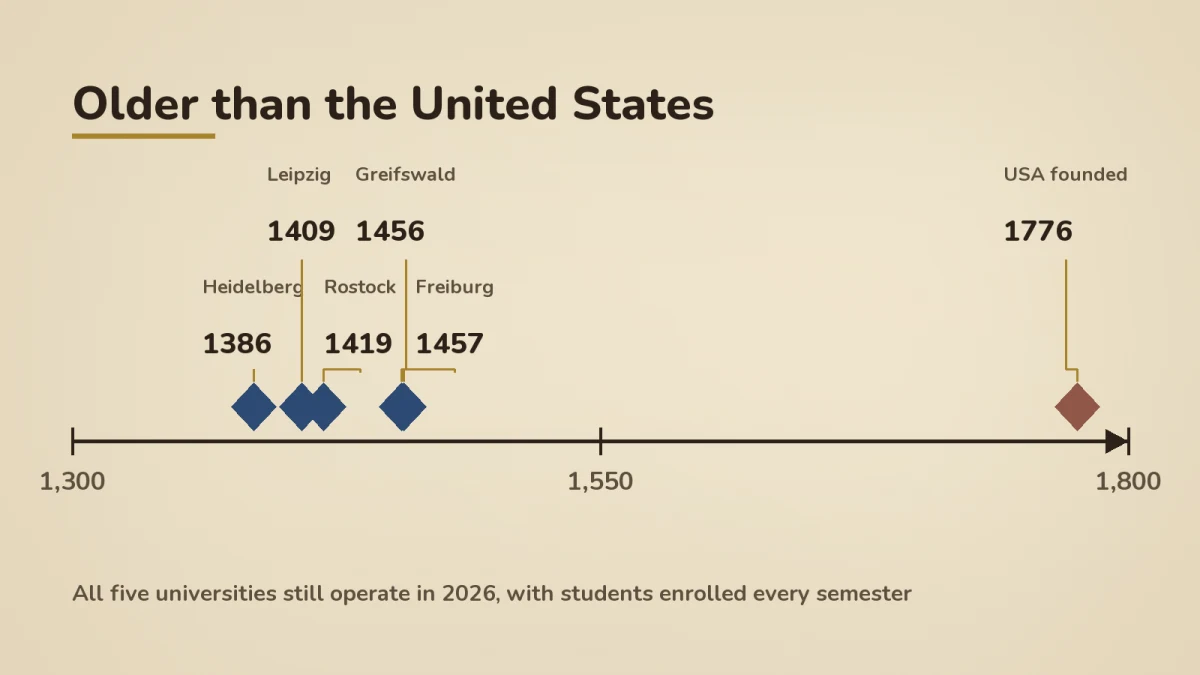
Heidelberg University was founded in 1386. That makes it 640 years old in 2026, predating the US by 390 years and the printing press by 54. Germany has five universities founded before 1500: Heidelberg (1386), Leipzig (1409), Rostock (1419), Greifswald (1456), and Freiburg (1457). All five are still fully operational, world-ranked, and producing Nobel laureates. Heidelberg alone has produced more than 30. Read the top public universities in Germany for context on which ones to apply to.
8. Most universities don't have a campus
There is usually no walled campus, no entry gates, no security guards. University buildings are scattered across the city, mixed in with apartments, kebab shops, and corner pharmacies. The University of Münster has more than 200 buildings spread across the town. The University of Bonn has 350+, including the former Electoral Palace. At Heidelberg, university buildings blend so naturally into the old town that visitors cannot tell which buildings belong to the uni. Students bike or take trams between classes.
9. You need TWO doctorates to become a professor
A PhD does not qualify you for a German professorship by itself. You traditionally also need a Habilitation, a second, higher-level doctoral thesis proving you can run independent research and teach at university level. After your PhD (3 to 5 years), the Habilitation takes another 4 to 6. On completion you become Dr. habil. Only then are you eligible for a permanent chair. Juniorprofessur is a newer, faster alternative, but the traditional Habilitation route is still dominant in many fields.
10. The "Dr." title is legally protected and goes on your passport
In Germany, the doctoral title is part of your legal name. It appears on your passport, ID card, driver's licence, and bank cards. Calling yourself "Dr." without the qualification is a criminal offence. Germans also stack titles. Prof. Dr. Dr. h.c. mult. (Professor, Doctor, multiple honorary doctorates) is a real way to address someone. Defence Minister Karl-Theodor zu Guttenberg resigned in 2011 after his doctoral thesis was found to contain plagiarism. The scandal was that serious because the title is that protected.
11. The student travel pass covers all of Germany
The Deutschlandsemesterticket gives university students a nationwide public transport pass covering every bus, tram, metro, and regional train in Germany. The student price was 29.40 euros per month at launch in summer 2024 and rose to roughly 34.80 euros for the winter 2025/26 semester. The non-student version (Deutschland-Ticket) is 63 euros per month from January 2026. Either way, students get the entire country for less than a single-city monthly metro pass in New York or Delhi.
12. Some fraternities still sword-fight with real blades
Roughly 400 traditional student fraternities (Studentenverbindungen) still practise Mensur, a form of academic fencing with sharp swords. Participants wear minimal protection, eyes and nose only. Cheeks are exposed. Getting cut is expected. The resulting scars (Schmiss) were historically a mark of courage and social standing. There is no winner: the point is to stand still while someone swings a blade at your face. The tradition has been practised since the 1700s and continues quietly today, mostly in Corps and Burschenschaften.
13. The "semester break" is when the hardest work happens
The period between semesters is called vorlesungsfreie Zeit (lecture-free time), specifically not vacation. It is reserved for writing term papers, preparing for and sitting exams, completing internships, and attending intensive block courses. Many final exams are scheduled in the first weeks of the "break." Students who treat it like a real holiday tend to fail their courses. Real free time, after deadlines, can be as short as two to four weeks.
What this means if you're about to move
These quirks aren't trivia. They shape how your day actually runs. The grade calculus is harsher because one bad exam day can sink an entire course. Skipping lectures is your right, but the responsibility for keeping up sits squarely on you. A degree is almost free, so the financial stress that defines US student life basically does not exist. And the cultural texture, from desk-knocking to the legal weight of a doctoral title, is older and more durable than most people expect.
For practical first steps once you arrive, see the guide to surviving the first year as a bachelor's student in Germany.
FAQ
Is the Karzer still in use today?
No. The last student was locked up in 1914. The Heidelberg Karzer is now a public museum on Augustinergasse, and several other universities (Jena, Bonn, Marburg, Freiburg, Tübingen, Göttingen, Erlangen) keep their own preserved Karzers as historical sites.
Do I really pay zero tuition as a non-EU student?
Mostly yes. Baden-Württemberg charges non-EU students 1,500 euros per semester, and TUM in Munich now charges most new non-EU students tuition too. Private universities charge real tuition, often 10,000 to 30,000 euros a year. Public is the default in Germany.
If attendance is unconstitutional, why do my friends say their seminar takes attendance?
Because there are exceptions. Mandatory attendance is allowed for practical reasons in lab courses, certain seminars, internship-linked modules, and language classes. Plain lectures cannot enforce it.
What does a 1.0 grade actually take?
A 1.0 is reserved for exceptional work. Most strong students sit between 1.3 and 2.3. A 2.0 is considered very good, a 2.7 is solid, a 3.0 is average. A 3.7 is a pass with concerns, and a 4.0 means you scraped through.
Do international students get the Deutschlandsemesterticket?
Yes, if you are enrolled at a participating German university and the local transport authority offers it. Eligibility, opt-in dates, and exact price vary slightly by university. Check with your Studierendenwerk in your first week.
Is Mensur legal?
Why don't fraternities get prosecuted?
Mensur is treated as a consensual sport, not assault, and has been ruled legal under that framing. It is not common: only about 400 fraternities practise it, mostly in private. Most German students go through their entire degree without ever encountering it.
Can I list "Dr." on my German passport?
Yes, once you complete a recognised doctorate (German or recognised foreign), you can apply to add the title to your passport, ID card, and driver's licence. The Bundesdruckerei prints it as part of your name, before your given name.
Where to next
Pick the next thread:
- Tuition fees for bachelor's in Germany for the cost picture in detail
- Top public universities in Germany including Heidelberg, LMU, TUM, RWTH Aachen
- German grade calculator to convert your existing transcript to the 1.0 to 5.0 scale
- Eight things to do after reaching Germany for the first-week checklist
Continue reading
Student Life·11 min read
Resources and Apps for Students in Germany: An Extensive Guide
Find out the best resources and apps for students in Germany. These tools can help you manage your studies, finances, and daily life with ease.
Read articleStudent Life·11 min read
Buddy Programme in German Universities for International Students
Discover how buddy programme in German Universities help international students adjust to their new surroundings, manage academic tasks, and integrate into German culture. Learn how to join and get started today.
Read articleStudent Life·11 min read
Semester Ticket for International students in Germany
Discover the benefits and essential information about the semester ticket for international students in Germany. Learn how to obtain this valuable pass and make the most of Germany's public transportation system during your studies.
Read articleReady to plan your Germany journey?
Explore our tools and resources to find the perfect university and program for your academic goals.