Why is university free in Germany? The full 200-year story (and the hidden costs)
Tuition is 0 euros at most German public universities thanks to a 200-year philosophy of education as a public good. Full story, hidden costs.

Table of contents
Last updated: June 2026
TL;DR: Germany scrapped tuition in 2014 because a 200-year-old philosophy treats education as a public good, not a private purchase. Taxpayers cover roughly €36.5 billion a year so any admitted student, German or foreign, pays €0 in tuition at most public universities. The catch: you still pay a semester contribution of €100 to €350, real cost of living, and in two states (Baden-Württemberg and Bavaria via TU Munich) non-EU students now pay tuition again. The "free" window is open. The numbers say it's narrowing.
When people ask why is Germany free, the short answer is taxes plus history. The longer answer is one of the most quietly engineered education systems in the world: 200 years of philosophy, one failed experiment with fees in 2006, and a cold-blooded calculation that international graduates pay back more than they cost. If you are weighing a Master's in Germany, you should understand both halves of that bargain. The tuition number is real. So is the trend line.
This post unpacks the full story: how Wilhelm von Humboldt's idea of Bildung shaped the system, what happened when seven states tried charging €500 per semester, who actually pays the bill today, and where the cracks are starting to show. We will also break down the real cost of studying in Germany so you can budget honestly, and look at public vs private universities since "free" only applies to the public side.
Yes, German public universities really are tuition-free
For students enrolling in Bachelor's or Master's programs at most public universities in Germany, tuition is €0 per semester. That holds whether you are German, EU, or non-EU. The federal Higher Education Framework Act (Hochschulrahmengesetz) and individual state laws abolished general undergraduate tuition by 2014, and most states never charged Master's students in the first place. Around 95 percent of all university students in Germany attend a public institution, and almost all of them pay no tuition at all.
What you do pay is a Semesterbeitrag, the semester contribution, which runs €100 to €350. It covers the student union, administrative services, and in most cities a Semesterticket that gives unlimited regional public transport for six months. It is not tuition. Calling it tuition is the single most common confusion in the entire German higher education conversation, and it leads people to believe Germany is "no longer free" when in fact only two states have crossed back over that line, and only for non-EU students. We will get to that.
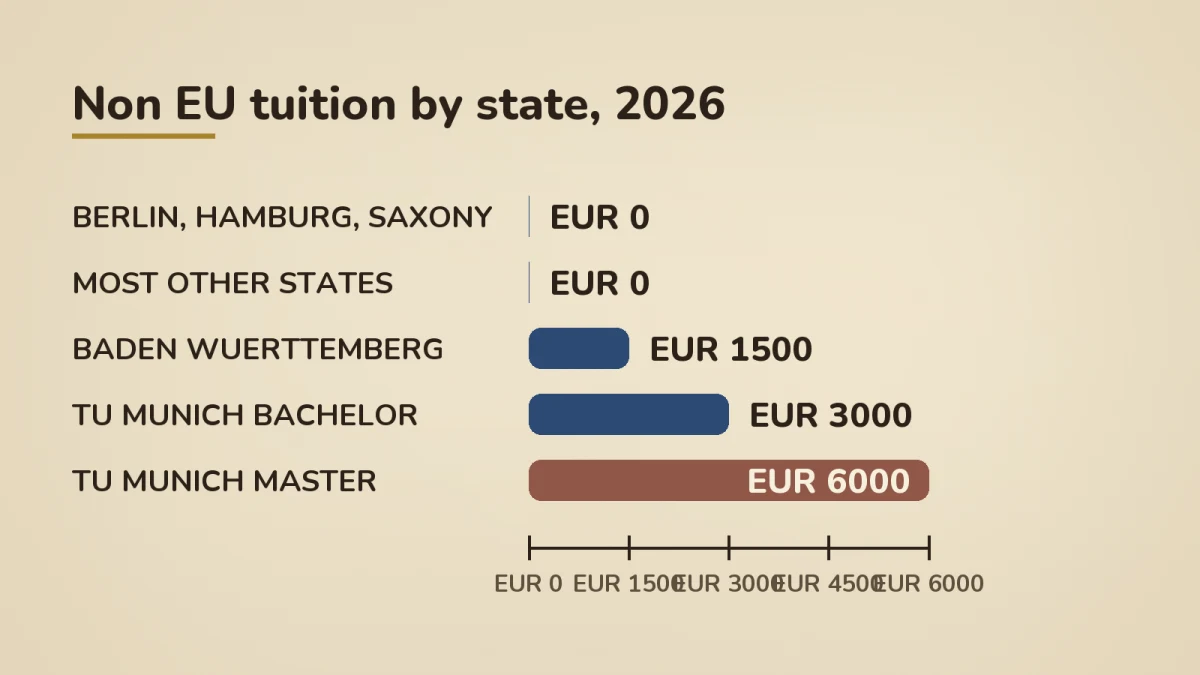
The free-tuition rule has three real exceptions worth knowing up front: Baden-Württemberg charges non-EU students €1,500 per semester since 2017, Technische Universität München (TUM) charges non-EU students €2,000 to €6,000 per semester since the 2024/25 winter semester, and certain executive or specialised Master's programs at otherwise free universities can charge market-rate fees. Everywhere else in the country, every other public university, every other Bachelor's and Master's, every nationality: still €0.
The 200-year story behind it
Free tuition in Germany is not a recent policy. It is the surface expression of a philosophical commitment that predates the country itself.
In 1810, Wilhelm von Humboldt founded what is now Humboldt University in Berlin and published a short essay redesigning what a university should be. His argument, carried by one untranslatable word, was Bildung. Career training was not the point. Apprenticeships handled that, and Germany had a thousand years of guilds. The university was for Bildung: the formation of a complete human being, capable of independent thought and ethical judgment.
That sounds abstract. It was. But it became the operating doctrine of every German university for the next two centuries. Knowledge belongs to the public. Universities exist to produce citizens, not employees. Charging tuition would convert education into a transaction, which would corrupt the thing being transacted. So the state pays.
The German tax base accepted this because the bargain was clear. Every German pays into a system that educates everyone, and in return education is treated as infrastructure, like roads or rail. You do not charge per kilometre on the Autobahn. You do not charge per semester at the Technische Universität.
When West Germany rebuilt itself after 1945 and East Germany rebuilt itself again after 1990, both kept Humboldt's framework. By the time of reunification, the principle was older than democracy in Germany itself.
They tried charging once. It didn't last.
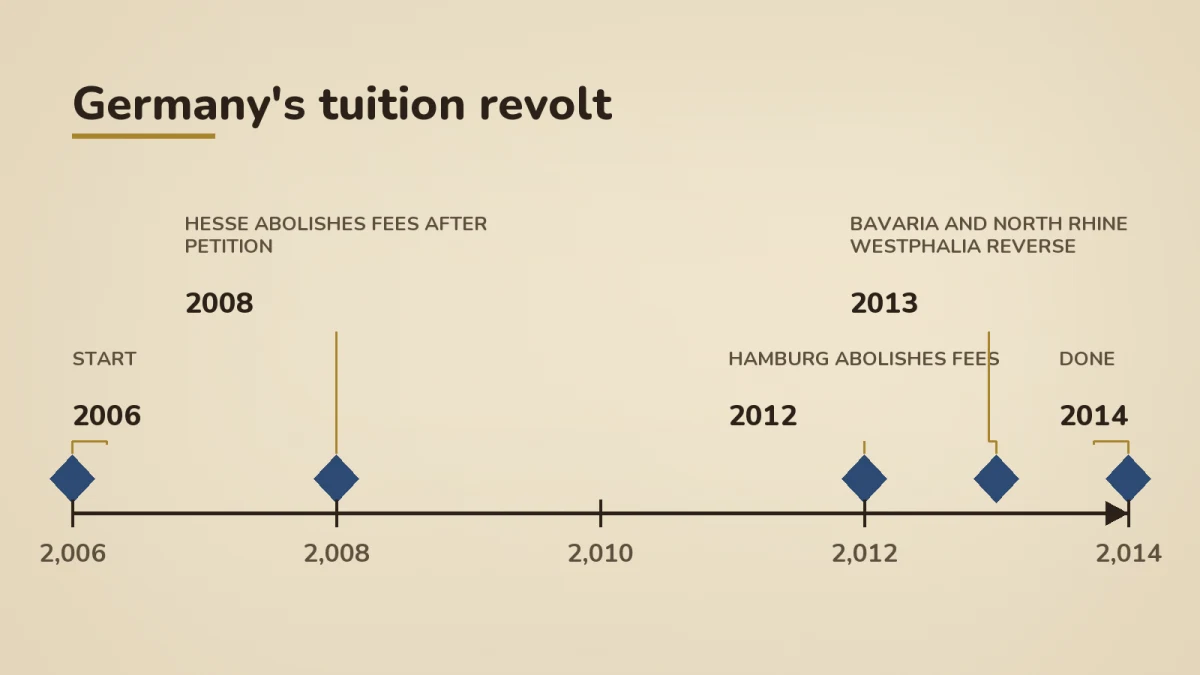
Between 2006 and 2007, seven of the ten Western German states broke ranks and introduced general undergraduate tuition fees of €500 per semester. The Constitutional Court had just lifted the federal ban, the states had budget pressure, and the political mood was that students could contribute. North Rhine-Westphalia, Bavaria, Baden-Württemberg, Lower Saxony, Hamburg, Saarland, and Hesse all signed on. Berlin and the Eastern states refused.
What happened next is the story most people miss.
Hesse abolished the fees in 2008, eighteen months after introducing them, after a citizens' initiative collected the largest petition in state history. Hamburg followed in 2012. Baden-Württemberg, Bavaria, North Rhine-Westphalia, and Saarland all reversed course between 2011 and 2014. Lower Saxony, the last holdout, abolished tuition in 2014. Within seven years of the experiment starting, every single state that had introduced general tuition reversed it. The political cost of charging students was higher than any state government wanted to absorb again.
This is the part that matters: Germany has already run the experiment. The country knows what charging tuition does to political capital, and it decided no. That is why, when budget shortfalls hit in 2025 and 2026, the conversation is about cutting research money or raising taxes, not reintroducing fees for German and EU students. The political third rail is electrified.
Who actually pays for "free" tuition?
Everyone in Germany who pays taxes. The system is publicly funded out of general state and federal budgets, and Germany maintains one of the higher effective tax rates in Europe to support it.
A German earning €100,000 a year pays roughly 38 percent of gross income in combined income tax and social contributions. An American earning the same in a high-tax state pays around 26 percent. That 12-point gap is not a quirk. It is the fee. It funds the universities, plus statutory health insurance, plus pensions, plus the rest of the public infrastructure. Germans do not call it a tax burden. They call it Daseinsvorsorge: provision of the conditions for a decent life.
State governments fund universities directly, with the federal government providing additional money for research excellence and inter-state coordination. Total public spending on higher education in Germany runs roughly €36.5 billion per year across all 16 states combined. That works out to around €15,000 per student per year for what would cost €40,000 to €70,000 at a comparable U.S. private institution.
Internationally, that funding is not philanthropy. It is treated as investment, and the math has gotten more interesting in the last decade.
Why "free" is actually a recruitment strategy
In 2024, the German Economic Institute (IW Köln) published a study commissioned by the DAAD that broke down what international students cost the German state versus what they pay back over their working lives. The headline number is the one most people remember: each new cohort of international students brings in €15.5 billion more in taxes than they cost, assuming retention rates hold.
Around 40 to 60 percent of international graduates stay in Germany after finishing their degrees. They take jobs, pay income tax, pay into the pension system, and fill the labour gaps that an aging German workforce can no longer cover on its own. Germany lists 163 shortage occupations on the Federal Employment Agency's official list, and international graduates flow disproportionately into the engineering, IT, and medical roles that headline that list.
So when you see "free tuition" advertised on a German university's English-language landing page, understand the framing. It is not a gift. It is the cheapest customer acquisition cost in the global education market. Germany invests roughly €15,000 per international student per year for the duration of a degree, and statistically expects to recover multiples of that in tax revenue if the student stays. Free tuition is the lure on a very well-baited hook.
The hidden costs you actually pay
This is the part the headline number hides. Tuition is €0 at most public universities. Studying in Germany is not.
A realistic 2026 budget for an international Master's student in a mid-cost city looks like this:
| Cost item | Per month | Per year |
|---|---|---|
| Rent (room in shared flat or studio) | €450 to €900 | €5,400 to €10,800 |
| Health insurance (statutory student rate) | €130 to €145 | €1,560 to €1,740 |
| Food and groceries | €250 to €350 | €3,000 to €4,200 |
| Public transport (often included in Semesterticket) | €0 to €60 | €0 to €720 |
| Books, supplies, internet, phone | €100 to €150 | €1,200 to €1,800 |
| Visa fee (one-time) | €0 to €75 | €75 |
| Semester contribution (twice a year) | €17 to €58 average | €200 to €700 |
| Discretionary (travel, hobbies, going out) | €150 to €300 | €1,800 to €3,600 |
| Total | €1,100 to €2,000 | €13,200 to €24,000 |
The single biggest line item is rent, and it varies enormously by city. Munich and Frankfurt are the expensive end. Leipzig, Halle, and most Ruhr cities are the affordable end. The full cost of living breakdown for international students goes deeper on city-by-city numbers.
You also need to prove you can fund yourself before you arrive. Germany requires non-EU students to deposit roughly €11,904 in a Sperrkonto (blocked account) for the visa, which the bank releases to you in monthly tranches once you arrive. That money is yours. You spend it. But you need it sitting in the account before the visa interview.
So while tuition is genuinely zero at most public universities, the all-in cost of an international Master's in Germany still lands somewhere between €25,000 and €50,000 across two years, all of it in living costs. That is roughly one-fifth of what the same degree costs at a U.S. private university and one-half of what it costs in the U.K. The free tuition is not a marketing fiction. It is just not the whole bill.
The cracks: where free tuition is breaking
Two things have shifted since 2017. Some states are charging non-EU students again. And the budget that funds the whole system is under pressure.
Baden-Württemberg introduced €1,500 per semester tuition for non-EU students in 2017. EU students still pay nothing. Within two years, non-EU enrollment in the state dropped by roughly 36 percent. The state kept the fees anyway. Refugees, exchange students, and students with German residency are exempt.
Technische Universität München started charging non-EU students from the 2024/25 winter semester. The fees are €2,000 to €3,000 per semester for Bachelor's programs and €4,000 to €6,000 per semester for Master's programs. FAU Erlangen-Nürnberg has followed: it charges new non-EU students €1,000 to €6,000 per semester from the summer semester 2027.
Berlin approved a €106 million cut to its universities in 2025, down from an initially proposed €250 million after a public backlash. Humboldt University, Freie Universität Berlin, and Technische Universität Berlin are absorbing those cuts through hiring freezes, reduced course offerings, and slower research funding.
North Rhine-Westphalia is planning over €240 million in cumulative university budget cuts for 2026, with universities pushing back hard. NRW has not announced new tuition fees, but the cost of staying tuition-free with a shrinking budget is being passed through to students in the form of larger lecture sizes and fewer staff.
Sachsen, Thüringen, and most other Eastern states remain fully free for everyone, and politically committed to staying that way.
What this means in practical terms: if you are a non-EU student weighing programs in 2026, your tuition cost depends entirely on which state and which university you pick. A computer science Master's at TU Berlin: €0. The same program at TU Munich: up to €6,000 per semester. Budget accordingly.
Why no other country can copy this
People often ask why their own country cannot just adopt Germany's system. The honest answer is that it is not really one policy. It is a stack of conditions that took 200 years to build, and removing any single layer would break the rest.
Germany has Ausbildung. Roughly 50 percent of German school leavers go into vocational training rather than university, with structured 3-year apprenticeships in everything from logistics to laboratory technician work. That keeps university enrollment roughly half of what it would otherwise be, which keeps the per-student cost manageable. A country without a vocational system that absorbs half its school leavers cannot afford to make university free at the same scale.
Germany has 16 states funding higher education. Federal-state cost sharing means no single budget line carries the whole weight. The state governments are constitutionally responsible for education, and the federal government layers research excellence funding on top.
Germany taxes accordingly. The 38 percent effective tax rate at €100,000 income is the political fuel for the whole system. Any country that wants free tuition without that tax base will run out of money in a decade.
Germany has cultural buy-in. Two centuries of treating education as a collective responsibility means voters do not see free tuition as a giveaway. They see it as infrastructure. That cultural assumption is the thing other countries cannot import.
It is the simultaneous combination, not any one piece, that makes this work. The system survives because every layer holds up the other layers.
Common mistakes international students make
- Confusing the semester contribution with tuition. The €100 to €350 you pay per semester is for the student union, admin, and your transit pass, not for the academic instruction.
- Assuming "free" means cheap. The all-in cost across living expenses, visa, and Sperrkonto is still meaningful. Budget honestly.
- Picking a university for the brand rather than the state. A famous program in Baden-Württemberg or Bavaria may now charge non-EU tuition. The same field at a top public university in Berlin, Hamburg, or Saxony stays free. Check the state before you check the ranking.
- Skipping the APS certificate (for Indian, Chinese, and Vietnamese applicants). It is mandatory for the visa, takes 4 to 8 weeks, and any slip there blocks your application regardless of your tuition status.
- Treating private universities as equivalent. Private universities in Germany do charge tuition, often €5,000 to €20,000 per year, and they are genuinely a different financial decision. Compare them with eyes open.
FAQ
Is university really 100 percent free in Germany?
Tuition is €0 at most public universities for Bachelor's and Master's students of any nationality. You still pay a Semesterbeitrag (semester contribution) of €100 to €350 that covers the student union, administration, and usually a public transport pass. Two exceptions: Baden-Württemberg charges non-EU students €1,500 per semester, and TU Munich charges non-EU students €2,000 to €6,000 per semester since 2024.
Why is Germany free?
What's the catch?
There is no individual catch. The system is publicly funded out of general taxes, and the German tax rate at €100,000 income is roughly 38 percent versus 26 percent in the U.S. That 12-point gap covers the universities (plus healthcare and pensions). The "catch" for non-Germans is that you cover full cost of living, around €13,000 to €24,000 per year, plus the €11,904 Sperrkonto deposit before the visa.
How does Germany afford to give free education to international students?
A 2024 DAAD/IW Köln study showed each new cohort of international students brings in €15.5 billion more in taxes over their careers than they cost in education spending, assuming current retention rates. About 40 to 60 percent of international graduates stay in Germany after finishing their degree, and Germany has 163 shortage occupations they fill. Free tuition is structured as a recruitment strategy.
Will Germany ever bring back tuition fees for everyone?
Politically very unlikely for German and EU students. Seven states tried in 2006 to 2007 and all reversed by 2014 after public backlash. The political cost of charging Germans for university is treated as too high. Non-EU students are a different question: Baden-Württemberg has charged since 2017 and TU Munich since 2024, and other states could follow. The trend on non-EU fees points toward more, not fewer.
Are private universities in Germany also free?
No. Private universities in Germany typically charge €5,000 to €20,000 per year. Around 95 percent of all students attend public universities, where tuition is free. Private universities account for a small minority of enrollment and are a separate financial decision. Most internationally recognised programs are at public universities.
Do I need to speak German to study for free?
Not necessarily. Germany offers around 2,500 English-taught Master's programs across public universities, and many Bachelor's programs are now in English too. You may need a TestDaF or DSH score for German-taught programs, or IELTS / TOEFL / language certificate for English ones. The myth that you must speak German is one of the most persistent and most wrong assumptions about studying in Germany.
What is the catch with studying in Baden-Württemberg or at TU Munich as a non-EU student?
You will pay tuition. Baden-Württemberg: €1,500 per semester (€3,000/year). TU Munich Bachelor's: €2,000 to €3,000 per semester. TU Munich Master's: €4,000 to €6,000 per semester. That is still less than U.S. private university costs, but it is not free. The same degree at a public university in Berlin, Hamburg, Saxony, or most other states remains €0.
How long has Germany had free tuition?
Free tuition is the post-1945 norm in West Germany and the post-1990 norm in unified Germany, but the underlying philosophy traces back to Wilhelm von Humboldt's 1810 founding of Humboldt University in Berlin. Germany briefly reintroduced tuition in 7 states between 2006 and 2014, then reversed all of them. So in current form, the system has run continuously since 2014 and the principle has run more or less since the early 1800s.
Where to next
If you are deciding whether Germany is the right call, three reads to anchor the decision:
- Cost to study in Germany for a per-line breakdown of what you actually pay
- Public vs private universities in Germany for the financial trade-off if you are tempted by a private program
- Top 10 public universities in Germany for which institutions are still genuinely tuition-free in 2026
And the pillar: Master's in Germany walks the full application path, from APS to admission to visa to arrival.
Free tuition is real. The cracks are also real. The smart play in 2026 is to know exactly which state and which university you are applying to, what the all-in cost looks like for your nationality, and what happens if the trend lines keep moving.
Continue reading
Study in Germany·15 min read
Is studying in Germany still free in 2026? State-by-state non-EU tuition tracker
Public Bachelor's in Germany stay tuition-free for non-EU students in 14 of 16 states in 2026. Baden-Württemberg and TUM are the paying exceptions.
Read articleStudy in Germany·17 min read
Studying in Germany vs USA - All You Need To Know
Explore every aspect of studying in Germany vs USA and delve into academic landscapes, costs, and career prospects for an informed higher education decision.
Read articleStudy in Germany·13 min read
German grade conversion explained: Bavarian formula, modified Bavarian, GPA to German scale
How German universities convert your GPA, CGPA, or percentage to the 1.0 to 5.0 German scale using the modified Bavarian formula, with worked examples.
Read articleReady to plan your Germany journey?
Explore our tools and resources to find the perfect university and program for your academic goals.