Is studying in Germany still free in 2026? State-by-state non-EU tuition tracker
Public Bachelor's in Germany stay tuition-free for non-EU students in 14 of 16 states in 2026. Baden-Württemberg and TUM are the paying exceptions.

Table of contents
Last updated: May 2026
TL;DR: Public university Bachelor's degrees in Germany are still tuition-free for non-EU students in 14 of 16 federal states. The two exceptions in May 2026: Baden-Württemberg charges €1,500 per semester at every public university, and the Technical University of Munich charges €2,000 to €6,000 per semester depending on the program. Everywhere else, the only money you actually pay your university is a small semester contribution of €100 to €350.
The "Germany is free for international students" headline you read on Reddit, on YouTube, and in every consultancy brochure was true in 2014. It is mostly still true in 2026, but the picture is now state by state, not country wide. If you are looking at an undergraduate seat in Germany this autumn, the question is no longer "is it free" but "is it free where I am applying".
This tracker breaks it down for the 2026 admission cycle. We cover the two public-university exceptions (Baden-Württemberg and TUM in Bavaria), the semester fee that catches first-time applicants off guard, the 2024 to 2026 policy debates that are unlikely to land before you graduate, and a decision tree you can run on any program you are shortlisting. For the broader pillar guide, see our Bachelor's in Germany overview. For numbers on living costs and the blocked account, see our cost of living guide and our tuition and Bachelor's cost breakdown.
Yes, public Bachelor's degrees are still mostly free in 2026
Public universities in Germany are funded by the federal states. Tax money pays for the running cost, so most of them charge no tuition for Bachelor's or consecutive Master's degrees, regardless of where you hold a passport. Two states have stepped outside that consensus.
Baden-Württemberg has been charging non-EU/EEA international students €1,500 per semester since the winter semester of 2017/18. The fee applies at every public university in the state, including Heidelberg, the University of Stuttgart, the University of Freiburg, the University of Tübingen, the University of Mannheim, the Karlsruhe Institute of Technology, and every Hochschule für Angewandte Wissenschaften (university of applied sciences) in the state. The state's Ministry of Science, Research and the Arts confirms this is still the policy in 2026.
Bavaria amended its higher-education law in 2023 (the Bayerisches Hochschulinnovationsgesetz, or BayHIG) to permit Bavarian universities to charge non-EU students. So far, only the Technical University of Munich (TUM) has used that authority. From the winter semester of 2024/25 onwards, TUM charges €2,000 or €3,000 per semester for Bachelor's programs and €4,000 or €6,000 per semester for Master's programs, depending on the specific program. LMU Munich, the University of Erlangen-Nuremberg (FAU), the University of Würzburg, the University of Regensburg, and the rest of Bavaria's public universities still charge no tuition in 2026, though FAU will charge new non-EU students €1,000 to €6,000 per semester from the summer semester 2027.
The other 14 states (Berlin, Brandenburg, Bremen, Hamburg, Hesse, Lower Saxony, Mecklenburg-Vorpommern, North Rhine-Westphalia, Rhineland-Palatinate, Saarland, Saxony, Saxony-Anhalt, Schleswig-Holstein, and Thuringia) charge no tuition for non-EU students at public universities in 2026. There are debates in some of them, which we cover later.
State-by-state non-EU tuition tracker for 2026
Here is the picture across all 16 federal states for the 2026 academic year. The "tuition" column is what your university charges for instruction. The "semester fee" column is the small administrative contribution every student pays and which usually includes a public-transport ticket.
| State | Non-EU tuition (Bachelor's, public unis) | Typical semester fee | Notes |
|---|---|---|---|
| Baden-Württemberg | €1,500 / semester | €150 to €200 | Applies to every public uni since winter 2017/18 |
| Bavaria | €0 at most unis. €2,000 to €3,000 per sem at TUM. | €100 to €130 | TUM only Bavarian uni charging non-EU since winter 2024/25 |
| Berlin | €0 | €310 to €350 | High semester fee includes Deutschlandticket |
| Brandenburg | €0 | €250 to €330 | |
| Bremen | €0 | €330 to €430 | |
| Hamburg | €0 | €330 to €350 | |
| Hesse | €0 | €280 to €380 | NRW-style debate raised in 2024, no legislation |
| Lower Saxony | €0 | €350 to €430 | Reintroduction debated, abandoned by state government |
| Mecklenburg-Vorpommern | €0 | €70 to €120 | Lowest semester fees in Germany |
| North Rhine-Westphalia | €0 | €280 to €330 | Reintroduction debated under CDU-Greens since 2024, no implementation |
| Rhineland-Palatinate | €0 | €280 to €330 | |
| Saarland | €0 | €280 to €310 | |
| Saxony | €0 | €230 to €270 | Debate raised by CDU in late 2025, not legislated |
| Saxony-Anhalt | €0 | €100 to €130 | |
| Schleswig-Holstein | €0 | €150 to €180 | |
| Thuringia | €0 | €230 to €270 |
Two takeaways. First: a "tuition-free" Bachelor's still costs you €600 to €700 a year in semester contribution before you have bought a single book. Second: the semester contribution is highest in Berlin, Bremen, Hamburg, and Lower Saxony because it bundles a regional or national public-transport ticket; this is a feature, not a bug, and you would otherwise pay it separately.
How much does Baden-Württemberg actually cost over a degree?
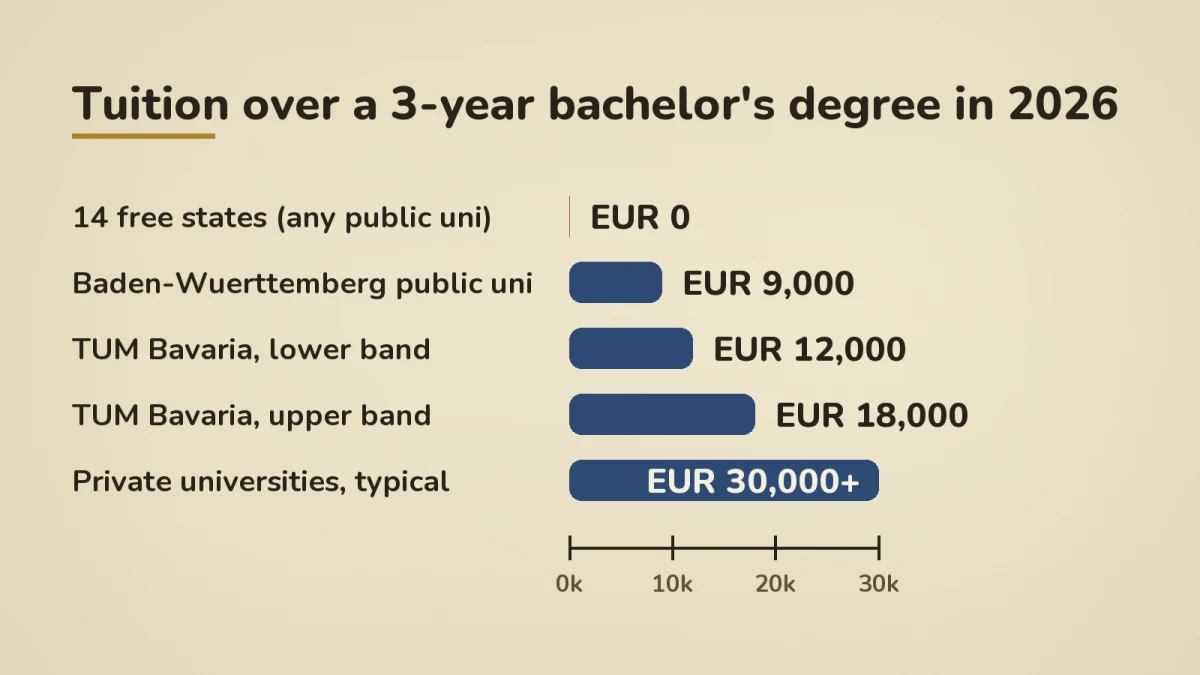
A standard German Bachelor's runs six semesters (three years), and a Master's two to four semesters. At €1,500 per semester, a Bachelor's at any public Baden-Württemberg university adds up to €9,000 in tuition over the full degree. A 4-semester Master's adds €6,000.
That is real money, and it has to come from somewhere your visa officer believes. The €11,904 you deposit in your blocked account for the 2026 visa year covers your first 12 months of living costs only, not tuition. If you are studying in Baden-Württemberg, you need to budget the €3,000 per year of tuition separately and document it during the visa interview. The state's universities sometimes waive the fee for partner-university exchange students, refugees, and a small set of scholarship recipients, but the default for a fee-paying non-EU degree-seeker is no waiver.
A few practical notes. Doctoral students in Baden-Württemberg are exempt: PhD remains tuition-free everywhere in Germany including BW. The fee is per semester, not per credit, so taking 30 ECTS or 12 ECTS in a given term costs the same. And it is a "Studiengebühr für internationale Studierende", not the older "Zweitstudiengebühr" (second-degree fee), which still exists separately at €650 per semester for students pursuing a second Bachelor's or unrelated second Master's.
If Baden-Württemberg is a destination you care about for academic reasons (Heidelberg, Karlsruhe, Tübingen, Stuttgart, Freiburg are world-ranked institutions), the €9,000 sticker for a Bachelor's or €6,000 for a Master's is still well below what an equivalent UK or Australian degree would cost you in tuition alone. It is not free. It is cheap.
TUM Bavaria: the charges that started in winter 2024/25
TUM is the only Bavarian public university charging non-EU/EEA students in 2026, and the fees vary by program. The published structure as of 2026:
- Bachelor's programs: €2,000 or €3,000 per semester
- Master's programs: €4,000 or €6,000 per semester
The exact figure depends on the program. TUM publishes the rate on each program's individual fees page; do not assume the lower band. A six-semester Bachelor's at TUM costs €12,000 to €18,000 over the degree; a four-semester Master's costs €16,000 to €24,000.
TUM does run a scholarship and waiver scheme. Top-quartile applicants by entrance test score, students from partner universities on exchange, and a small number of merit recipients get partial or full waivers. The scheme is competitive: most non-EU TUM students pay the published rate. You apply for the waiver in parallel with the program, not after admission.
If TUM is on your shortlist for a specific program (Informatics, Mechanical Engineering, Robotics, the joint TUM-LMU programs in chemistry and physics), the cost is real but manageable. If you are open about which Bavarian university you attend, LMU Munich, FAU Erlangen-Nuremberg, the University of Augsburg, the University of Bayreuth, and Munich's universities of applied sciences are all still tuition-free in 2026 and offer comparable programs.
The Bavarian law (BayHIG) does permit other state universities to opt in to charging non-EU fees. FAU has since opted in: it charges new non-EU students €1,000 to €6,000 per semester from the summer semester 2027. Check each university's own fee page before you apply.
Semester fee, tuition, and the things students confuse
Three different lines in your university bill are not the same. Most arguments about "is Germany still free" turn on conflating them.
Tuition (Studiengebühren) is what you pay for instruction. In 14 states this is zero for public-uni non-EU undergraduates. In Baden-Württemberg it is €1,500. At TUM it is €2,000 to €6,000 per semester depending on level.
Semester contribution (Semesterbeitrag) is mandatory at every public university in Germany, including the tuition-free ones. It runs €100 to €430 depending on the city. It bundles administrative cost, support for the student union (Studierendenwerk), and in many states a public-transport ticket. Some German cities (Berlin, Hamburg, Bremen, Hannover, parts of NRW) include the nationwide €63-per-month Deutschlandticket inside the semester fee, which makes the headline number look bigger but actually saves you money compared to buying transport separately.
Long-term tuition fee (Langzeitstudiengebühr) is a per-semester charge of €500 to €800 that some states impose on students who exceed the standard study time (Regelstudienzeit) by more than four semesters. NRW, Bremen, and Saxony-Anhalt apply versions of it. If you finish a Bachelor's in six or seven semesters and a Master's in four, you will never see this charge.
Second-degree and non-consecutive Master's fees (Zweitstudiengebühr) apply if you are pursuing a Bachelor's after already holding one in a different field, or a non-consecutive Master's. These run €500 to €650 per semester at most public universities. If you are coming from India with a three-year Bachelor's of Engineering and applying for a Master's in Engineering, this is a "consecutive" Master's and the fee does not apply. If you are switching from a Bachelor's of Commerce to a Master's of Computer Science, ask the university whether they classify it as consecutive before you assume it is free.
Private universities charge tuition separately and substantially: €5,000 to €25,000 per year is the typical range. Some elite Master's at private institutions (Hertie School, ESMT Berlin) cost €30,000 plus per program. Free-tuition state policy does not apply to private universities; if the university is private, expect to pay regardless of state.
Will more states reintroduce fees?
What's actually in motion in 2026
This is the question Reddit cannot stop asking. The honest 2026 answer: a few state governments have raised the idea, none have legislated it, and the path from "raised" to "in your bill" is at least 18 months under German legislative practice.
North Rhine-Westphalia: the CDU-Greens state government has had non-EU fees on its discussion list since 2024. Minister-President Hendrik Wüst has said publicly that NRW is "looking at the Baden-Württemberg model". No bill has reached the state parliament. Even if it did this year, the earliest it could affect students is the winter semester of 2027/28.
Saxony: a CDU faction proposal in late 2025 floated the idea. The state government has not adopted it. Saxony has historically had some of the lowest fees in Germany and a strong tradition against tuition; the proposal is unlikely to clear coalition negotiations.
Hesse: signalled openness to the idea in 2024 budget discussions. Not legislated.
Lower Saxony: looked at reintroduction in 2024, abandoned the idea after coalition pushback.
The pattern across all four states: discussion happens during budget years when state finance ministries are looking for revenue, then dies in the legislative process because the political cost of becoming "the state that charges international students" is high. In 2026 there is no implemented reintroduction outside the existing two cases. If you start a Bachelor's this autumn anywhere outside Baden-Württemberg or TUM, the probability that your tuition stays at zero through your full degree is high.
A 30-second decision tree for any program
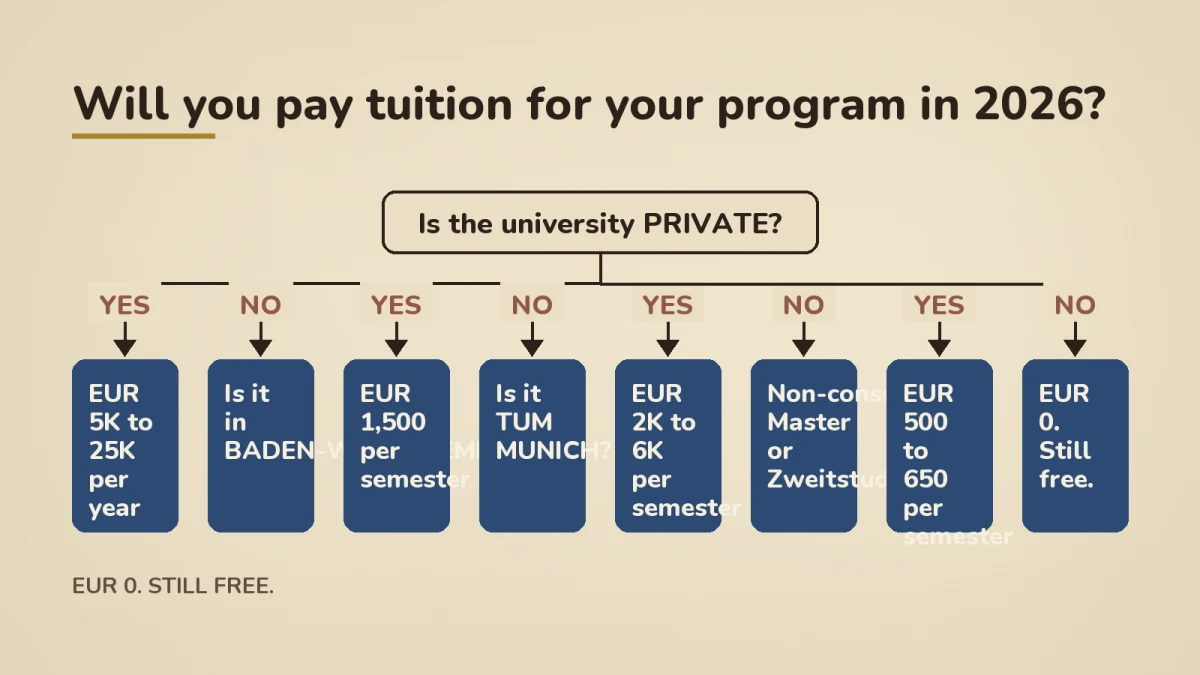
Run this on every program you shortlist:
- Is the university private? If yes, expect €5,000 to €25,000 per year. Stop here and budget accordingly.
- Is the university in Baden-Württemberg? If yes, you pay €1,500 per semester. €9,000 over a Bachelor's, €6,000 over a Master's.
- Is it the Technical University of Munich? If yes, check the program's fee page. €2,000 to €3,000 per semester for Bachelor's, €4,000 to €6,000 for Master's.
- Is it a non-consecutive Master's, a Zweitstudium, or part-time evening continuing-education program? If yes, expect €500 to €650 per semester or program-specific fees regardless of state.
- Is it any other public university in any other state? Tuition is zero. You only pay the €100 to €430 semester contribution. That is your full bill from the university.
Always confirm with the program's "Tuition fees" or "Studiengebühren" page on the university's own website. Information from third-party blogs and consultancies (including this one) ages faster than the official source.
How to budget the real cost in 2026 even when tuition is zero
Tuition is one line. The real Germany cost in 2026 looks like this for an average non-EU undergraduate:
- Blocked account requirement: €11,904 for the visa year (€992 per month). Read the full blocked account guide.
- Semester contribution: €100 to €430 per semester (typically €600 to €800 per year)
- Tuition: €0 in 14 states, €3,000 per year in Baden-Württemberg, €4,000 to €12,000 per year at TUM
- Accommodation: €400 to €1,200 per month depending on city. Munich is the most expensive German student city; Leipzig, Dresden, Halle, Magdeburg, Chemnitz are the cheapest.
- Health insurance: €130 to €150 per month for public student insurance
- Deutschlandticket: €63 per month (often included in semester contribution; check the breakdown)
- Food, books, phone, miscellaneous: €250 to €350 per month
For a non-Baden-Württemberg, non-TUM student, the all-in annual cost in 2026 is typically €13,000 to €16,000 outside Munich, €16,000 to €20,000 inside Munich. Tuition is the smallest line by far in most cases. Cost of living is the line that bites.
What to do before you apply
A short checklist:
- Confirm the tuition policy on the university's own site (not a consultancy site). Search the university domain for "Studiengebühren" or "Tuition fees".
- Email the international office if anything is unclear, especially for non-consecutive Master's classifications.
- Factor BW or TUM tuition into your blocked-account math. The blocked account itself is for living costs only; tuition is on top.
- Apply for scholarships in parallel: DAAD scholarships are program-by-program but cover full tuition plus living for selected awardees. University-internal awards (Heidelberg, Tübingen, TUM) cover partial tuition for the strongest applicants.
- If you are choosing between two programs and one is in Baden-Württemberg, factor the €9,000 differential against rankings, fit, and language of instruction. The fee is real money but the universities are also genuinely top tier.
FAQ
Are EU students charged the €1,500 fee in Baden-Württemberg or the TUM fee?
No. Both fees apply only to non-EU/EEA students. EU and EEA citizens, and students with permanent residency in Germany, pay only the standard semester contribution.
Is the €1,500 Baden-Württemberg fee the same for Bachelor's and Master's programs?
Yes. The €1,500 per semester is uniform across Bachelor's and consecutive Master's programs at every public university in the state.
Are there waivers or scholarships at TUM or in Baden-Württemberg?
Yes, but they are competitive. TUM runs a scholarship and waiver scheme for top-scoring applicants and partner-university exchange students. Baden-Württemberg universities sometimes waive the fee for refugees, partner-exchange students, and merit-scholarship holders. In both cases, the default is no waiver. Apply for waivers in parallel with the program, not after admission.
Will North Rhine-Westphalia start charging non-EU students in 2026?
Not in 2026. The CDU-Greens state government has discussed it since 2024 but no bill has reached the state parliament as of May 2026. The earliest a hypothetical fee could take effect is the winter semester of 2027/28.
Are doctoral (PhD) programs free in Germany?
Yes. PhD programs are tuition-free at all public universities in Germany, including in Baden-Württemberg and at TUM. Doctoral students still pay the standard semester contribution. Many doctoral candidates also receive a research stipend or salaried research-assistant contract through their chair.
Does the semester contribution include health insurance?
No. Health insurance is separate and runs €130 to €150 per month for public student insurance (TK, AOK, DAK, Barmer). The semester contribution covers administrative cost, the student union, and a public-transport ticket.
Are non-consecutive Master's programs free anywhere in Germany?
Almost never. Non-consecutive Master's at public universities typically charge €500 to €650 per semester regardless of state. Specialised executive Master's and MBA programs at any institution charge full private-style tuition.
How does the cost of studying in Germany compare to the UK, US, or Australia?
For a non-Baden-Württemberg, non-TUM Bachelor's, your tuition bill in Germany is €0. The UK charges international Bachelor's students £20,000 to £40,000 per year. US public state schools charge $25,000 to $40,000 per year for international undergraduates, US private universities $50,000 to $80,000. Australian Bachelor's tuition for international students runs A$30,000 to A$50,000 per year. Germany remains the cheapest mainstream English-language-friendly study destination in 2026, with Baden-Württemberg and TUM still cheaper than most international Bachelor's options elsewhere.
Where to next
- Bachelor's in Germany: the full pillar guide
- Bachelor's in Germany: requirements, programs, and the application timeline
- Cost of studying for a Bachelor's in Germany
- Top English-taught Bachelor's programs in Germany
- Affordable Bachelor's programs for international students
- Cost of living in Germany for international students
If you are still deciding between Bachelor's and Ausbildung, our Ausbildung vs Bachelor's comparison walks through the cost, salary, and visa trade-offs side by side.
Continue reading
Study in Germany·16 min read
Why is university free in Germany? The full 200-year story (and the hidden costs)
Tuition is 0 euros at most German public universities thanks to a 200-year philosophy of education as a public good. Full story, hidden costs.
Read articleStudy in Germany·13 min read
German grade conversion explained: Bavarian formula, modified Bavarian, GPA to German scale
How German universities convert your GPA, CGPA, or percentage to the 1.0 to 5.0 German scale using the modified Bavarian formula, with worked examples.
Read articleStudy in Germany·8 min read
A Guide to Anabin Database
Plan your study in Germany with the Anabin Database! Learn about degree recognition, H+, H-, and H+/H- statuses, and streamline your admission and visa process.
Read articleReady to plan your Germany journey?
Explore our tools and resources to find the perfect university and program for your academic goals.