APS Certificate India 2026: Digital verification, faster processing, the new anabin rules for Indian degrees
APS India in 2026: digital PDF certificates, faster processing, and the new anabin rules with a 70% Class XII floor for Bachelor applicants in March 2026.

Table of contents
Last updated: May 2026
TL;DR: APS India in 2026 means three things. The certificate is a digital PDF, has been since 2023, and got a fresh D-Trust seal in December 2025. Processing is faster after the move to digital handling. From 15 March 2026 the anabin database uses updated criteria for Indian qualifications, and the headline rule for Bachelor's applicants is a 70% minimum in Class XII for every board, applying to Winter Semester 2026/27 admissions onwards. Existing APS certificates stay valid. If you applied before 15 March 2026 you keep the old criteria.
If you are an Indian student planning to study in Germany, the APS certificate is the first official gate you have to clear. The Akademische Prüfstelle (Academic Evaluation Centre) is part of the German Embassy in New Delhi, and almost no German university will look at your application without an APS Bescheinigung in your file. The rules for issuing that certificate changed in 2026, and the changes are big enough that you need to understand them before you book your appointment, pay the fee, or even pick a degree program.
This post explains exactly what is new, what stayed the same, and how to apply in 2026 without losing a semester to a paperwork mistake. Every fact is sourced from the APS India News page and the anabin database operated by the Standing Conference of the Ministers of Education and Cultural Affairs of the Länder. If you are still figuring out the basics of the certificate itself, start with our APS certificate guide for Indian students and come back here.
What changed in APS India in 2026
Three things changed, and they did not all change at once.
One. Updated anabin criteria from 15 March 2026. The German evaluation criteria for Indian academic qualifications were refreshed in the anabin database with effect from 15 March 2026. These updated criteria apply to admissions starting Winter Semester 2026/27. The single biggest practical change is a uniform 70% floor on Class XII marks for undergraduate applicants, regardless of board.
Two. A new digital seal certificate from December 2025. The trust service provider Bundesdruckerei (D-Trust) had to deactivate older signing cards in late 2025 because of a security issue found in Infineon chips that used ECDSA. APS India switched to a new seal card. Old certificates stay verifiable under EU eIDAS rules. New certificates from December 2025 onwards use the new seal and will not show the Adobe Acrobat warning that some older PDFs briefly displayed.
Three. Faster, fully digital handling. The certificate has been a signed PDF since April 2023. By 2026 the workflow around it is fully digital end to end, processing times are tighter than the paper-printed era, and applicants receive the verified certificate by email at their registered address.
What did not change: existing APS certificates remain valid. The two pathways into a German Bachelor's program (Studienkolleg or direct subject-restricted) are still the routes. APS still does not decide university admissions. Private-university applicants still need their institution to hold H+ status in anabin, a rule that has been in force since June 2024. Master's applicants still need APS, and the 70% Class XII rule is specifically about Bachelor's eligibility, not the Master's track.
The new anabin rules: 70% in Class XII becomes the floor
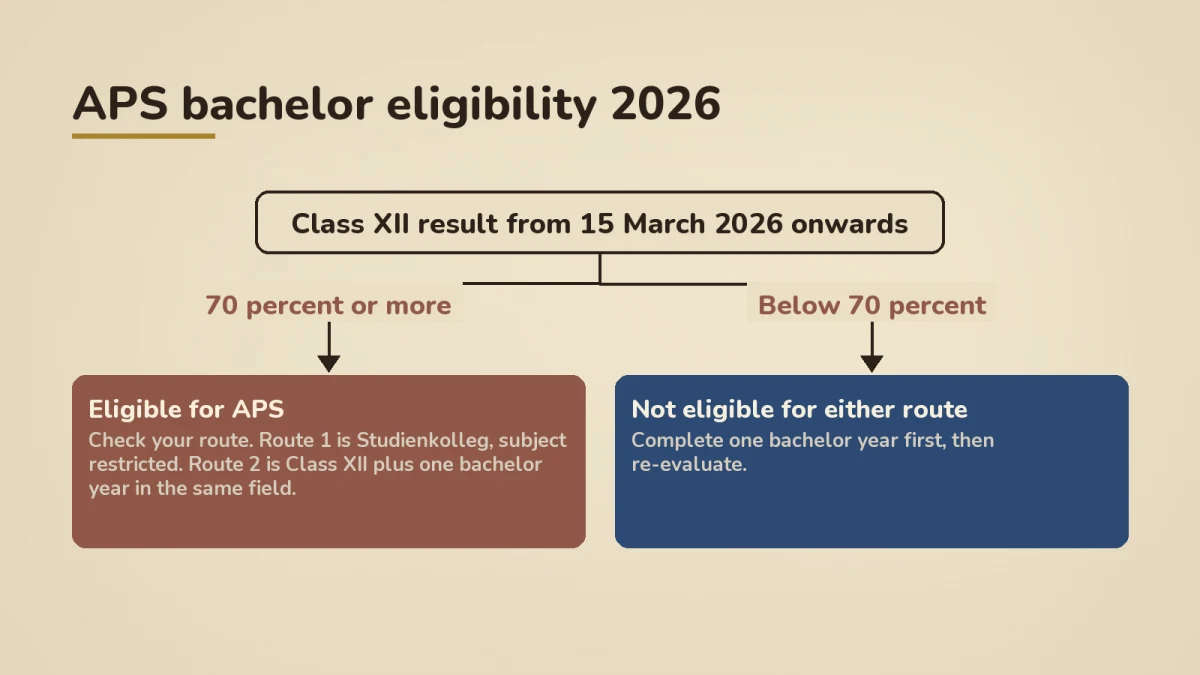
The single line worth memorising from the 23 February 2026 APS India update: from Winter Semester 2026/27, undergraduate applicants need a minimum of 70% of the maximum achievable marks in Class XII, on every Indian board, to be eligible for either of the two admission pathways.
That sentence has three parts and each one matters.
"70% of the maximum achievable marks"
This is not best-five, not subject average, not the percentage your CBSE marksheet prints in the box. It is your overall percentage, calculated against the highest score the certificate could have shown. For most boards the maths is straightforward: total marks divided by maximum possible total. CBSE, ICSE, and state boards all publish the maximum on the marksheet. If your certificate shows you scored 425 out of 500 across the five reported subjects, that is 85% and you are clear. If it shows 320 out of 500, that is 64% and you do not qualify under the new rule.
"Every Indian board"
There is no carve-out for state boards, no different threshold for ICSE, no allowance for international boards within India. The 70% threshold is uniform. If your board reports marks differently (some state boards convert internal assessment, some weight practicals, some publish CGPA), the value APS reads is the overall percentage of maximum achievable marks on the official Class XII certificate.
"From Winter Semester 2026/27"
The new rule applies to admissions for Winter Semester 2026/27 (intakes starting October 2026) and every later intake. If you submitted your APS application before 15 March 2026, your file is evaluated under the criteria that were in force at the time of submission. APS confirmed this in writing on the news page: "Applications submitted before the implementation date (15 March 2026) will be assessed based on the criteria applicable at the time of submission."
So in the 2026 picture there is a clean before-and-after line on 15 March 2026. Anything you submitted before that date is grandfathered. Anything submitted from that day forward goes through the new evaluation criteria.
Two pathways under the new rules
The 70% rule connects to Germany's two long-standing entry routes for non-EU Bachelor's applicants. Nothing new about the routes themselves. What is new is that 70% is now the entry condition for both.
| Pathway | Class XII | Plus | Outcome |
|---|---|---|---|
| Studienkolleg (subject-restricted) | 70% minimum | APS Certificate | Eligible to attend a Studienkolleg, sit the Feststellungsprüfung, then apply |
| Direct subject-restricted | 70% minimum | APS Certificate + 1 successful academic year of a Bachelor's at a recognised Indian higher education institution | Eligible to apply directly to the same field or closely related subjects |
A few things to underline. The "1 successful academic year" must be a regular Bachelor's program (not a foundation course, not a diploma) and it must be from a recognised institution. Successful means actually completed; a partial year does not count. The direct route also restricts you to the field you started in or closely related subjects, so an Indian B.Com first-year student cannot use this route to switch into Computer Science in Germany.
Read the small print
APS itself does not decide whether you get into a German university. It evaluates whether your documents meet the criteria in anabin and issues a certificate that confirms the result. Universities then take that certificate and apply their own admission rules on top. So a 70% Class XII candidate with a clean APS certificate is eligible to apply but is not guaranteed a seat.
If you already have an APS certificate from before 15 March 2026, the certificate stays valid. The clarification on the APS news page reads: "APS certificates that have already been issued remain valid. APS is not involved in university admission decisions." Universities decide what they accept. Most German universities will continue to honour valid APS certificates issued under the old criteria.
Digital verification: how APS certificates work since 2023
If you have not applied recently, the format of the certificate may surprise you. There is no embossed paper, no courier-shipped folder. The APS Bescheinigung is a signed PDF. APS India switched to digital certificates on 24 April 2023, and all standard individual applications now receive the certificate by email after verification.
What you actually get:
- A secure PDF file with a digital signature.
- A unique APS verification number that uni-assist, German universities, and the visa section at VFS can cross-check.
- One PDF file that you reuse, unchanged, for every application.
The signature is what makes the document accepted by every German authority that handles your file. It is a qualified electronic seal under the EU eIDAS regulation, which gives the PDF the same legal standing as a paper-printed and stamped certificate.
The new D-Trust seal from December 2025
In late 2025 the trust service provider had to deactivate the previous batch of seal cards. The reason was technical: a security flaw nicknamed EUCLEAK was found in Infineon chips that used the ECDSA algorithm. APS India received a new seal card and started using it from December 2025. The change is invisible to applicants in the sense that the workflow stayed the same, but it is visible in one specific way.
Some PDF readers, including Adobe Acrobat, may show a warning when opening older APS certificates after the old seal card was deactivated. Typical messages:
- "There are problems with at least one signature."
- "Signature validity is unknown."
These warnings refer only to the technical deactivation of the old certificate. They do not mean the document is invalid. If you open the signature details, you can still see that the document has not been modified since it was sealed, that the seal issuer's identity was valid at the time of signing, and the validity period of the original seal certificate. EU eIDAS keeps a qualified electronic seal valid as long as it was created with a valid certificate at the time of issuance and the document has not been modified afterwards.
In plain English: if you received your APS certificate in 2023 or 2024, and Adobe shows a "signature validity unknown" warning today, the document is still valid. Universities and the visa section have been informed. Do not pay for a new evaluation just to silence the warning.
Certificates issued from December 2025 onwards use the new seal and will not show those messages.
File-handling rules you must follow
APS India is strict about how the PDF gets submitted. The 13 March 2025 notice on the news page lists three rules. Every applicant should treat them as hard rules.
- Do not rename the file. The original filename APS gave you must be preserved. Applications with renamed APS PDFs run into verification issues at uni-assist and at universities.
- Do not modify the PDF. No editing, no cropping, no flattening, no annotations. Any modification breaks the signature and the file fails verification.
- Submit the APS certificate as a standalone file. It cannot be merged with your other documents into a single combined PDF.
The rules sound trivial until you watch a friend lose a semester because they re-saved the PDF in a tool that rebuilt the file structure and broke the signature. Treat the certificate file the way you would treat the original signed copy of a passport: do not touch the bytes.
Faster processing: what to expect in 2026
Processing times for APS India have been a moving target since the office moved to its current premises at the RK Khanna Stadium complex in New Delhi in October 2022. The transition to digital certificates in 2023 cut weeks off the post-verification turnaround. APS India now says it cannot give a fixed processing time, so plan with a buffer.
Two things drive that variance.
One. The "physically opens" wording on the APS news page is deliberate. Their processing-time clock starts when your courier package is opened in their office, not when you mail it. Couriers from outside Delhi can take 3 to 7 working days to be delivered, sorted, and opened. Plan for it.
Two. Verification depends on cooperation from your school and your university. APS writes to your institutions to verify the documents you submitted. If your school responds quickly, your case moves quickly. If your school stalls or ignores the request, your case stalls. There is no fast-track payment that sidesteps this.
When to submit your application
APS India released an explicit clarification on 16 March 2026, and it is worth quoting: "APS certificates are issued on the basis of the academic qualifications that have been completed and documented at the time an application is processed. APS cannot keep applications open while applicants are waiting for future examination results or additional semester marksheets."
In practice this means you should not register for APS in February of your final Bachelor's year hoping to slip in a transcript later. You should submit only once you have completed the academic stage that determines your intended admission pathway:
- For the Studienkolleg route: after Class XII results.
- For the direct subject-restricted route: after one full successful academic year of your Indian Bachelor's.
- For Master's admission: after your final Bachelor's results.
If your academic situation changes later (for example you complete a second academic year and want to update your eligibility category), you can request a new evaluation. APS treats this as a new application: you pay the fee again, and the new evaluation is performed under the criteria in force at the time of the new application. You should only do this if the new qualification actually changes your admission category.
The realistic 2026 timeline
For most Indian applicants in 2026 the timeline from "I want to do this" to "I have my APS certificate in my inbox" looks like this:
- Week 0: Decide route, gather documents, register on aps-india.de, pay the fee (CCAvenue online or offline bank transfer).
- Week 1: Mail hard copies by registered courier to RK Khanna Stadium.
- Week 1 to 2: APS opens your file, payment is matched, your case enters the verification queue.
- Weeks 2 to 8: APS writes to your school and university for verification. Your file moves when both reply.
- Week 4 to 10: Digital APS certificate arrives by email at your registered address.
If your school is fast and your file is clean, six weeks total is realistic. If anything is missing or your school takes time, 10 weeks is normal.
APS for Master's, Bachelor's, and distance education
The 2026 changes are heaviest at the undergraduate end. The Master's track is largely unchanged, but every Indian applicant needs to know how the rules apply to their specific situation.
Bachelor's applicants
The 70% rule is the headline. The two pathways are the Studienkolleg subject-restricted route and the direct subject-restricted route after one successful Bachelor's year. Both now require 70% in Class XII. Many German universities also require a TestAS aptitude test score alongside the APS, so plan a six-week prep window before your Winter Semester application deadline.
If you are below 70% in Class XII, the new criteria do not give you a route into a non-EU Bachelor's at a German public university. There are still options: complete one or more years of an Indian Bachelor's first and re-evaluate, or look at private German universities (which are free to set their own admission criteria but still need an APS certificate).
Master's applicants
The 70% Class XII rule does not apply to Master's applicants. APS evaluation for Master's looks at your Bachelor's degree from a recognised Indian higher education institution. This is where the H+ rule from June 2024 applies: if your Bachelor's was from an Indian private university, that university must hold H+ status in anabin. H+/- and H- universities cannot have an APS certificate issued for their graduates. Read our dedicated post on APS update on Indian private university accreditation for the H+ status check workflow.
For Master's, your Bachelor's percentage matters at the university level (most German Master's programs ask for 70% or 75% as a minimum), but APS itself is checking eligibility, not ranking. If your Bachelor's qualification meets the criteria in anabin, APS issues the Bescheinigung.
Distance education
This is the question that catches the most people. The APS news page from 19 September 2025 is the cleanest single statement: distance education courses are accepted by APS as recognised academic qualifications if both the university and the specific course are recognised by the Distance Education Bureau (DEB) for the entire duration of the course.
But not every discipline is eligible through distance mode. The 2020 DEB regulations exclude these programs from APS recognition, even if the university itself is DEB-recognised:
- Medical, Physiotherapy, Occupational Therapy, other Para-Medical disciplines (including Optometry).
- Pharmacy, Nursing, Dental.
- Architecture, Law.
- Agriculture and Horticulture.
- Hotel Management and Hospitality (including Catering Technology and Culinary Sciences).
- Aircraft Maintenance, Visual Arts, Sports.
- M.Phil.
- Ph.D.
If your degree is on this list and you completed it in distance mode, APS will not process your application. This applies regardless of when you enrolled or graduated.
Private universities and the H+ rule
Since 18 June 2024, private Indian universities must have H+ status in anabin to qualify for an APS certificate. H+/- and H- universities cannot. The reason German authorities give is incomplete UGC accreditation: until the UGC accreditation process is complete, German universities cannot recognise the qualification.
How to check your university:
- Open the anabin institutions filter at anabin.kmk.org.
- Search by institution name.
- Look at the status column. H+ means full recognition, H+/- and H- mean partial or no recognition for German higher education purposes.
- If your university is H- or H+/-, an APS certificate cannot be issued for your degree.
This rule was added before the 2026 anabin update and remains in force. Always check anabin before applying.
Step by step:
APS application in 2026
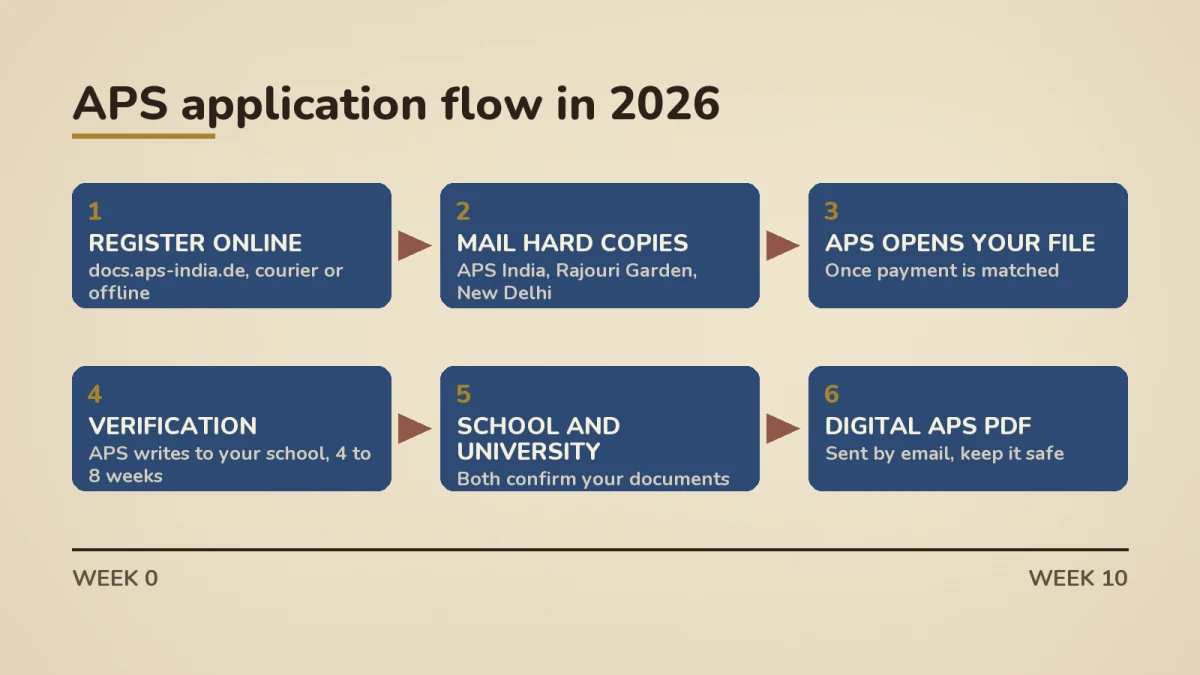
The procedural steps for the 2026 cycle.
- Pre-checks. Confirm your university is on anabin with H+ status (private) or that it is a publicly recognised university. Confirm your discipline is eligible (especially if distance education). Confirm your Class XII percentage if you are a Bachelor's applicant submitting after 15 March 2026.
- Decide your route. Studienkolleg subject-restricted, direct subject-restricted (after 1 academic year), or Master's. Submit only once the qualifications for that route are completed and documented.
- Register on aps-india.de. Fill the seven-step form, upload your photograph, and reach the payment step.
- Pay the fee. Two options: CCAvenue (online card or net banking, fee is reflected immediately and account is auto-activated) or offline bank transfer (you enter UTR details into the form, payment is matched manually within a couple of business days). The total verification fee changes occasionally; the current value is shown on the APS payment page.
- Mail hard copies by courier. Address: Gate No. 3, DLTA Complex, R.K. Khanna Stadium, 1 Africa Avenue, 110029 New Delhi, India. Include the signed authorisation letter from the Checklists section of the APS site, the signed application form, and the originals or attested copies of your documents per the checklist.
- Wait while APS verifies. APS writes to your school and university. APS India gives no fixed verification time; it depends on how fast your institutions respond.
- Receive your digital APS certificate by email. Save the PDF. Do not rename it. Do not modify it. Do not merge it. Use it as a standalone file in your university and visa applications.
If you want a shortlist before all of this, our APS eligibility quiz walks through the checks in 10 questions and tells you whether your profile fits one of the supported routes.
Common mistakes to avoid
A short list, all drawn from the APS news page and from years of student questions.
- Submitting too early. Do not register before completing the academic stage that determines your route. APS will not hold your file open for future results.
- Modifying the PDF. Do not rename, edit, crop, flatten, or merge the certificate. Any change breaks the signature and the file fails verification at the receiving end.
- Choosing a non-H+ private university and applying anyway. The status check on anabin takes two minutes. Do it before paying any application fee.
- Picking a distance education degree on the exclusion list. Medical, law, pharmacy, hotel management, M.Phil., Ph.D., and the other listed disciplines are not eligible through distance mode regardless of your university.
- Treating "signature validity unknown" as fatal. It is not fatal. The document remains legally valid under EU eIDAS if it was signed with a valid certificate at the time and was not modified afterwards.
- Sending email follow-ups to APS. APS does not respond to status queries. Send only what is essential. Repeated queries can trigger automated email blocks.
- Confusing aps-india.de with aps-india.com. The .com is an unrelated real estate site. The Academic Evaluation Centre lives at aps-india.de only.
Frequently asked questions
Do I still need APS if I have an admission letter from a German university?
Yes. The admission letter from the university and the APS certificate are two separate documents. The visa section at VFS and the German embassy will not process your student visa file without an APS Bescheinigung. The university itself usually requires APS during application or, at the latest, before enrolment.
My Class XII overall is 68%. Can I still apply for a Bachelor's in Germany under the new rules?
Not directly under the 70% rule that takes effect from 15 March 2026 for Winter Semester 2026/27 admissions. Two practical alternatives. Complete at least one successful academic year of an Indian Bachelor's at a recognised institution, then re-evaluate. Or apply to private German universities, which set their own admission criteria but still require an APS certificate. Talk to a counsellor about which fits your profile.
I submitted my APS application in February 2026. Do the new rules apply to me?
No. APS India's clarification is explicit: applications submitted before 15 March 2026 are evaluated under the criteria that were in force at the time of submission. The new criteria apply only to applications submitted from 15 March 2026 onwards.
My APS certificate from 2023 shows "signature validity unknown" in Adobe. Is it still valid?
Yes. The warning is a side-effect of the December 2025 deactivation of the older D-Trust seal cards. Under EU eIDAS, a qualified electronic seal stays valid if the certificate was valid at the time of signing and the document was not modified afterwards. Both conditions are independently verifiable in the signature details. German universities and the visa section have been informed. Do not request a new evaluation just to remove the warning.
Can I do a distance Bachelor's from India and use it for an APS certificate to apply for a Master's in Germany?
Yes, but only if both your university and the specific program are recognised by the Distance Education Bureau (DEB) for the entire duration of the course, and the discipline is not on the DEB exclusion list. Excluded disciplines include medical, law, pharmacy, architecture, hotel management, M.Phil., and Ph.D. If your distance Bachelor's is in computer science, business, or general engineering at a DEB-recognised university, APS will process it.
My Indian private university shows H+/- on anabin. What can I do?
You cannot get an APS certificate for a degree from an H+/- or H- institution under the rules in force since June 2024. There is no workaround at the APS level. Two options: complete a degree at an H+ recognised institution, or change pathway (for example a Master's after a recognised Bachelor's elsewhere).
How much does the APS certificate cost in 2026?
The verification fee is shown on the APS payment page during registration and changes occasionally. Most applicants pay through CCAvenue. CCAvenue charges its own service fees on top depending on payment method (for example a credit card surcharge); these are kept by CCAvenue and are not part of the APS fee. Always check the live amount on aps-india.de before paying.
Do I need a fresh APS certificate every time I apply somewhere?
No. The certificate is one digitally signed PDF. You can use the original file, unchanged, for multiple applications across universities, uni-assist, and the visa section. As long as the underlying qualifications have not changed, you do not need a new evaluation.
Where to go next
If your route is the Bachelor's pathway, our admission requirements for Bachelor's in Germany walks through the full process from APS to enrolment. If you are below the 70% Class XII threshold and want to understand the one-year-Bachelor option, the post on Bachelor's in Germany after one year of Bachelor's in India is the follow-up read. For Master's applicants worried about the H+ rule for private universities, the dedicated post on APS and Indian private university accreditation covers the anabin status check in detail.
Two tools to bookmark. The APS eligibility quiz is the fastest way to check whether your profile fits one of the supported routes. The German grade calculator converts Indian percentages and CGPAs to the German 1.0 to 4.0 scale, useful when you start shortlisting universities and reading their entry requirements. Our grade conversion explainer walks through the modified Bavarian formula step by step with Indian worked examples. If you also need to convert your Indian course credits to ECTS for your German application, our ECTS credits conversion guide covers the workload formula and where uni-assist applies it.
Continue reading
Document Preparation·9 min read
Ultimate Guide to Uni Assist for Studying in Germany
Discover how to use Uni Assist effectively for your application to study in Germany. This guide covers all you need to know about requirements, processes, and tips to simplify your application journey.
Read articleDocument Preparation·11 min read
Transcripts for Studying in Germany
Explore the essential steps for acquiring and submitting transcripts for studying in Germany to ensure a smooth application process with our detailed guide.
Read articleDocument Preparation·9 min read
Documents Required for Bachelor's in Germany : A Detailed Checklist
Learn about application forms, educational certificates, and other key documents required for Bachelor’s in Germany in this step-by-step guide.
Read articleReady to plan your Germany journey?
Explore our tools and resources to find the perfect university and program for your academic goals.