TestAS 2026: Every test date, what each section asks, how to prep in 6 weeks
TestAS 2026 test dates, what each section asks, and a six-week prep plan that actually fits an applicant's calendar. Confirmed sittings, costs, format choice.

Table of contents
Last updated: May 2026
TL;DR: TestAS 2026 runs in two formats (digital, 3.5 hours; paper-based, 4.5 hours) and tests two things: a Core Module of general cognitive tasks, and one Subject Module in your field. Confirmed 2026 sittings include 19 March (digital), 25 April (paper), 9 June (digital), 24 October (paper), and 26 November. Most candidates can prep in six focused weeks.
If you are applying to a German Bachelor's programme as an international student, TestAS is one of the few admission instruments that lets you compensate for a lower school GPA. Many universities of applied sciences now expect it, and a strong Core Module result moves your application up the stack. This guide walks through what the test is, every confirmed 2026 sitting, what each section actually asks of you, and a six-week prep plan that works for most candidates. For broader admission context, see our Bachelor's admission requirements guide and the parent study in Germany pillar.
What TestAS is and what it is not
TestAS is the standardised aptitude test for international applicants to German Bachelor's programmes, run by g.a.s.t. (Gesellschaft für Akademische Studienvorbereitung und Testentwicklung). It is not a language test. It is a cognitive test that measures general academic ability plus subject-specific reasoning, scored on a single scale that German universities can compare across schooling systems.
You can sit it in English or German (the test only assumes A2 to B2 level in your chosen language). It is not mandatory at every university, but it is required or strongly recommended at many universities of applied sciences and some research universities. A good score (above the 80th to 90th percentile) is one of the few things that can offset a weaker school transcript when you apply via uni-assist or directly. There is no age limit, and you can retake it as many times as you want, though g.a.s.t. notes that improvement on retakes is usually small because the test measures abilities that do not respond to short-term cramming.
For a wider picture of admission tests at the Bachelor's stage, see our entrance exams for Bachelor's programmes guide.
TestAS 2026 test dates and registration deadlines
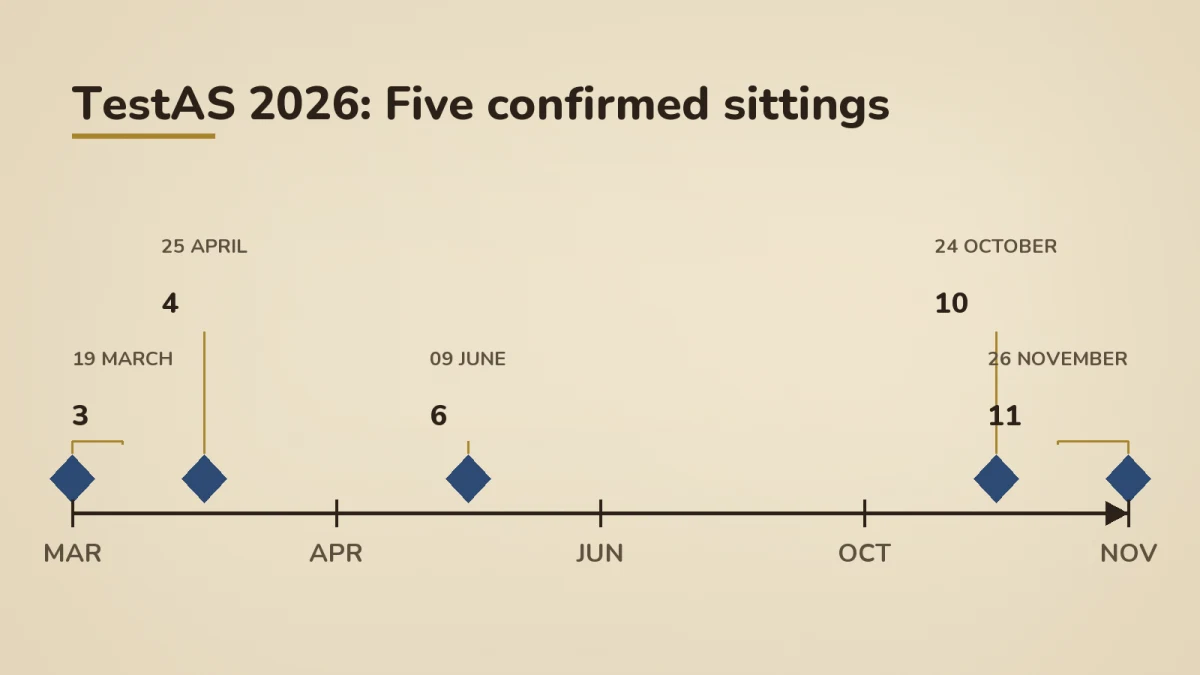
Five 2026 sittings are confirmed at the time of writing. Register through your account at account.gast.de; the registration window typically closes about 5 weeks before each sitting.
| Test date | Format | Registration window | Late registration |
|---|---|---|---|
| 19 March 2026 | Digital | 05 Jan 2026 to 07 March 2026 | by 13 March 2026 |
| 25 April 2026 | Paper-based | 05 Jan 2026 to 13 March 2026 | by 27 March 2026 |
| 9 June 2026 | Digital | 05 Jan 2026 to 29 May 2026 | by 30 June 2026 |
| 24 October 2026 | Paper-based | 05 Jan 2026 to 18 September 2026 | by 02 October 2026 |
| 26 November 2026 | Digital | open via account portal | check portal for cut-off |
Fees are set in three country groups by g.a.s.t.; the exact figure for your country is shown when you register through the portal. Late registration carries a surcharge. Aim for the regular window: late slots fill quickly at popular test centres in India, Vietnam, Iran, and Egypt.
What each section asks of you
The test has two parts, regardless of format: a Core Module (called Core Test in the paper version) plus one Subject Module. You pick the Subject Module that matches your intended degree.
Core Module (digital): roughly 90 minutes
Three subtests, 25 minutes each, 20 items per subtest:
- Figure Sequences. You see a series of image matrices where shapes change position, colour, or alignment by a hidden rule. Your job is to continue the pattern. This rewards visual pattern recognition and short-term working memory.
- Mathematical Equations. You solve systems of equations where each letter takes a value from 1 to 20. There is exactly one solution that fits all constraints. Arithmetic is light, but constraint-tracking is heavy.
- Latin Squares. A 5x5 grid contains some letters from A to E. Each letter appears exactly once per row and per column. You decide which letter belongs where the question mark is. Sometimes you have to fill nearby cells in your head first.
Core Test (paper-based): 110 minutes
Four task groups, 22 items each: Solving Quantitative Problems, Inferring Relationships, Completing Patterns, and Continuing Numerical Series. Same skills as the digital format, slightly different question shapes. Both formats are scored on the same scale, so universities treat the two as equivalent.
Subject Module: 90 minutes (digital) or 145 minutes (paper)
You choose one of these, based on your intended field:
| Subject Module | Available in |
|---|---|
| Humanities, Cultural Studies and Social Sciences | both formats |
| Engineering | both formats |
| Mathematics, Computer Science and Natural Sciences | both formats |
| Economics | both formats |
| Life Sciences | digital only |
| Medicine | digital only |
The Subject Module is built around testlets: each testlet uses a short text, table, or diagram from your field, and asks 4 to 8 questions about it. You are not expected to know technical vocabulary in advance; you are expected to think the way that field thinks. For Engineering and Math/CS that means reading formulas and diagrams quickly. For Humanities it means following an unfamiliar argument. For Medicine and Life Sciences it means staying oriented in dense terminology.
Digital or paper-based: which to pick
Both formats are scored on the same scale, so the choice is about logistics, not ranking. Pick digital if your test centre offers it, you want a shorter day (3.5 vs 4.5 hours), or you intend to apply to a Bachelor's in Medicine or Life Sciences (those subjects only exist in the digital format). Pick paper-based if your nearest centre only offers paper, or you prefer to scribble on a working sheet during the test (paper allows note-taking on a provided concept sheet; the digital format does not).
A six-week prep plan
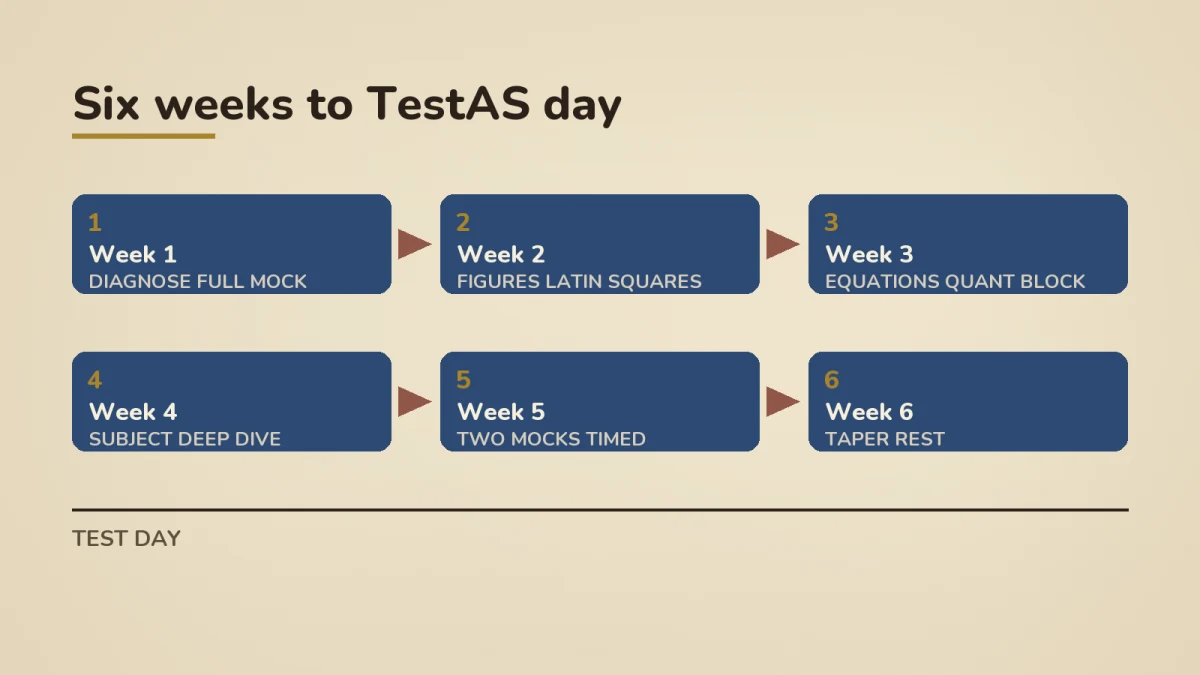
You do not need months. Most candidates with a solid school maths background and basic English or German reading can hit a competitive percentile in six focused weeks of about 10 to 12 hours per week.
Week 1: diagnostic and orientation. Take a full digital practice test from the official preparation materials (g.a.s.t. publishes a free PDF and a demo version inside the participant portal once you register). Score yourself, then read through the section instructions and worked examples. No drilling yet. Goal: know the rules cold.
Week 2: Figure Sequences and Latin Squares. These two together account for roughly half your Core Module score and reward repetition. Do 30 to 40 items a day from the official materials and at least one paid prep set (jobtestprep.de and edulink both publish full pools). Time yourself. Anything past 75 seconds per item gets reviewed.
Week 3: Mathematical Equations and quantitative items. Build a small library of system-of-equations solving heuristics: substitution, elimination, range constraints. Do 25 items a day. Add one timed full Core block at week's end to track pace.
Week 4: Subject Module deep dive. Switch to your chosen module. Read three or four testlets a day, mark every question you got wrong, and write one sentence on why you missed it. The point is not to learn new content; it is to learn how that field expects you to read.
Week 5: full mocks under timed conditions. Two full mocks this week (one Core, one full test including Subject). Use the official demo, not third-party simulators. Review every error.
Week 6: taper and logistics. Two short sessions of 60 minutes each, then stop. Confirm your test centre, ID requirements, and arrival time. Sleep is worth more than one extra prep block in the final 48 hours.
For candidates routing through a Studienkolleg first, our Studienkolleg guide explains how TestAS results feed into that pathway.
Common mistakes to avoid
- Confusing TestAS with a language test. It is not. Take TestDaF, DSH, or IELTS separately for language proof.
- Picking the wrong Subject Module. A Mechanical Engineering applicant who sits the Math/CS module instead of the Engineering module gets a valid score but one that does not match the programme's profile. Universities notice.
- Cramming the day before. TestAS measures pattern recognition and working memory under time pressure. A tired brain underperforms on every subtest.
- Skipping the demo. The digital format has a specific click-and-confirm flow that is faster once you have practiced it. Five minutes inside the participant-portal demo saves real points on test day.
- Late registration as a default. It costs more and gives you fewer test centre options. Register inside the regular window.
FAQ
Is TestAS mandatory for every German Bachelor's programme?
No. Some research universities accept your school transcript and language proof alone. Many universities of applied sciences and a growing number of competitive Bachelor's programmes now require it or strongly recommend it. Check the programme page on the university's website or the uni-assist VPD requirements for your application.
What is a good TestAS score?
Scores are reported on a standardised scale and as a percentile. A Core Module result above the 80th percentile is competitive; above the 90th is strong. Subject Module percentiles matter most for that programme's admission committee. There is no single pass mark; it depends on the programme.
Can I take TestAS in English?
Yes. You choose English or German at registration. The test only assumes A2 to B2 level in your chosen language, so English-medium candidates do not need fluent German to take it.
How long are TestAS results valid?
There is no expiry on the certificate itself, but most universities prefer scores from within the past two years. If your score is older than that, retake it before applying.
Can I retake TestAS?
Yes, as often as you want. There is no cap. g.a.s.t. notes that the test measures abilities that do not respond to short-term cramming, so improvement on retakes is usually modest. Use a retake only if you are confident your prep gap was real.
Does TestAS replace the APS certificate for Indian, Chinese, or Vietnamese applicants?
No. APS verification is a separate, mandatory document for those nationalities applying to most German programmes. TestAS supplements your application, but APS is the authenticity gate. See our APS certificate guide for Indian students for that workflow.
Where to next
Continue reading
Entrance Exams·13 min read
The Role of TestAS in Pursuing a Bachelor's Degree in Germany
Discover how the TestAS exam can boost your chances of securing a Bachelor's degree in Germany. Learn about the benefits and its significance, and get top preparation tips.
Read articleEntrance Exams·14 min read
GRE for Master's in Germany: Eligibility, Format, Fees
Confused about taking GRE for Master’s in Germany? Our comprehensive guide covers everything you need to know about the GRE test format, preparation, timeline, cost, and more.
Read articleEntrance Exams·14 min read
Entrance Exams for Studying in Germany: A Comprehensive Guide
Essential entrance exams for studying in Germany: IELTS, TOEFL, GRE, GMAT, and German proficiency tests. Tips to ace them and unlock your dream MS!
Read articleReady to plan your Germany journey?
Explore our tools and resources to find the perfect university and program for your academic goals.