Sending money from India to Germany: Wise vs Remitly vs SBI vs bank transfer
Cheapest, fastest way to send money from India to Germany in 2026. Wise vs Remitly vs SBI Flywire vs bank SWIFT, with LRS and TCS rules.

Table of contents
Last updated: May 2026
TL;DR: Wise is the cheapest option for everyday transfers from an Indian bank account to a German one. Total cost lands around 0.5 to 0.8 percent of the amount sent, with the recipient getting EUR within hours. SBI and HDFC SWIFT wires are slower and pricier (2 to 4 percent all-in) but make sense when you need a stamped Form A2 trail or are paying tuition through SBI's Flywire tie-up. Remitly works for occasional small transfers, especially the first one, where the promo rate beats Wise.
You arrive in Germany with a short list of money problems. Topping up your blocked account, paying first-month rent, sending pocket money home if you took a part-time job, or in the other direction, parents wiring living costs from India after the blocked account drains. Every one of those flows asks the same question. What is the cheapest, fastest, legal way to move INR into a German account?
The honest answer for 2026 is that Wise wins for almost every retail use case under EUR 25,000. RBI's LRS limit of USD 250,000 per financial year sits comfortably above what any student needs, and TCS only kicks in if you self-fund and cross ₹10 lakh in a year. The expensive options exist because of paperwork, not value. This guide is one piece of your finances setup in Germany, which also covers SCHUFA, Anmeldung-linked banking, and tax. For arrival-day budgeting, see tips to manage finances in Germany and the cost of living guide for international students.
What is the cheapest way to send money from India to Germany in 2026?
For everyday amounts (EUR 200 to EUR 5,000), Wise is cheapest end-to-end. You pay roughly ₹1,250 to ₹1,650 on a 80,000 INR send, and Wise applies the mid-market INR/EUR rate with no hidden FX markup. That works out to 1.5 to 2 percent on a small transfer and drops below 1 percent above ₹2 lakh. Wise advertises 74 percent of transfers arriving in under 20 seconds and 95 percent within a day. In real-world testing, IMPS-funded sends to a German Sparkasse or N26 account credit in 2 to 6 hours during banking hours.
For larger amounts (EUR 5,000+) SBI's Flywire tie-up can match or beat Wise on FX, especially when paying a German university directly, because Flywire publishes university-specific corridor rates within 0.3 percent of mid-market. The catch is that Flywire is for institutional payments, not for sending money to a personal German account.
Bank wire through your branch (SBI, HDFC, ICICI SWIFT) is the most expensive and slowest. Expect ₹500 to ₹1,500 in branch fees, plus a 1 to 3 percent FX markup, plus correspondent bank charges deducted from the recipient amount. Use it only when your provider asks for a stamped Form A2 that an online service cannot produce.
Remitly competes with Wise on small first-time transfers, where the promo rate is genuinely good, but on the second transfer onwards it usually loses to Wise on the all-in cost.
Comparing the four methods on cost, speed, and limits
| Method | Typical fee on EUR 1,000 | FX markup | Speed | LRS applies | Best for |
|---|---|---|---|---|---|
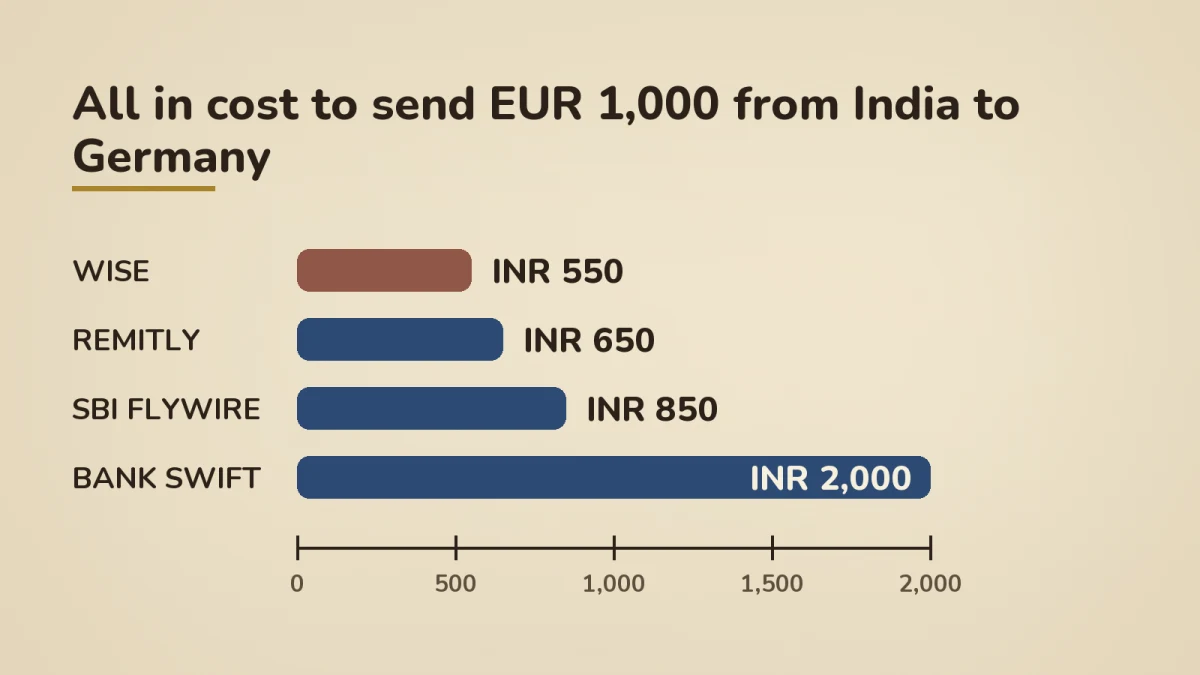
| Wise | ₹450 to ₹650 (~0.5 to 0.7%) | 0% (mid-market) | Hours, often minutes | Yes | Rent, blocked account top-ups, family transfers |
| Remitly | ₹400 to ₹700, first transfer often free | 0.3 to 0.8% | Minutes to 2 days | Yes | One-off small sends, first-transfer promo |
| SBI Flywire | ₹600 to ₹900 + GST | 0.2 to 0.5% | 1 to 3 working days | Yes | University tuition direct to the institution |
| SBI / HDFC / ICICI direct SWIFT | ₹500 to ₹1,500 + correspondent fee | 1 to 3% | 2 to 5 working days | Yes | Stamped Form A2 needs, very large one-off transfers |
The "fee on EUR 1,000" column is the all-in cost, including FX markup translated to rupees, not just the upfront ticket charge.
Wise is a UK-headquartered, listed money services business (LSE: WISE) operating in India under RBI authorisation. You fund in INR via UPI, IMPS, or NEFT, Wise converts at the live mid-market rate, and the recipient receives EUR through a domestic SEPA credit. There is no correspondent bank in the chain. Per-transfer cap is around ₹15 lakh. Cumulative cap follows your LRS limit.
Remitly is a US-based, NASDAQ-listed (RELY) remittance specialist that operates the EUR-to-INR corridor at scale and the reverse INR-to-EUR direction at lower volumes. The first transfer is typically promo-priced. After that, economics are similar to Wise but slightly worse on FX.
SBI Flywire is the State Bank of India's tie-up (signed May 2023) for same-day or next-day international tuition payments. The recipient is the German university's Flywire-managed account, not a personal account. Useful for tuition at private universities or language schools where the bill is substantial.
Direct bank wire is the legacy route. You walk into your branch (or open the bank's online forex portal), fill Form A2, attach a purpose code (S0305 maintenance, S0301 education), and the bank executes a SWIFT MT103. Total cost is the highest of the four. The only reason to choose this in 2026 is when a loan disburser, scholarship body, or apostille filing demands a stamped paper Form A2.
RBI LRS rules: how much you can send, and the TCS angle
The Liberalised Remittance Scheme (LRS) lets every resident Indian (including minors) send up to USD 250,000 per financial year abroad for permitted current and capital account transactions. The April-to-March cycle resets the limit. If education costs exceed USD 250,000, both parents can use their individual limits, taking the family ceiling to USD 500,000.
What changed from 1 April 2025 and 1 April 2026 (current rules in 2026):
- TCS threshold raised from ₹7 lakh to ₹10 lakh per financial year on most LRS heads.
- Education funded by a bank or NBFC education loan: 0 percent TCS (down from 0.5 percent).
- Self-funded education above ₹10 lakh: 2 percent TCS on the amount above the threshold.
- Other LRS purposes (apart from education, medical treatment and tour packages) above ₹10 lakh: 20 percent TCS.
TCS is a tax collected at source. It is not a cost. You claim it back as a credit when filing your ITR. The cash-flow hit is real, though, so plan for it on large wires. Wise and Remitly do not deduct TCS on your behalf; SBI does, and issues Form 27D as proof.
Step-by-step: how to send money
The three retail flows are nearly identical from a user standpoint. Differences are in upload requirements and where you reconcile TCS.
Wise (recommended default). Open a Wise account using PAN, Aadhaar, and a selfie. In the app, choose "Send money", select INR as source and EUR as destination, enter the amount. Wise shows the locked rate, fee, and recipient amount before you confirm. Add the German recipient using IBAN and BIC (if you do not have a German account yet, the best German bank accounts for expats in 2026 post compares Sparkasse, N26, DKB, and the major options on monthly fees and English support). Fund through UPI (under ₹1 lakh) or IMPS/NEFT (above). Recipient gets EUR via SEPA, usually in 2 to 6 hours during business hours. Save the PDF receipt. It is your remittance proof for any later TCS or ITR Schedule FA reconciliation.
Remitly. Sign up using PAN and Aadhaar; verification mirrors Wise. Choose Express (faster, higher fee) or Economy (slower, cheaper or free). Enter the recipient's IBAN. Fund via UPI or net banking. Express usually credits within an hour, Economy in 2 to 5 days.
SBI direct outward remittance. Log in to SBI Online Forex (or visit a branch with NRI/forex desk). Fill Form A2 with the purpose code, attach KYC documents and the recipient's SWIFT details. SBI quotes a rate including its 1 to 2 percent markup. Approve the debit. SBI sends a SWIFT MT103, deducts TCS if applicable, and issues Form 27D for self-funded education above ₹10 lakh. Funds typically arrive in 2 to 5 working days. The receiving German bank may deduct EUR 8 to EUR 25 as an inward credit fee.
SBI Flywire (university tuition). From the German university's payment portal, choose "International payment via Flywire" if available. Flywire generates a payment instruction. Pay through SBI NEFT or RTGS to the Flywire collection account. Flywire credits the university in 1 to 3 working days.
Common mistakes and how to avoid them
- Funding Wise with a credit card. The card issuer treats it as a cash advance and charges 2.5 to 3.5 percent plus interest from day one. Use UPI, IMPS, or net banking debit.
- Splitting one education payment across multiple transfers to dodge the ₹10 lakh TCS threshold. The threshold is annual and per remitter, not per transfer. The bank's reporting catches it at year-end and you owe TCS plus interest.
- Forgetting Schedule FA in your ITR. Any foreign account you hold, including a Wise EUR balance kept for more than a few days, must be declared if you are still a resident Indian. Penalty for non-disclosure is severe.
- Routing through a relative's LRS limit. That looks like benami and is reportable. Use your own limit; both parents can stack legally.
- Picking Express on every Remitly send. Economy is free or near-free for non-urgent rent and arrives within the same week.
- Wiring through your branch when no Form A2 is needed. Branch wires cost 3 to 5 percent all-in for no marginal benefit over Wise.
Which provider to pick when
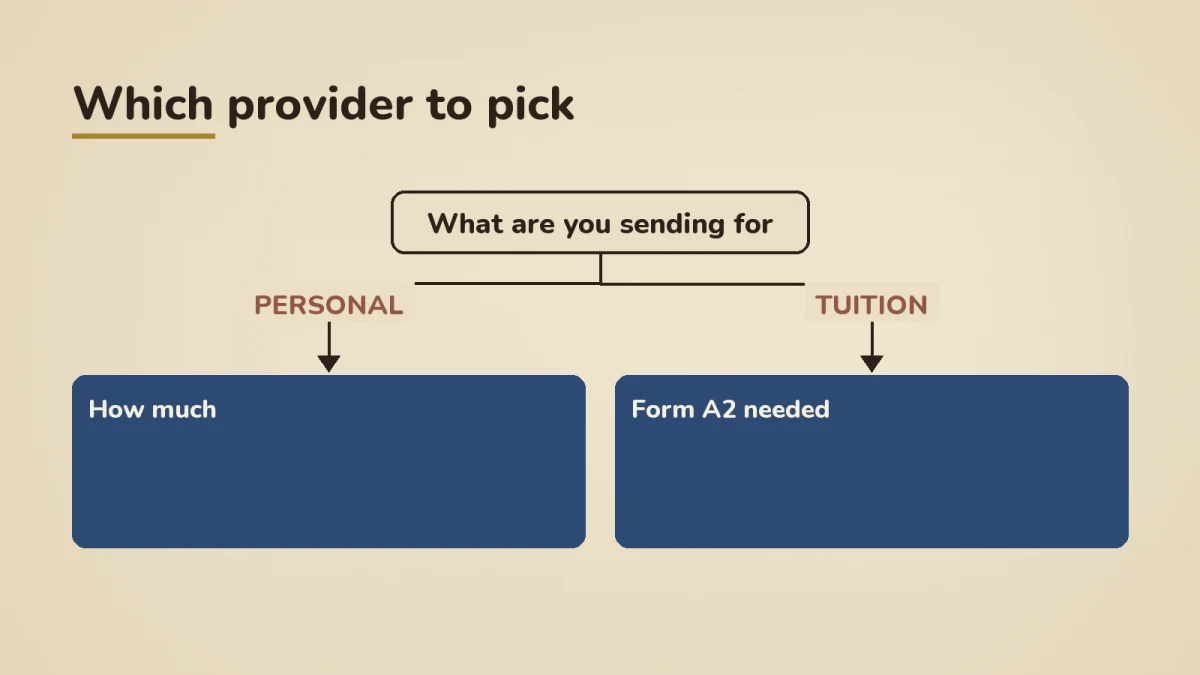
A short decision rule for 2026:
- Under EUR 5,000 to your own German account: Wise.
- First transfer ever, under EUR 1,500: Remitly (the promo rate beats Wise once).
- Paying a German university directly: Flywire if accepted; otherwise SBI direct SWIFT with Form A2.
- Single transaction above EUR 25,000: Split across two Wise sends, or use SBI direct SWIFT if the recipient bank requires a wire-style MT103.
- Stamped paper Form A2 needed (loan disburser, scholarship body, apostille filing): SBI or HDFC direct SWIFT.
- Sending money the other way (Germany to India): Wise still wins. Remitly's EUR-to-INR side is competitive on small sends.
FAQ
How much does it cost to send EUR 1,000 from India to Germany using Wise in 2026?
About ₹450 to ₹650 in total, including Wise's flat fee. Wise applies the mid-market INR/EUR rate with no FX markup, so the cost is the visible fee in the app. The recipient gets very close to the full ₹1,000 worth of euros at the live rate.
Is Wise legal in India for sending money abroad?
Yes. Wise operates under RBI authorisation and reports outward remittances under the LRS. Every transfer counts toward your USD 250,000 annual limit. You receive a transfer receipt and can reconcile it on your ITR Schedule FA.
Do I have to pay TCS on every transfer to Germany?
No. TCS only applies once your cumulative LRS remittances cross ₹10 lakh in a financial year (April to March). Education funded by a sanctioned education loan is exempt at 0 percent. Self-funded education above ₹10 lakh attracts 2 percent. Other purposes (apart from education, medical treatment and tour packages) above ₹10 lakh attract 20 percent. TCS is not a cost; you claim it back at ITR filing.
What is the fastest way to top up my blocked account from India?
A Wise transfer funded via IMPS or UPI typically credits the German blocked-account provider's bank within the same day. Expatrio and Fintiba both accept SEPA credits, and most blocked-account holders see the EUR balance reflect within 24 hours.
Can I use Google Pay or PhonePe to send money to Germany?
Not directly. Indian UPI does not yet support outward cross-border push payments to a German IBAN. UPI works as the funding leg of a Wise or Remitly transfer (you pay them in INR via UPI, they push EUR via SEPA), but a direct Google Pay to German IBAN is not yet possible in 2026.
Does the recipient need to declare the money in Germany?
For students and expats with a residence permit, regular incoming family transfers within typical living-cost amounts are not separately taxable as "income" in Germany. They are gifts or maintenance. Keep your remittance receipts in case the Finanzamt asks during a tax-year audit, especially if any single transfer is over EUR 20,000.
Where to next
- How to manage finances in Germany for budgeting after you have moved
- Cost of living guide for international students for what your euros need to cover
- Blocked account activation when studying in Germany if your first transfer is the deposit
- Education loan options for Master's in Germany for loan-funded zero-TCS routes
- The /live/finances pillar for the full money map of life in Germany
Continue reading
Financial Planning·8 min read
Outward Remittance for Germany, A Complete Overview
Discover everything you need to know about outward remittance for Germany. Learn about the process, regulations, and tips for making secure and efficient money transfers.
Read articleFinancial Planning·8 min read
BAföG for international students in Germany 2026: Who qualifies, how much, and the start-up grant
BAföG eligibility for international students in 2026: residence-permit rules, monthly rates around EUR 992, the EUR 1,000 Studienstarthilfe, and how to apply.
Read articleFinancial Planning·8 min read
Tuition fees for Bachelor's in Germany
Find out all you need to know about tuition fees for Bachelor's in Germany! This guide covers everything from free public university options to living costs and financial aid tips.
Read articleReady to plan your Germany journey?
Explore our tools and resources to find the perfect university and program for your academic goals.