
On this page
What work you can get in Germany after an MBA
The permit you get on graduation day, the salary bar that unlocks the good residence status, and the honest version of what a German MBA is worth.

At a glance
Finish an MBA at a German university and you can apply for a residence permit of up to 18 months to look for a job, and you may work during that time. The permit that matters after that is the EU Blue Card, which needs a gross salary of 50,700 EUR a year, or 45,934.20 EUR if your degree is less than three years old or your job is on the shortage occupation list. Both figures are the 2026 values and both reset every January.
- Blue Card salary, recent graduate
- 45,934.20 EUR
- Blue Card validity
- Four years as a rule
- MBA programs in our catalogue
- 131
- MBA programs that charge tuition
- 122 of 131
- Sources checked
- 27 July 2026
The 18 months you get for finishing the degree in Germany
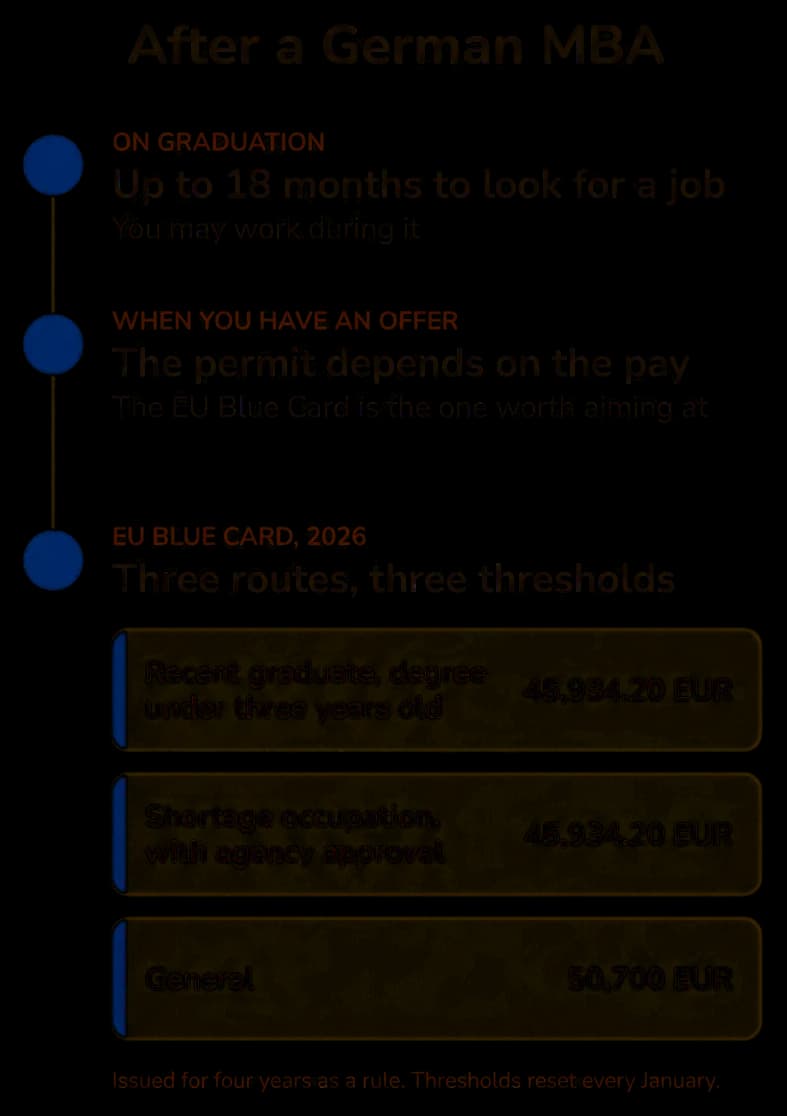
This is the single biggest advantage of doing the MBA in Germany rather than applying to German jobs from abroad. The law gives graduates of German universities a dedicated window to find work.
Per the Federal Office for Migration and Refugees, checked 27 July 2026:
you will receive a residence permit for up to 18 months to look for a job if you can prove that your livelihood is ensured during this period. You may work during this period.
The legal basis is Section 20 of the Residence Act, checked the same day, which sets the permit at up to 18 months for someone who has successfully completed studies in Germany.
Three practical points sit inside that.
- You must show you can support yourself for those months. The permit is not automatic. Budget for it while you are still studying.
- You may work while you search. That is what makes 18 months usable rather than 18 months of burning savings.
- The clock starts when you graduate, not when you start looking. Most people who run out of time started applying in month nine. Start in the semester before you finish.
Applying to German jobs from outside Germany without this permit is a much harder route, because the employer has to be willing to sponsor a visa before they have met you in person.
The salary bar that decides your residence status
Once you have an offer, the residence permit you get depends mostly on what it pays. For an MBA graduate the target is the EU Blue Card, because it leads to permanent residence faster than an ordinary work permit and it moves with you across the EU.
| Route | Minimum salary | Who it applies to |
|---|---|---|
| General | 50,700 EUR | Any qualified job with a recognised degree |
| Recent graduate | 45,934.20 EUR | Degree completed within the last three years |
| Shortage occupation | 45,934.20 EUR | Job on the shortage list, with Federal Employment Agency approval |
These are the 2026 figures published on the Federal Government’s Make it in Germany portal, checked 27 July 2026. They are recalculated every January against the pension insurance contribution ceiling, so confirm the current number before you negotiate. The BAMF page on the EU Blue Card, checked the same day, states that the card is issued for four years as a matter of principle.
The recent graduate rule is the part worth planning around. For three years after your MBA, the bar you have to clear is about 4,800 EUR lower. That is the difference between an offer that gets you a Blue Card and one that does not, and it expires. Our Blue Card eligibility check works out which threshold applies to you, and our Blue Card and Opportunity Card comparison covers the alternative if your offer sits below the bar.
One warning on the shortage occupation route: the reduced threshold there needs approval from the Federal Employment Agency, and it applies to the job, not to you. Do not assume your role qualifies because your field sounds like a shortage area. Check the published list.
What a German MBA is actually good for
Here is the part that most pages about this skip, and it changes whether the degree is worth the money.
Germany is not the United States on MBA hiring. There is no equivalent of the American on-campus recruiting season where consulting firms and banks hire an entire class at a fixed salary band. German companies recruit by function and by sector, and an MBA is treated as one qualification among several rather than an automatic route into management.
What the degree does do well:
- It converts a technical career into a commercial one. Engineers moving to product, operations or business development are the clearest case, because the German industrial base actually needs that combination.
- It gets you into the country with a legal path to stay. The 18-month permit plus the recent-graduate Blue Card threshold is a real advantage over applying from abroad.
- It gives you a German network and German references. For an employer weighing two similar CVs, one of them having worked and studied locally is a real difference.
What it does not do:
- It does not replace German for management roles. An English-only MBA graduate competes well in engineering, IT, research and international functions at large firms. General management, sales, HR, public sector and the Mittelstand, which is where most German employment sits, run in German. If your plan is to lead teams in Germany, treat German as part of the degree, not as an optional extra.
- It does not carry a fixed salary outcome. Pay depends on sector, city and role. Be sceptical of any page quoting an average MBA salary in Germany without naming the survey and the year, including this one. We are not quoting one, because we do not have a source we would stand behind.
Where the jobs actually are
The employers that hire MBA profiles sit in a handful of sectors and cities, and they are mostly not in Berlin, where the programs cluster. Automotive and industrial companies, BMW, Volkswagen, Mercedes-Benz Group, Siemens and Bosch among them, hire for product, operations and business development around Munich and Stuttgart. Finance concentrates in Frankfurt, where Deutsche Bank and Commerzbank are headquartered. SAP anchors enterprise software near Heidelberg, and Bayer and Merck carry pharma and chemicals. Berlin’s market is startups and tech, Hamburg’s is logistics and media, Düsseldorf’s is consulting and consumer goods. Pick your city for the sector you want, not for where the course was.
How to actually search
Germany has no single MBA hiring pipeline, so use the boards Germans use: the Federal Employment Agency’s Jobbörse, the EU-wide EURES portal, StepStone, LinkedIn and XING. The channels that convert best for international graduates are the ones that create a German reference before the full-time search: a working-student role or internship during the degree, your university’s career service and alumni network, and sector career fairs. Treat the 18 months as time to be converted into one of those, not just time to send applications.
Our career prospects guide goes deeper on which sectors hire international graduates.
The cost, and the comparison nobody makes
Our catalogue holds 131 MBA programs across 77 German universities, counting programs recorded at MBA degree level or with MBA in the program name. Here is the money reality.
| Group | Programs | Charge no tuition | Share that is free |
|---|---|---|---|
| MBA programs | 131 | 9 | 7% |
| All Master’s programs | 2,655 | 1,694 | 64% |
That gap is the decision. Germany’s free education applies to most Master’s degrees but almost never to an MBA. 114 of the 131 MBA programs charge more than 1,500 EUR per semester and only 9 are free. Meanwhile 1,694 specialist Master’s programs cost nothing in tuition at all.
So the honest question before you enrol is not "MBA in Germany or MBA elsewhere". It is "MBA or a specialist Master’s". A free MSc in your technical field gets you the same 18-month job search permit, the same recent-graduate Blue Card threshold, and the same right to stay, at a fraction of the cost. The MBA earns its price when you specifically need the management credential and you already have the work experience to use it.
Other facts from the catalogue that shape the choice:
- 115 of the 131 MBA programs are taught in English, so language is not a barrier to admission. It is a barrier to the job afterwards, which is a different problem.
- 46 MBA programs take a summer intake and 104 take a winter intake, so you are not locked to October.
- 35 require an APS certificate at the point of application, which for Indian applicants is the step that sets your real start date.
- Programs cluster in Berlin, which holds 32 of the 131. Bremen has 7, Cologne and Hamburg 6 each, Frankfurt 4. That is where the courses are, which is not the same as where the jobs are.
Compare specific programs and fees in our course catalogue, and see the full tuition picture in our Master’s tuition guide.
Where these facts come from
Immigration rules are quoted from BAMF, the Residence Act and the Federal Government’s Make it in Germany portal, each checked on 27 July 2026. Salary thresholds are the 2026 values and are recalculated every January. Program counts are from our own catalogue of active, published Master’s programs, queried on 27 July 2026.
Related tool
Blue Card eligibility check
Which threshold applies to you
Next steps
Frequently asked questions
Ready to plan your Germany journey?
Create a free account to save courses, track deadlines and see your next step.