Applying for a Master's in Germany? There's a New Test You Can't Skip
From the Summer 2027 intake, engineering, commerce and business graduates must clear a new test, the dMAT, inside APS before they can apply. Here is who it hits, the 150 EUR fee, the dates, and what to do.

Table of contents
If you are planning a Master's in Germany from India for the Summer 2027 intake or later, there is a new step you cannot skip: the Digital Master Test, or dMAT. APS India has added it as a mandatory part of the APS process for certain applicants, and if it applies to you, your APS is not complete without it. APS India issues your APS certificate only after the required dMAT certificate is in, so this matters before you do anything else.
The first test date was 26 September 2026 (registration closed 15 September 2026). APS India and g.a.s.t. have not yet published a next date, so check aps-india.de/dmat and d-mat.de for new dates. Here is the full picture, from the official APS India and g.a.s.t. sources, with none of the panic: who is affected, the fee, the dates, how to register, and what to do. And since first publishing this guide, our counseling team has completed a real dMAT registration for one of our students, start to finish. The registration walkthrough below is first-hand, from that live registration.
You can practice for the dMAT free, today
You can try real dMAT questions now. The full free practice area includes:
- 2 full mock tests, with 86 questions each
- The official timing and order, including a General Academic Module
- Unlimited Core practice
- Instant explanations after every answer
Start the free practice test, or see the complete dMAT guide and test format.
The short version:
- What it is: the Digital Master Test (dMAT), a computer-based academic aptitude test, now a required part of APS documentation for some applicants.
- Who must take it: Indian applicants going through APS, with an Engineering, Commerce, Finance, Economics, Business or Management degree, applying for a Master's for Summer 2027 or later.
- When: register by 15 September 2026, test on 26 September 2026, certificate on 12 October 2026.
- Fee: 150 EUR, paid to g.a.s.t., on top of the normal APS fee.
- What it is not: not a pass or fail test, and it does not replace anabin, TestAS, or your document check.
Please read this first. This guide is for general information only. It is based on official APS India and g.a.s.t. sources as of 18 July 2026, plus a real dMAT registration our team completed in July 2026. The dMAT is a newly introduced procedure, and details such as dates, fees and affected fields may still change. Always confirm the latest on the official APS India (aps-india.de) and g.a.s.t. (d-mat.de) websites before you act. This is not official immigration, legal or admissions advice.
What is the dMAT, and the name mix-up to avoid
You may have seen this called the "Digital Mathematics Aptitude Test." That name is wrong, and it is worth fixing in your head straight away.
The official name is the Digital Master Test (dMAT). It is not a maths exam. It is a general academic aptitude test, run by g.a.s.t., the German non-profit behind TestDaF and TestAS, and originally supported by the DAAD. The test format was developed with the Universities of Ulm and Kassel. APS India still runs your document check as part of the normal APS process. g.a.s.t. runs the test and issues a separate dMAT certificate that then sits inside your APS file.
Do you have to take the dMAT?
The affected fields
The dMAT is mandatory only if all three of these are true:
- You are applying through APS in India, and
- Your bachelor's degree is in one of these fields:
- Engineering
- Commerce, Accounting, Finance or Economics
- Business or Management
- You are applying for a Master's for the Summer 2027 intake or any intake after that.
If that is you, you take the dMAT with the General Academic Module, and the certificate goes in with your APS documents.
Not sure if the dMAT applies to you? Run the free dMAT eligibility check and get a clear answer for your exact degree in about two minutes.
The part most people get wrong
APS India has published an official list of affected degree fields, and the rule is simple but strict: the exact title on your degree certificate decides it, not the everyday name of your course. This catches a lot of people out, especially in computing.
| Covered (Engineering-titled degrees) | Not automatically covered |
|---|---|
| Computer Science and Engineering (CSE), Computer Engineering | Standalone Computer Science (B.Sc), BCA, B.Sc Information Technology |
| Information Science and Engineering, IT and Engineering | Data Science, Artificial Intelligence, AI and Machine Learning, Cyber Security |
| Mechanical, Civil, Electrical, Electronics and Communication, Chemical | Architecture, Pharmacy, Law, Education, Humanities, Social Sciences |
| Commerce, B.Com, Economics, Business, BBA, BMS | Nursing, Physiotherapy and other health sciences, most pure sciences |
Economics is the one social-science exception, it is covered. Some titles also need a case-by-case check: mixed or sector names like Engineering Management, Industrial Engineering and Management, Business Analytics, and "Management" degrees in Hotel, Hospitality, Tourism, Aviation or Healthcare. The word "Management" on its own does not decide it.
Quick rule of thumb: if your certificate literally says Engineering, Commerce, B.Com, Economics, Business, Management, BBA or BMS, assume you are in. If you did standalone CS, IT, BCA, Data Science or AI, you are probably not, but check the official list and confirm with APS before you decide.
Who is exempt from the dMAT
You do not need the dMAT if you are:
- Applying for a Bachelor's (any field)
- A bachelor student who has not yet finished at least 5 semesters (in a 3-year degree) or 7 semesters (in a 4-year degree)
- A PhD applicant
- In a field outside the three groups above
- In an officially confirmed exchange, double-degree or university-partnership program (send the confirmation and your group number with your APS documents)
- Someone who completed APS online registration, or shipped complete APS documents, before 29 June 2026, even if your verification is still running
- Applying for Winter 2026/27 (this requirement is aimed at Summer 2027 onward)
dMAT dates, fee, and test centres in India
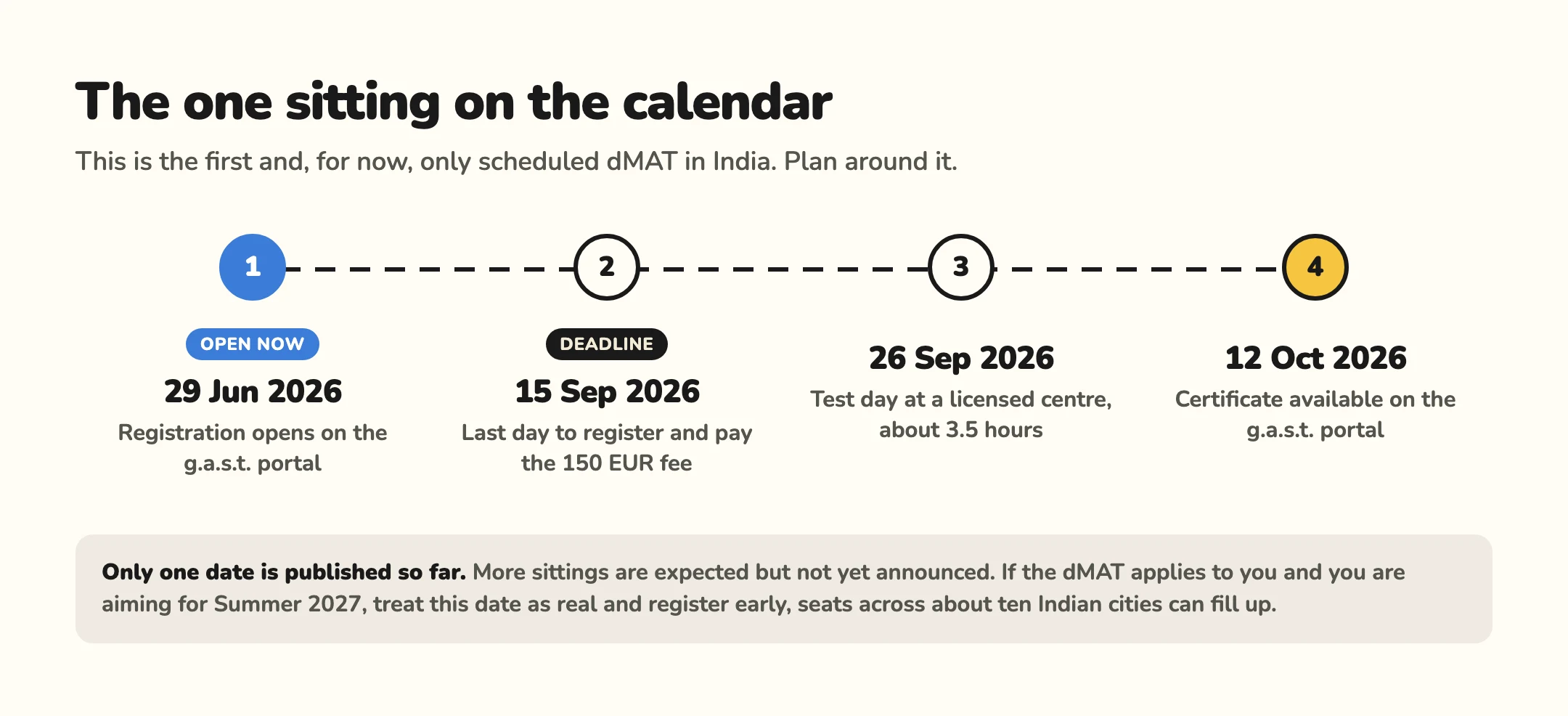
| What | When |
|---|---|
| Registration opens | 29 June 2026 |
| Registration closes | 15 September 2026 |
| Test date | 26 September 2026 |
| Certificate available | 12 October 2026 |
- Fee: 150 EUR, paid to g.a.s.t. when you register. This is on top of your normal APS fee, and you pay it online during registration.
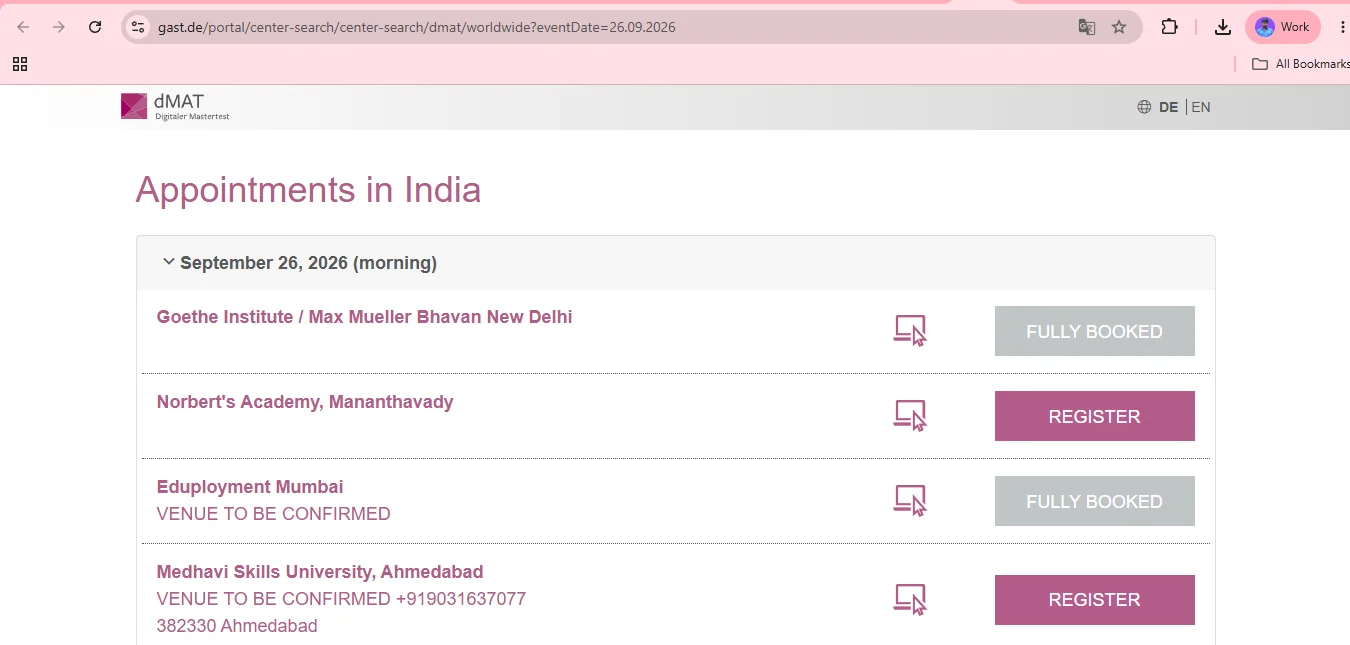
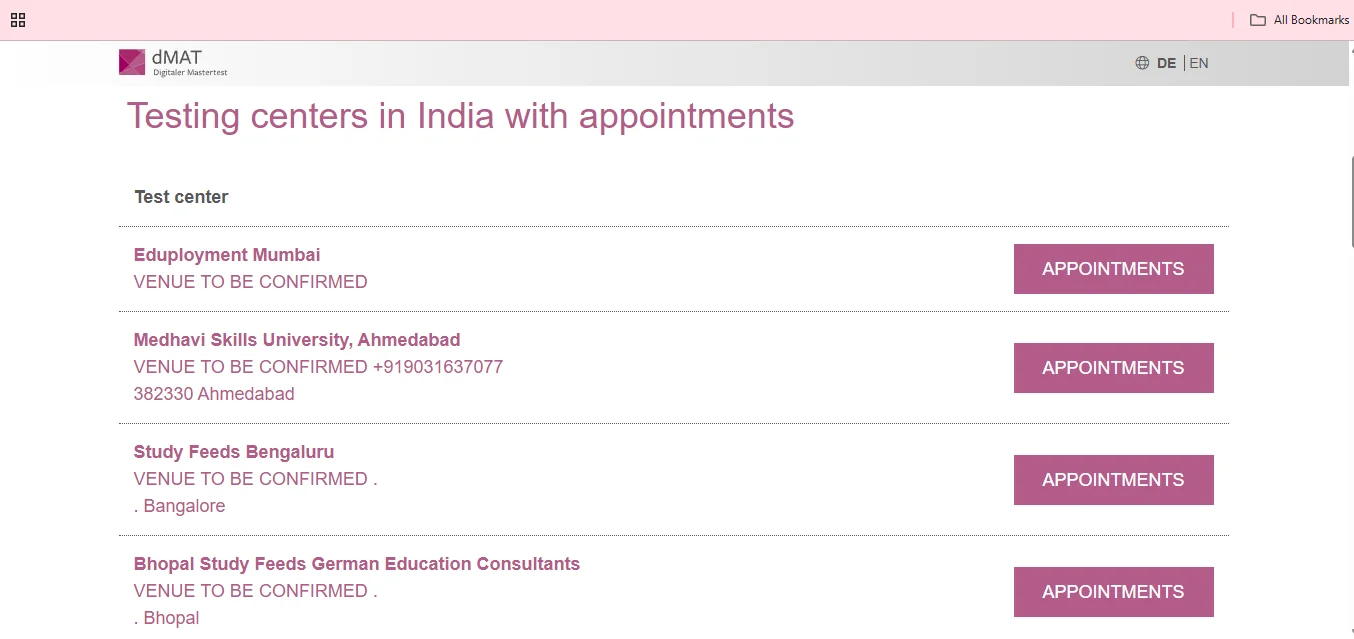
- Test centres in India: the portal currently lists centres in Ahmedabad (Medhavi Skills University), Bengaluru (Study Feeds), Bhopal (Study Feeds), Chandigarh, Chennai (Study Feeds), Kolkata, Mananthavady (Norbert's Academy), Mumbai (Eduployment), New Delhi (Goethe Institute / Max Mueller Bhavan) and Pune. Many still say "venue to be confirmed", which is normal: the exact address is announced closer to the test day, and each centre listing shows a phone number and email you can contact.
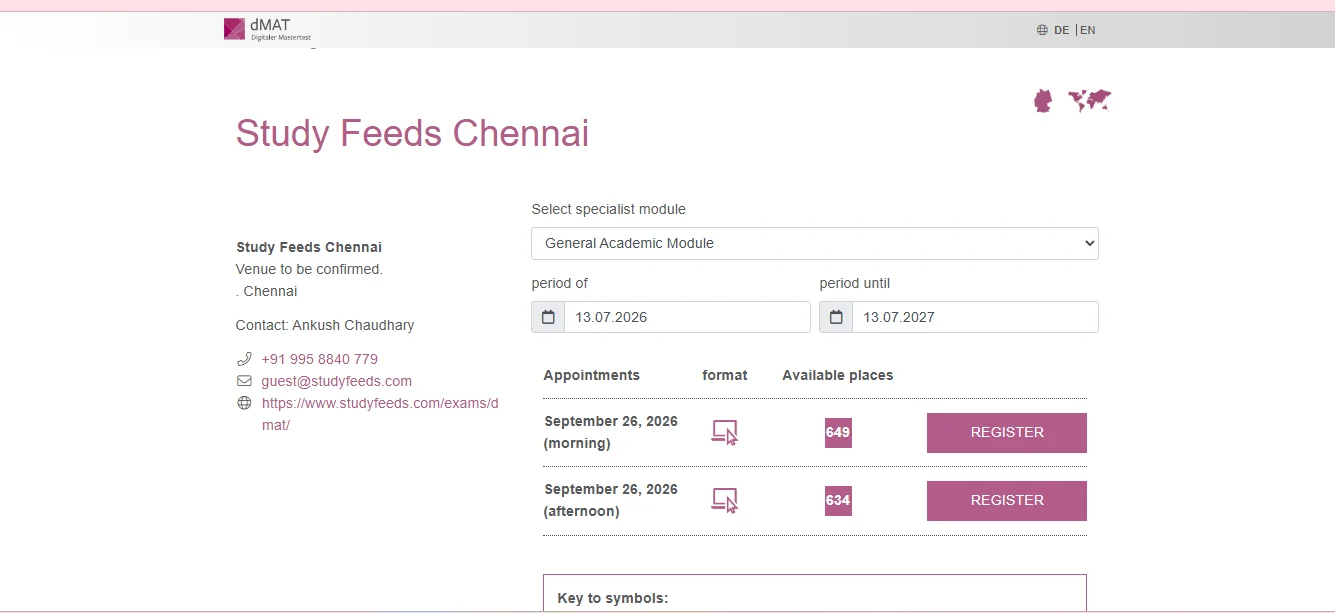
- Two sittings on the same day: each centre runs a morning and an afternoon sitting on 26 September 2026, and each sitting has its own seat pool. If the morning is full in your city, check the afternoon before looking at another city.
A note on timing: 26 September 2026 was the first sitting, and no later date is published yet on the official pages. If the dMAT applies to you, watch aps-india.de/dmat and d-mat.de for the next date and register as soon as it opens. With one date, about ten cities, and a large affected group, it is sensible to register the moment you can. That is not a theoretical warning: by early July 2026, the New Delhi (Goethe Institute) and Mumbai (Eduployment) morning sittings were already fully booked, while other centres still had plenty of seats.
How to register for the dMAT, step by step
Registration, payment, test centres and the certificate are all handled by g.a.s.t., not by APS India. Our team went through the whole flow for a real student in July 2026, so this is what actually happens, screen by screen.
Keep these three things ready before you start:
- Your passport. The portal asks for an ID number and warns that if the number you enter differs from the document you bring on test day, you will not be allowed to take the exam. Use your passport, and type the number exactly as printed on it.
- A digital passport-style photo of yourself. You upload it during registration, and on test day the centre checks your face against this photo as part of the identity check.
- A card or PayPal account that can make a 150 EUR international payment. The portal accepts Visa, Mastercard, American Express, JCB, UnionPay and PayPal.
The steps, with screenshots from our registration:
Step 1. Open the official dMAT India page at d-mat.de/en/dmat-in-india and click Registration.
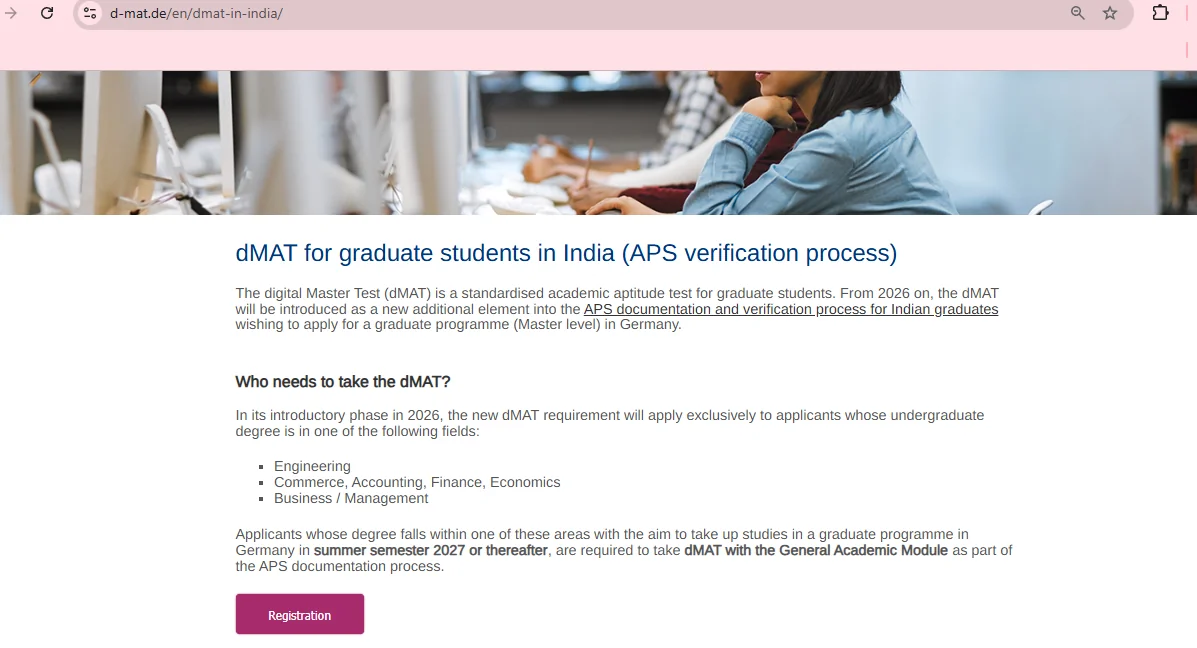
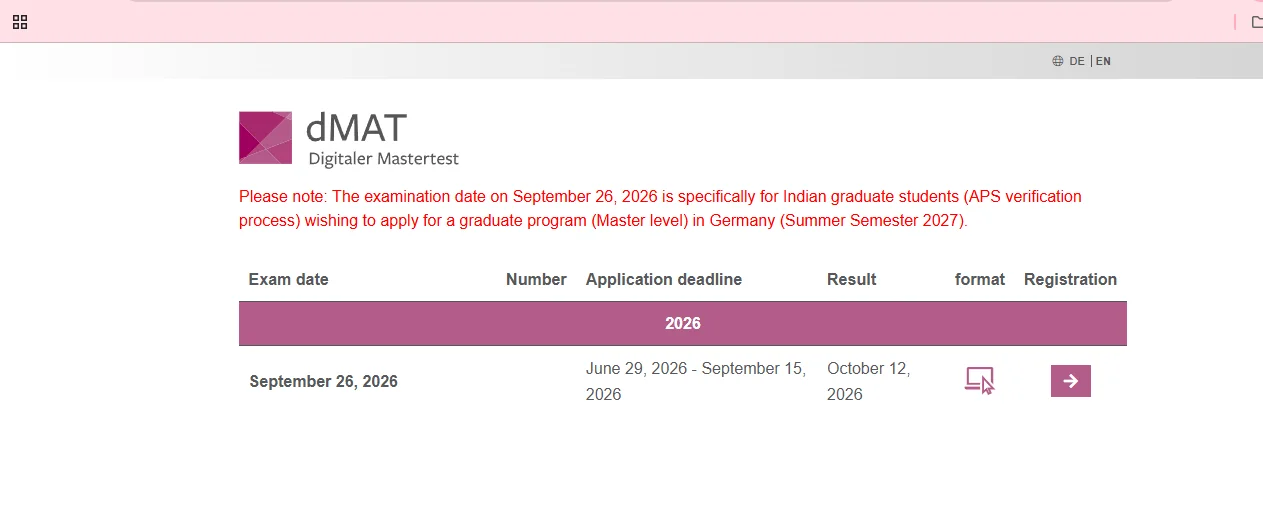
Step 2. Select the 26 September 2026 examination window. The portal itself notes this date is specifically for Indian graduate students in the APS process aiming at Summer 2027.
Step 3. In the test centre search, choose Worldwide, then select General Academic Module and India.
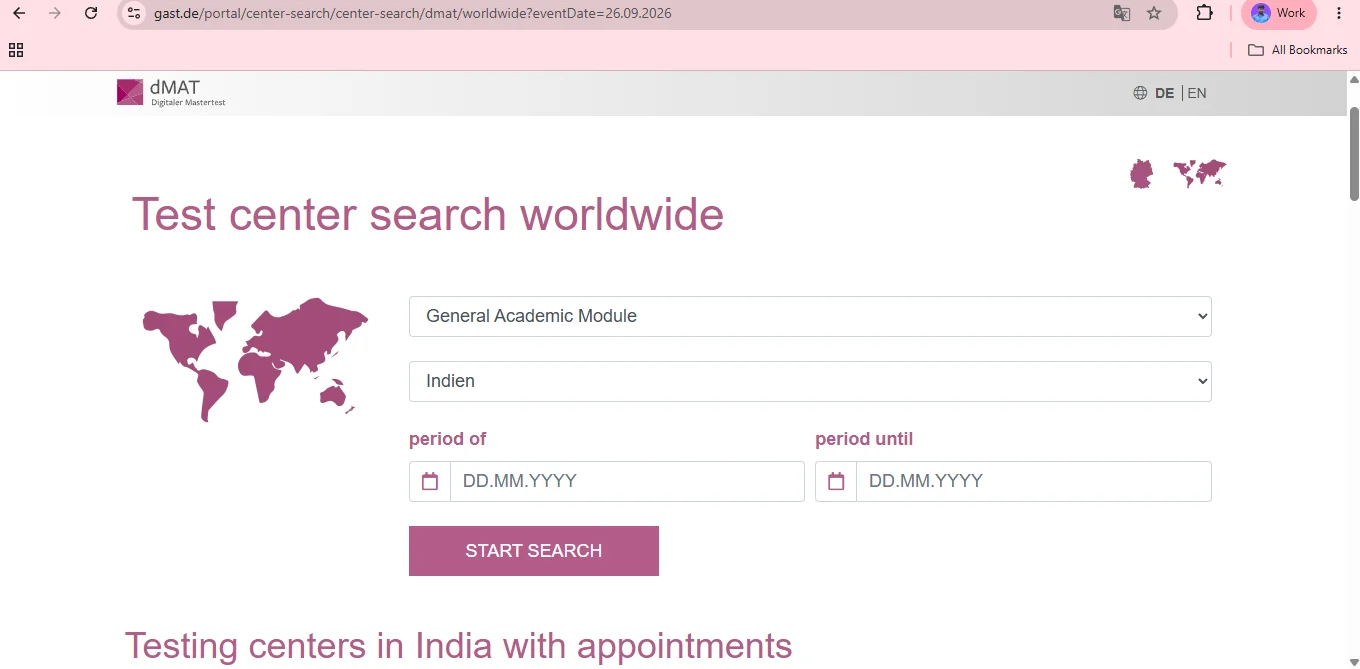
Step 4. You get the list of Indian test centres with appointments. Pick your preferred centre.
Step 5. Choose the morning or afternoon sitting, based on which still has seats. The portal shows the live seat count per sitting.
Step 6. Review the summary (exam date, test centre, module) and continue.
Step 7. Create your g.a.s.t. account: name, date of birth, country, email, username and password. If you already have one from TestDaF or TestAS, just log in.
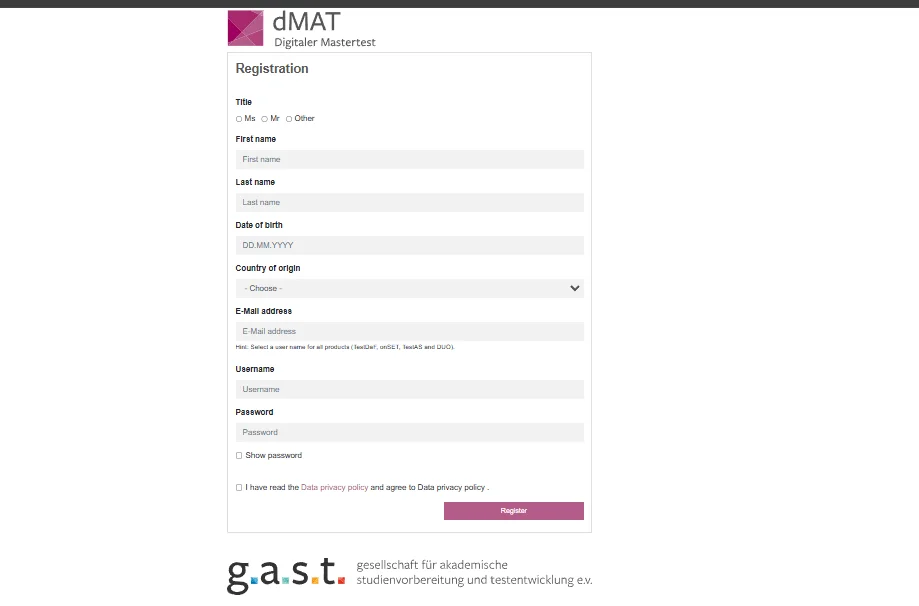
Step 8. Fill in the Your data page: your address, identification type and passport number, your photo upload, the General Academic Module, and English as the test language.
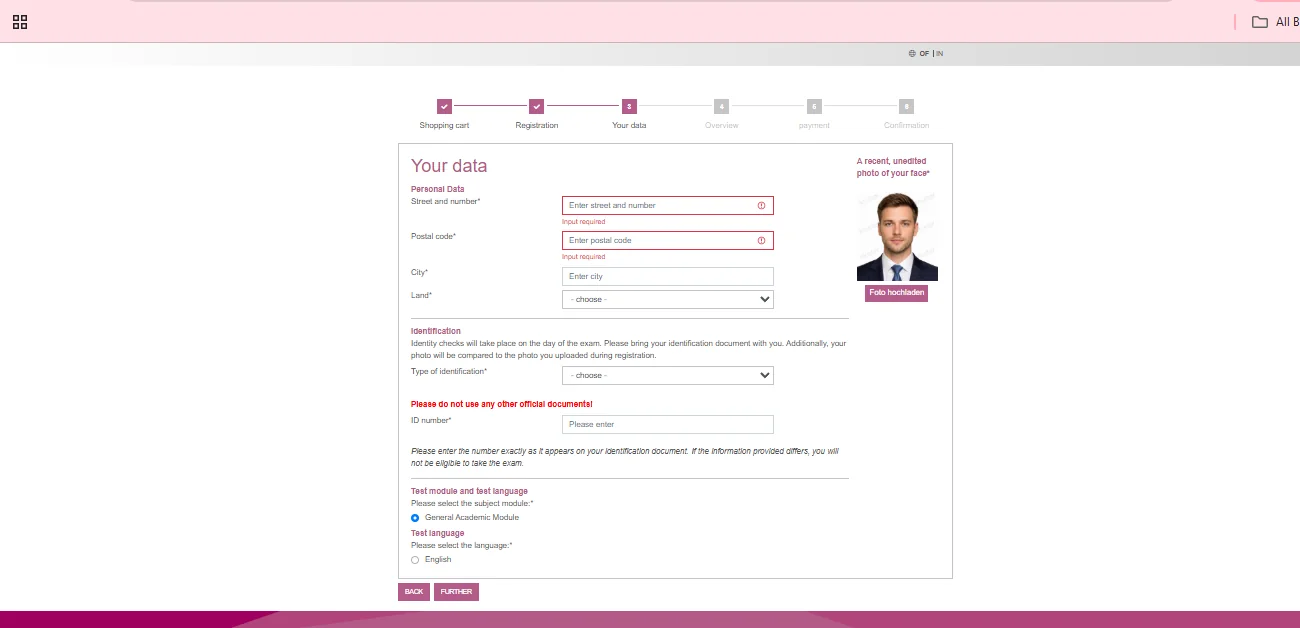
Step 9. Review everything, then accept the privacy policy and the terms and conditions.
Step 10. Pay the 150 EUR fee by card or PayPal. You get a confirmation, and your registration is complete.
After the test, your certificate appears in the g.a.s.t. portal on 12 October 2026, and you enclose it with your APS documents.
Two practical notes from our own registration:
- The portal can glitch. When we registered in mid July, India was missing from a country dropdown on the Your data page. We emailed g.a.s.t. support, and it was sorted out quickly.
- For any doubt, email [email protected]. In our experience g.a.s.t. replies fast and actually answers the question. Do not let one confusing screen make you miss the deadline.
Before you spend anything, it is worth checking that your university and degree are recognised in Germany. Our free anabin university checker tells you where your institution stands, because a dMAT certificate cannot fix a recognition problem.
Short on time before the deadline? Our dMAT + APS Fast-Track handles your dMAT registration: we set up your g.a.s.t. account, book your 26 September 2026 slot, and track the 15 September deadline with you. It does not include test prep or APS registration or APS application support. The 150 EUR exam fee is paid by you directly to g.a.s.t.; the Rs 4,999 is our service fee. Registered before the deadline, or a full refund.
What the dMAT exam is like
- Two parts: a core module that measures general thinking skills across three short subtests, and a General Academic Module that asks you to apply that thinking to academic-style problems.
- Question style: things like figure sequences, mathematical equations and Latin squares in the core module. These reward clear reasoning under time pressure, not memorised facts. Most Indian students have not seen this format before, so it is worth practising.
- Format: single-choice answers, in English, done on a computer at a licensed test centre.
- Length: about 3.5 hours, with a break in the middle.
Official practice material is out. g.a.s.t. lists its official preparation material for the General Academic Module on d-mat.de; this link is the latest version listed there. It is the only official sample of the question formats, so work through it before test day.
dMAT scoring and the certificate
Your certificate is issued by g.a.s.t. and shows two things:
- A percentile rank, which is the share of test-takers you scored above or level with. A university can set a cut-off, for example the top 10 percent, if it chooses to use the result.
- A dMAT score on a 0 to 200 scale where 100 is the average, shown for the core module, the subject module, and as a combined total.
The certificate does not expire, so you sit the dMAT once and the result reflects onto your APS certificate. There is no need to repeat it for a later intake.
What the dMAT is not (please breathe)
This is the part that gets lost in the panic. Straight from APS India's own FAQ:
- It is not pass or fail. A low score does not automatically get your APS refused.
- It does not replace your document check, TestAS, anabin, or the recognition of your degree.
- It cannot rescue a non-recognised degree. If your university is marked H+/- or H- on anabin, a great dMAT score does not fix that. Check your university recognition before you register.
- It does not guarantee admission. Each university decides for itself how to use the result, if at all. You still choose and apply to programs the usual way, so it is worth lining up your university and course shortlist in parallel.
What it does do: for affected applicants, it becomes a required part of your APS file. Without it, APS India cannot complete your APS procedure or issue the APS certificate, although you may send your other APS documents before the dMAT certificate is available. So the honest summary is simple. It is not a wall. It is a new box you have to tick, and the certificate then follows you onto your APS.
dMAT rules, refunds, and appeals
A few money and rules details worth knowing before you register:
- If you deregister after the deadline, do not attend, or stop the exam partway, the 150 EUR fee is not refunded and you get no certificate.
- If you deregister before the deadline, you get a refund minus an administrative fee of up to 15 percent.
- You can appeal your result for 30 EUR to review one part, or 60 EUR for both parts, refunded only if your grade is adjusted.
- Cheating, using aids or a falsified ID gets you excluded, your fee kept, and can bar you from future dMAT sittings.
What to do next if the dMAT applies to you
- Check your field against the official APS affected-fields list, and go by the exact title on your degree.
- Check your university and degree on anabin before you spend anything. If the recognition status is unclear, sort that out first with our anabin checker.
- If you are affected, register for the next published dMAT sitting as soon as registration opens on d-mat.de, and pick your nearest centre.
- Practise the core-module formats (figure sequences, equations, Latin squares). They are learnable, but only if you have seen them before test day. Start with the official preparation material linked above.
- Send all your academic documents in your first APS submission. If the dMAT applies to you, APS India lets you send your APS documents before the dMAT certificate is ready and add the certificate later, but no other academic documents can be added later.
This is a brand-new procedure, so some details may still change and more test dates should appear. We are tracking the official APS India and g.a.s.t. pages and will keep this guide current.
If you would rather not handle the dMAT registration yourself, our dMAT + APS Fast-Track sets up your g.a.s.t. account, books your 26 September 2026 slot, and tracks the 15 September deadline with you, for a Rs 4,999 service fee. The 150 EUR exam fee is paid by you directly to g.a.s.t. It does not include test prep or APS registration or APS application support, and you are registered before the deadline or fully refunded. For the wider application, our Master's counseling can guide the rest.
Download both dMAT guides
Two free PDFs, no sign up needed.
- dMAT registration guide (PDF, 8 pages, by MS in Germany): every screen of the booking flow, from picking your test centre to paying the 150 EUR fee, built from a real student registration our team completed.
- Official dMAT preparation booklet (PDF, 58 pages, by g.a.s.t. / TestDaF Institute, July 2026): the exam makers' own material for the General Academic Module, the version Indian applicants sit, with every question type and worked solutions.
Sources
- APS India, dMAT page and FAQ: https://aps-india.de/dmat/
- APS India, Affected Fields List (PDF, version 1.0, 29 June 2026): https://aps-india.de/wp-content/uploads/2026/06/dMAT_India_Affected_Fields_List.pdf
- g.a.s.t., d-mat.de (English): https://www.d-mat.de/en/
- g.a.s.t., dMAT in India: https://www.d-mat.de/en/dmat-in-india/
- g.a.s.t., Terms and Conditions: https://www.d-mat.de/en/terms-conditions/
- g.a.s.t., official dMAT preparation material (PDF, latest version listed on d-mat.de): https://www.d-mat.de/wp-content/uploads/2026/09/260902_dMAT_General-Academic-Module_Preparatoy-Materials_EN.pdf
- anabin recognition check: https://anabin.kmk.org/db/institutionen
Last updated: 18 July 2026, with a first-hand registration walkthrough from a real student registration our team completed.
Continue reading
Entrance Exams·14 min read
GRE for Master's in Germany: Eligibility, Format, Fees
Confused about taking GRE for Master’s in Germany? Our comprehensive guide covers everything you need to know about the GRE test format, preparation, timeline, cost, and more.
Read articleEntrance Exams·14 min read
Entrance Exams for Studying in Germany: A Comprehensive Guide
Essential entrance exams for studying in Germany: IELTS, TOEFL, GRE, GMAT, and German proficiency tests. Tips to ace them and unlock your dream MS!
Read articleEntrance Exams·16 min read
Guide to TOEFL Exam for Master's Degree in Germany
Get into your dream University with this guide to TOEFL Exam for Master's program in Germany. Learn key tips and strategies for success, and boost your chances of acceptance.
Read articleReady to plan your Germany journey?
Explore our tools and resources to find the perfect university and program for your academic goals.