Hotel and Hospitality Ausbildung in Germany for international students: Salary, B1, top employers
Hotel and hospitality Ausbildung in Germany pays EUR 900 to 1,300 a month, needs B1 German, and opens a section 16a training visa for international students.

Table of contents
Last updated: May 2026
TL;DR: Hotel and hospitality Ausbildung is a paid 3-year dual training programme in Germany. International students earn roughly EUR 900 to 1,300 per month while training, need around B1 German, and can move on to a §16a training visa, full-time work, and eventually permanent residency. It is one of the easier non-degree routes for B1-level applicants.
If you want to live and work in Germany without a Master's degree, the Hotelfachmann or Hotelfachfrau Ausbildung is one of the most accessible doors in. The hospitality sector is short-staffed across the country, the language bar is lower than for healthcare, and the training visa under §16a is well-defined. This guide covers who qualifies, what you actually earn, the language level you really need, the employers worth applying to, and how the route compares to other popular Ausbildung courses.
What is hotel and hospitality Ausbildung?
Hotel and hospitality Ausbildung is a state-recognised 3-year dual training programme that combines on-the-job work in a hotel with classroom learning at a Berufsschule (vocational school). The most common qualifications are Hotelfachmann or Hotelfachfrau (hotel professional), Hotelkaufmann or Hotelkauffrau (hotel business administrator), Restaurantfachmann or Restaurantfachfrau (restaurant professional), and Koch or Köchin (chef). All four are regulated by the IHK (the Chamber of Commerce) and end with a national exam.
You spend roughly three to four days a week at the hotel, rotating through reception, F&B, housekeeping, banqueting, and back-office, and one to two days a week at vocational school covering German, business, accounting, hospitality law, and food safety. The contract is a real employment contract: you pay tax, you contribute to public health insurance and pension, and you are entitled to at least 24 paid holiday days a year (most chains give 26 to 28).
The 3 years can drop to 2 years for trainees who already have a high school diploma plus relevant experience, on application to the IHK.
Who can apply: requirements for international students
The route is open to non-EU students, but the German embassy and the hiring hotel both check four things.
Education
You need a school-leaving certificate that the German recognition database (Anabin) treats as equivalent to a German Hauptschulabschluss or Realschulabschluss. For Indian students this is usually the 10+2 or sometimes the 10th-grade certificate, depending on the state board. The Atlas of Anabin, run by the KMK, is the authoritative check.
Language:
B1 is the practical floor On paper, the federal government allows in-company training contracts with as little as A2. In practice, no serious hotel chain will sign an Ausbildungsvertrag with a guest-facing trainee below B1. Restaurants and back-of-house roles sometimes accept high A2 with a commitment to reach B1 by month six. Front office, reservations, and event planning effectively require B1 to start and B2 by year two. The Goethe-Zertifikat B1 or telc Deutsch B1 is the document the embassy will accept; school certificates from your home country usually are not enough by themselves.
Age and timing
There is no formal upper age limit, but most hotels prefer trainees under 30 because the salary scale assumes a young entrant. Application windows for the August or September intake open between September and January of the previous year. If you are applying from abroad in May 2026 for an August 2026 start, you are already late for the big chains and should target smaller hotels, January 2027 intakes, or the rolling-start programmes some Mittelstand groups run.
A signed Ausbildungsvertrag
You cannot apply for the visa until a German hotel has signed a training contract with you. This is the single biggest hurdle for applicants from outside the EU. Ausbildung jobs are not posted on LinkedIn the way English-language graduate roles are; they live on ausbildung.de, the IHK Lehrstellenbörse, the Bundesagentur für Arbeit portal, and individual hotel-group career pages.
Salary: what trainees actually earn
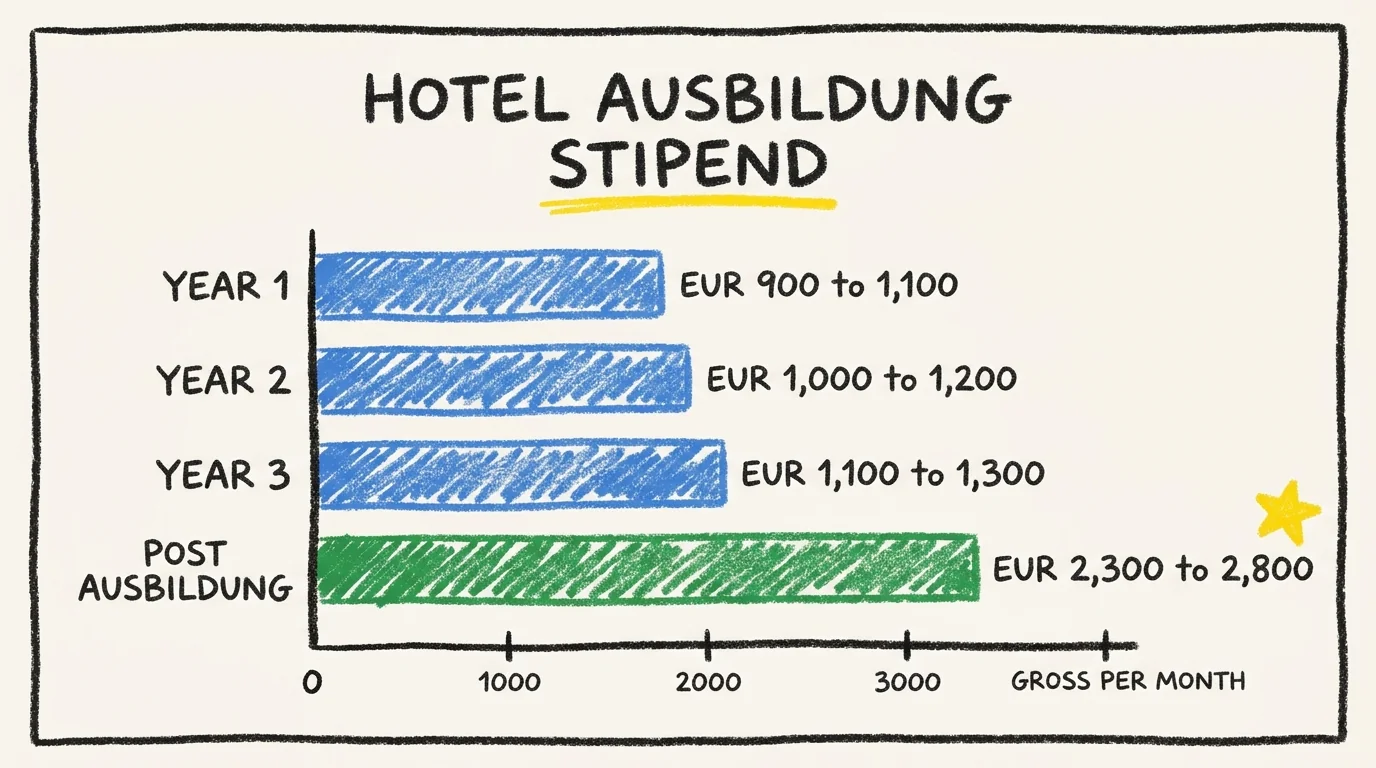
Hospitality Ausbildung salaries are set by either the regional Tarifvertrag (collective bargaining agreement) or the federal minimum training allowance (Mindestausbildungsvergütung). The minimum rises every January. For 2026, the figures most international applicants will see are roughly:
| Year | Monthly stipend (gross) | Notes |
|---|---|---|
| Year 1 | EUR 900 to 1,100 | Higher in tariff-bound chains, lower in unbound regional hotels |
| Year 2 | EUR 1,000 to 1,200 | Tariff hotels add roughly 10% step-up |
| Year 3 | EUR 1,100 to 1,300 | Some chains add an end-of-Ausbildung bonus |
| Post-Ausbildung entry-level | EUR 2,300 to 2,800 (gross) | Reception or F&B supervisor roles |
These are gross numbers. After tax, social security, and church tax (if applicable), expect to take home roughly 75 to 80% of the gross in your first year, 70 to 75% in years two and three. Free or subsidised staff meals are standard. Subsidised staff accommodation is offered by chains in expensive cities (Munich, Frankfurt, Hamburg, Stuttgart) and by spa or resort hotels in remote regions.
The IHK publishes the regional Ausbildungsvergütung table every year. If you have a specific city or chain in mind, ask the hotel for the relevant Tarifvertrag during the interview. It is a normal question and a non-answer is a yellow flag.
For broader context on what entry-level hospitality roles pay after the Ausbildung ends, see our Germany salary guide.
Top employers and where they hire
The Ausbildung market in hospitality is dominated by four employer types:
- International chains. Marriott, Hilton, Hyatt, IHG, Accor, and Radisson all run structured Ausbildung programmes in their German properties. They are the easiest to navigate from abroad because their career pages are bilingual and their trainee handbooks are documented. Marriott Munich, Hilton Berlin, and the Frankfurt Hilton are common entry points.
- German chains. Steigenberger, Maritim, Dorint, Best Western Germany, and Lindner have larger trainee cohorts than the international chains and run rotation programmes between sister properties. Maritim is the largest single trainer in this group with hotels in roughly 15 German cities.
- Mittelstand and family-run groups. ATLANTIC Hotels (north Germany), H-Hotels, and Welcome Hotels treat Ausbildung as a long-term recruitment pipeline and often pay above tariff with sign-on bonuses and early holiday accruals. They are slower to respond to international CVs but loyal once you are in.
- 5-star independent and resort hotels. Brenners Park-Hotel Baden-Baden, Schloss Elmau, Hotel Adlon, Bayerischer Hof, and the Roomers group hire small intakes (often 2 to 6 trainees per year) but lead to faster supervisor and management progression for strong performers.
Apply to a mix. Five applications to international chains, five to German chains, five to Mittelstand groups, and a handful to resort hotels is a realistic batch. Personalise the cover letter for each one. Generic mass applications get filtered out before HR even reads them.
How to apply from abroad: step by step
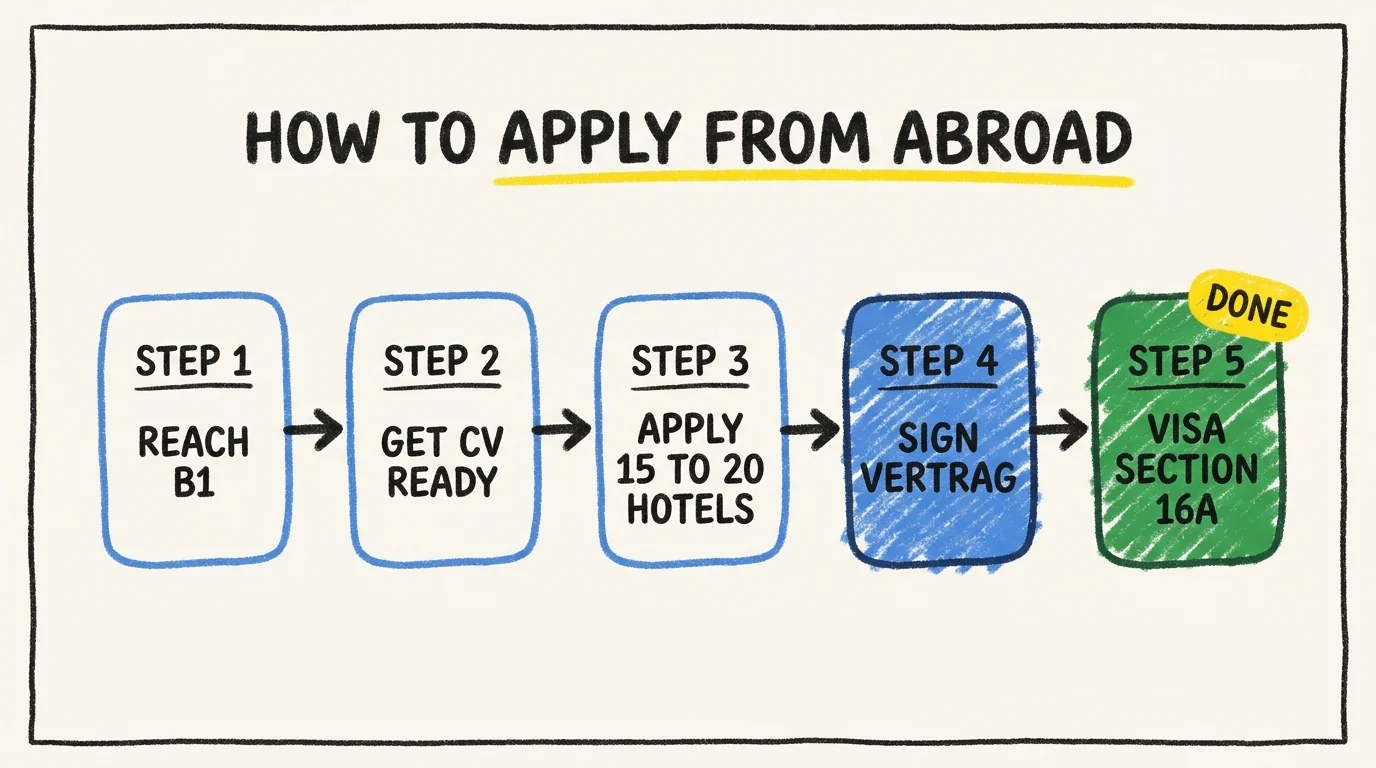
- Reach B1 German and get certified. Goethe-Zertifikat B1 or telc B1. Allow 9 to 12 months of full-time study from zero.
- Get your school certificate recognised on Anabin. If your certificate is not listed, you can request a Zeugnisbewertung from the ZAB (Zentralstelle für ausländisches Bildungswesen).
- Translate your CV into German format (1 to 2 pages, photo, table of work history, references). The English-language graduate-CV style does not work here.
- Apply to 15 to 20 hotels between September and January for the following August intake. Use ausbildung.de, the IHK Lehrstellenbörse, and chain career pages.
- Sign the Ausbildungsvertrag when offered. The contract is on a standard IHK template and is registered with the local IHK.
- Apply for a §16a training visa at the German embassy in your home country. You will need the Ausbildungsvertrag, B1 certificate, school certificates, proof of financing for the first months, and accommodation confirmation. Decisions take 6 to 12 weeks.
- Travel and register your address (Anmeldung) within 14 days of arrival. Open a Sperrkonto if your embassy required proof of financing.
What happens after the Ausbildung
After 3 years you sit the IHK final exam. Pass and you are a qualified Hotelfachfrau, Hotelfachmann, Koch, or Köchin under German federal law. Three things are then on the table.
- Stay with your training employer. Most chains offer post-Ausbildung contracts at EUR 2,300 to 2,800 gross per month for line roles. You typically need to commit for at least one year.
- Switch chains. A German Ausbildung certificate is recognised across the EU. Switching is normal in year one or two after qualification.
- Move toward permanent residency. After 2 years of qualified work post-Ausbildung, you can apply for a German Niederlassungserlaubnis (settlement permit) under the §18b route. Five total years in Germany is the usual baseline. You can also explore the Chancenkarte (Opportunity Card) if you finish the Ausbildung but want to switch industries.
The Ausbildung system is also a known on-ramp for moving into hotel management later, either by adding the Hotelbetriebswirt (IHK) qualification, by joining an in-house management trainee programme, or by stacking a Bachelor in Hospitality Management on top.
Common mistakes
- Applying without a B1 certificate. No serious hotel signs a contract with a candidate who only has "self-study" or a school B1. Get the Goethe or telc paper.
- Sending a 6-page English CV. German CVs are 1 to 2 pages, in German, with a photo and a table-style work history. Keep it tight.
- Targeting only 5-star hotels in Munich. Munich is the most competitive market. Hamburg, Hannover, Leipzig, Dresden, and the spa towns have high vacancy rates and faster offers.
- Ignoring the kitchen route. Koch or Köchin Ausbildung pays the same as Hotelfachmann or Hotelfachfrau, has lower B1 pressure for guest interaction, and has the strongest job market in Germany right now.
- Underestimating the cost of the first 3 months. Even with a stipend, the first month deposit, Anmeldung, public health insurance setup, and language top-up can put you EUR 2,000 to 3,000 in the hole before the first salary lands.
FAQ
Q:
Can I do hotel Ausbildung in Germany with only A2 German? A: Officially yes, in practice no. A handful of back-of-house and kitchen positions accept high A2 with a B1 commitment by month six, but every guest-facing role, every embassy that interprets §16a strictly, and every IHK that registers the contract will expect a Goethe or telc B1 certificate at the start.
Q:
Is the salary enough to live on in Germany? A: It is enough in smaller cities (Leipzig, Dresden, Hannover, Bremen) where rent is EUR 350 to 500 for a shared room. It is tight in Munich, Frankfurt, and Hamburg unless the hotel provides subsidised accommodation, which the bigger chains often do for trainees.
Q:
How long does the §16a training visa take? A: 6 to 12 weeks at most German embassies, longer in India and Pakistan during peak summer. Apply the moment your Ausbildungsvertrag is signed. Do not wait.
Q:
What if I fail the IHK final exam? A: You can retake it twice. Most hotels keep failed candidates on a transitional contract until the next exam window, which is usually 6 months later. The pass rate for first-time attempts in hospitality is around 90%.
Q:
Can I bring my spouse or family on a §16a visa? A: Yes, as a family reunion (Familiennachzug) once you have your residence permit and proof of sufficient income and housing. Spouses get a residence permit that allows full work rights.
Q:
How does hotel Ausbildung compare to nursing Ausbildung? A: Nursing pays EUR 1,300 to 1,500 per month in year one (higher than hotel) but requires B2 from day one and a longer recognition process. Hotel pays less but the B1 floor and faster placement make it the more accessible non-degree route for most international applicants.
Q:
Will hotel Ausbildung lead to permanent residency? A: Yes. Three years of Ausbildung plus 2 years of qualified work in Germany puts you on the standard route to a settlement permit. Total time in Germany: about 5 years.
Where to next
- Top 10 Ausbildung courses in Germany for international students for a side-by-side view of all the popular routes
- Mechatronics Ausbildung programmes if you want to compare a technical route to the hospitality one
- Germany salary guide for what hotel professionals earn after the Ausbildung ends
- The Chancenkarte (Opportunity Card) if you finish the Ausbildung and want to switch into a different industry on a points-based residence permit
Continue reading
Ausbildung·14 min read
Ausbildung vs Bachelor's in Germany: Cost, salary trajectory, PR timeline compared
Compare Ausbildung and Bachelor's in Germany on 2026 cost, year-by-year salary trajectory, EU Blue Card vs Niederlassungserlaubnis timelines.
Read articleAusbildung·12 min read
How to find an Ausbildung company in Germany from abroad: Portals, agencies, direct outreach
Find an Ausbildung training company in Germany from abroad. Official portals, free private boards, government recruitment schemes, agencies, and direct employer outreach.
Read articleAusbildung·12 min read
German B1 vs B2 for Ausbildung: Which level you actually need by profession
B1 is the visa floor for the Ausbildung visa, B2 is what most employers want. Profession-by-profession breakdown for nursing, technical trades, hospitality, logistics, IT.
Read articleReady to plan your Germany journey?
Explore our tools and resources to find the perfect university and program for your academic goals.