German B1 vs B2 for Ausbildung: Which level you actually need by profession
B1 is the visa floor for the Ausbildung visa, B2 is what most employers want. Profession-by-profession breakdown for nursing, technical trades, hospitality, logistics, IT.

Table of contents
Last updated: May 2026
TL;DR: Germany's Ausbildung visa needs B1 German as the floor (A2 with a prep course in some embassies). The level you actually need depends on the profession: B2 for healthcare, B1 for most technical trades and hospitality, B1 plus a written promise to reach B2 in year one for almost everything else. Picking the wrong level is the most common reason an Ausbildung application stalls before it even reaches a company.
If you have searched "B1 or B2 for Ausbildung" and gotten three different answers from three different consultants, that is because the question has three different audiences hiding inside it. The German embassy cares about visa eligibility. The vocational school cares about whether you can follow lessons. The employer cares about whether you can talk to customers, colleagues, and the IHK examiner without stalling the dual training. We split those three out below and tell you what level each one actually wants in 2026.
We assume you have already read our Ausbildung requirements pillar and have a profession in mind. If you are still picking, start with our top Ausbildung courses for international students, then come back here.
B1 or B2 for Ausbildung: the 60-second answer
There is no single answer. There are three thresholds stacked on top of each other:
- Visa floor. B1 for the Ausbildung visa under Section 16a AufenthG. A2 is sometimes accepted if you also book a prep language course in Germany before training starts, but only some embassies allow this and only for certain professions.
- Vocational school floor. Berufsschule lessons are in German. Realistically you need solid B1 to follow class and pass the IHK or HWK final exam (Abschlussprüfung) at the end of year three.
- Employer floor. This is the one most candidates underestimate. Healthcare employers will not interview you below B2. Technical trades take B1 if you also commit to reach B2 by mid-training. Hospitality and logistics will hire at B1 today.
If you only learn one rule from this post, learn this: B1 is the legal minimum, B2 is the professional norm, and the gap between them decides how many companies will actually call you back.
What the Ausbildung visa actually requires
The Auswärtiges Amt (Federal Foreign Office) is the authority on visa rules, and the diplomatic missions publish the same checklist worldwide. For the Ausbildung visa under Section 16a of the Residence Act (AufenthG), the language proof is:
- At least B1 for "qualified vocational training" (the standard 2 to 3.5 year dual Ausbildung).
- At least A2 plus a prep course in Germany if you have a confirmed Ausbildungsvertrag but have not yet hit B1. This is the "preparatory measure" route.
- The certificate has to come from a recognised provider. Goethe-Institut, telc, ÖSD, and TestDaF are accepted at every embassy. Online-only "verified" certificates from random schools are usually rejected. See our comparison of Goethe vs TestDaF vs DSH if you have not picked an exam yet.
A few embassy-specific notes that trip people up:
- India. New Delhi accepts B1 from Goethe-Institut, telc, and ÖSD. They will ask why you sat the exam at a non-Goethe centre if your certificate looks unusual.
- Philippines, Vietnam, Indonesia. Embassies often require B1 already in hand for the visa appointment. The A2 plus prep course route is harder to get approved here than in MENA or East Africa.
- EU and EEA candidates. No visa needed, but employers still apply the B1/B2 thresholds below for shortlisting.
The visa floor is not the same as the realistic floor. We have not seen a healthcare candidate get hired at B1 in 2026, even though the visa would technically allow it.
Profession-by-profession: which level you actually need
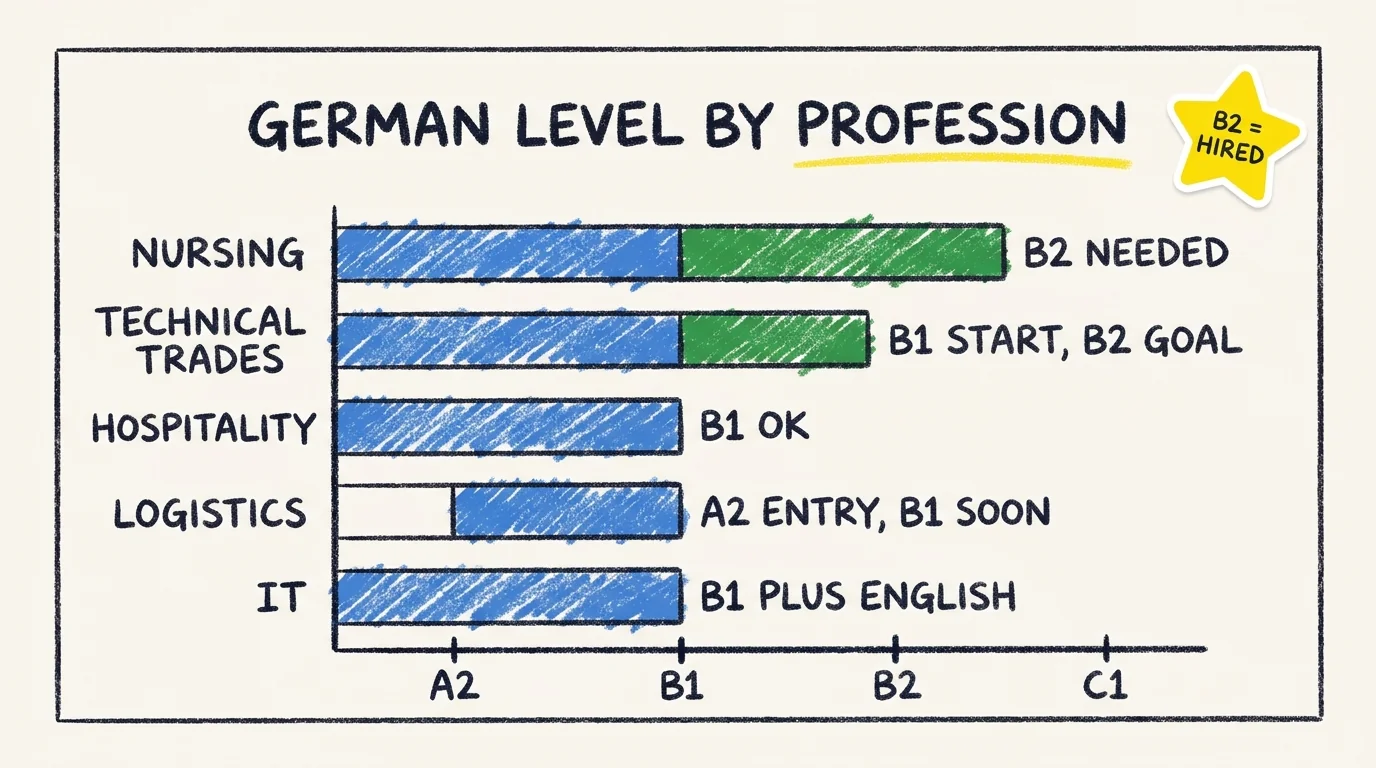
Healthcare:
B2 standard, B1 only via Recognition Partnership
Pflegefachfrau and Pflegefachmann (qualified nurse) is the only Ausbildung-adjacent profession where B2 is written into the recognition rules. The Pflegeberufegesetz and the relevant state ordinances require B2 to use the protected job title and work unsupervised. There are two paths:
- Direct Ausbildung route (most common for new starters): You need B2 before the company will sign a contract. Even the recruitment programmes run by the Bundesagentur für Arbeit with India, Vietnam, and the Philippines target B2 candidates. A handful of employers will sign you at B1 if you start a B2 prep class on day one and finish before the practical phase.
- Section 16d Recognition Partnership ("Anerkennungspartnerschaft"): For trained nurses from outside the EU who already have a foreign nursing qualification. Lets you enter Germany at A2 or B1 and reach the B2 + recognition decision while already working under supervision. This is a recognition route, not an Ausbildung visa, and it has stricter employer obligations.
If you are healthcare, treat B2 as non-negotiable and budget the extra 3 to 4 months of language training. Read our Nursing Ausbildung guide for the full process.
Technical trades:
B1 minimum, B2 strongly recommended
Mechatroniker, KFZ-Mechatroniker (automotive), Elektroniker (electrician), Anlagenmechaniker (plumbing and HVAC), and Industriemechaniker all sit in the same bucket: B1 will get you past the visa and the first interview. B2 will get you past the third interview and through the Berufsschule classroom without lonely study sessions every weekend.
What employers actually look for:
- B1 certificate in hand.
- A clear plan for B2, ideally with a course already booked in Germany or a continued schedule in your home country.
- Enough technical vocabulary to follow a wiring diagram or a torque spec read aloud.
Why B2 matters even though B1 passes the visa: the IHK Abschlussprüfung at the end of training is partly written, partly oral, partly practical, and entirely in German. International trainees who started at B1 and stayed there have a measurably higher repeat rate on the final exam.
For specifics, see our Mechatronics Ausbildung guide, Electrician Ausbildung guide, and Fachinformatiker IT Ausbildung guide.
Hospitality and food service:
B1, customer-facing
Hotelfachmann/-frau, Restaurantfachmann, Koch and Köchin (chef), Tourismuskaufmann all hire at B1 in 2026. The work is customer-facing in German, so you cannot fake your way through with English. But the vocabulary band is narrower than healthcare or technical trades, and most employers will train you on the role-specific terms during onboarding.
A handful of hotel chains in Berlin, Munich, and Frankfurt run English-first training tracks for international candidates. These are the exception, not the rule, and they still expect you to reach B2 by the end of year one. See our Hotel and Hospitality Ausbildung guide for the chain-by-chain breakdown.
Logistics and warehousing:
B1, sometimes A2 entry
Fachkraft für Lagerlogistik (warehouse logistics specialist) and Berufskraftfahrer (commercial driver) have the lowest verbal threshold in the Ausbildung catalogue. B1 covers the visa and the daily work. A few employers will sign you at A2 if you commit to reach B1 within six months of arrival and enrol in a course before you fly.
This is the route most candidates from the Philippines and Vietnam pick when they want to enter the German labour market quickly and upgrade later.
IT:
B1 with English on top
Fachinformatiker (Anwendungsentwicklung or Systemintegration) is the only Ausbildung where strong English is a real asset. Many of the bigger employers (SAP, IBM, Siemens, Deutsche Bahn IT) use English in daily team work and in technical documentation. The classroom and the exam are still German, so B1 minimum, B2 by year two is the norm.
If your German is weak but your English is strong and you have a tech background, IT Ausbildung is your shortest path into Germany. If your German is already B2, you broaden the employer pool from "international-friendly only" to "anywhere".
B1 with a B2 plan beats waiting for B2
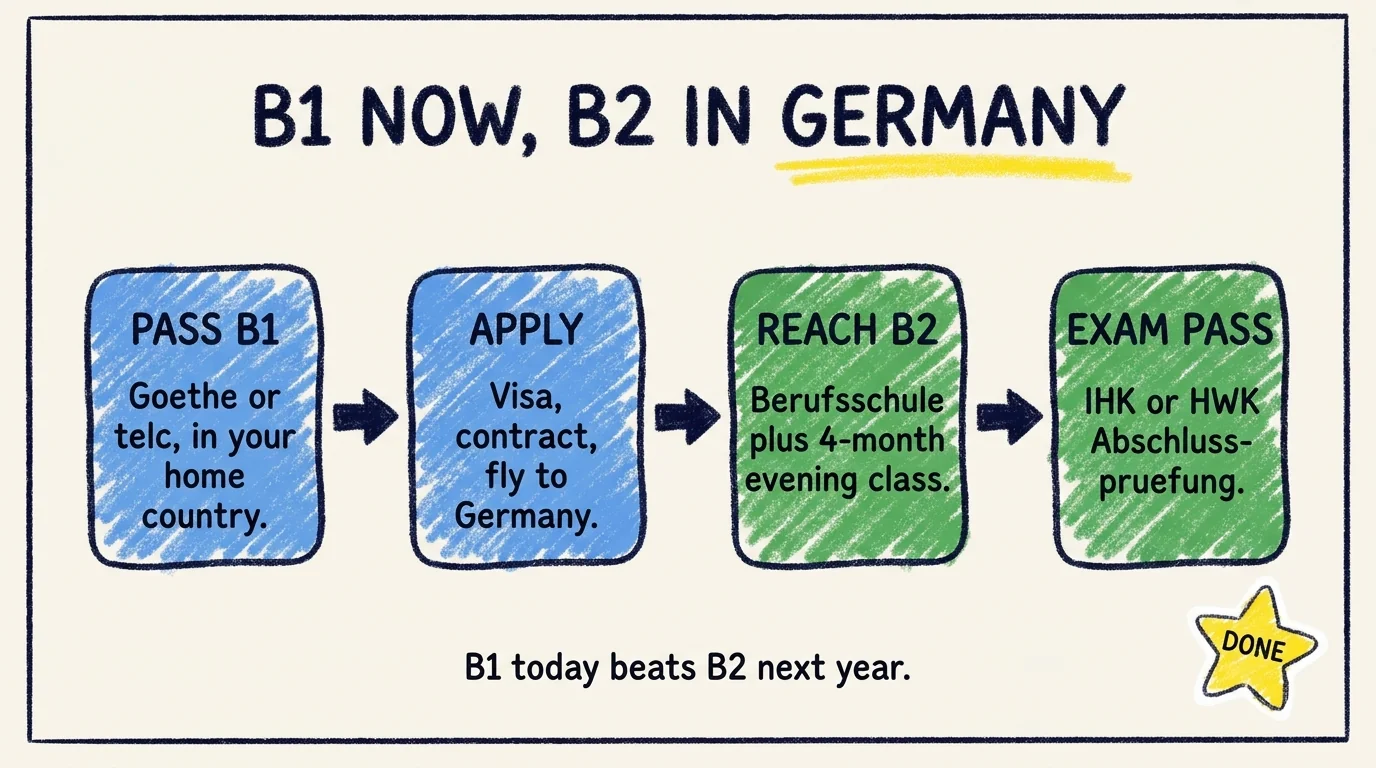
The most expensive mistake we see is candidates sitting at home for another six months trying to get B2 perfect before they apply. While they wait, they age out of preferred recruitment cohorts, miss the August Ausbildung start window, and lose visa appointment slots.
Apply with B1 in hand the moment you have it. Show employers a written plan for B2 with a date and a course booking. For most professions outside healthcare, B1-with-momentum beats B2-still-waiting.
The exceptions stay the same: nursing needs B2 before contract, and the few English-first IT and hospitality programmes have their own rules.
Which certificate actually counts
Embassies and employers accept these:
- Goethe-Institut (Goethe-Zertifikat A1 through C2). The gold standard. Accepted everywhere, no questions asked.
- telc (telc Deutsch B1, B2, B2-Beruf, B2-Pflege). Accepted for the visa and by every employer. The telc B2-Pflege is the specialised nursing exam many healthcare employers prefer.
- ÖSD (Österreichisches Sprachdiplom). Accepted, less common in Asia.
- TestDaF (TDN 3, 4, 5). More common for university admission than Ausbildung; accepted but unusual.
- Goethe-Test PRO Pflege. A profession-specific German-for-nurses exam. Some employers accept it as B2 equivalent for nursing only.
Avoid: online-only "certified" exams from non-recognised providers, internal language school certificates that are not telc/Goethe/ÖSD, and old certificates more than two years old (some embassies reject anything older than 12 months).
For the full exam comparison and how to register, see our Goethe vs TestDaF vs DSH guide.
Common mistakes to avoid
- Trusting "A2 is enough" agents. A2 only works for the visa with a prep course AND only for some professions AND only at some embassies. Treat B1 as the realistic minimum for everything.
- Booking a B2 attempt without a B1 certificate first. If you fail B2, you have nothing to show. Sit B1, get the certificate, then attempt B2 on top.
- Picking healthcare without a B2 budget. A 4-month B2 course (telc B2-Pflege) is the price of admission for nursing in 2026. Plan for it.
- Submitting the wrong exam variant. telc Deutsch B2 is general; telc B2-Pflege is the nursing-specific version. Healthcare employers prefer the latter. Get the right one the first time.
- Letting your certificate expire. Some embassies and employers refuse anything older than 12 to 24 months. Schedule the exam close to your application window.
FAQ
Is B1 enough for the German Ausbildung visa?
Yes. B1 is the standard minimum the Auswärtiges Amt requires under Section 16a AufenthG for qualified vocational training. A2 is sometimes accepted if you also book a preparatory language course in Germany, but this varies by embassy and profession. Healthcare and most technical trades want B2 before contract regardless of the visa floor.
Can I do an Ausbildung in Germany with only A2?
In a few cases, yes, with a confirmed Ausbildungsvertrag and a booked prep course in Germany before your training starts. In practice, A2 is rarely enough to land the contract in the first place, since most employers shortlist at B1 and above. Logistics and warehouse Ausbildung is the most A2-friendly category.
Do I need B2 for nursing Ausbildung?
In practice, yes. Pflegefachfrau and Pflegefachmann recognition rules require B2 for the protected job title, and almost every employer wants B2 before signing a contract. The exception is the Section 16d Recognition Partnership for already-trained foreign nurses, which lets you enter at A2 or B1 and reach B2 during the recognition phase.
Which German certificate do employers prefer?
Goethe-Institut and telc are the two most widely recognised. For nursing specifically, telc B2-Pflege or Goethe-Test PRO Pflege carry extra weight because they test profession-specific German. Avoid online-only certificates from non-recognised providers; they often do not pass the embassy check.
Will my German skills be enough to pass the IHK Abschlussprüfung?
If you start at B1, you will need active B2 by year two to comfortably pass. The final IHK or HWK exam is in German and includes a written, oral, and practical component. International trainees who plateau at B1 have a higher repeat rate on the exam. Plan to keep learning during training.
How long does it take to go from B1 to B2?
For most learners, 3 to 5 months of focused study (around 200 to 300 hours of class time plus self-study). Intensive in-Germany courses can compress this to 8 to 10 weeks. The jump from A2 to B1 is shorter; B1 to B2 is the harder one because grammar and vocabulary range expand sharply.
Does Berufsschule offer language support for international trainees?
Some Berufsschulen run "DAZ" (Deutsch als Zweitsprache) support classes for trainees who need extra help. Coverage is patchy and depends on the state, the school, and how many international trainees they have. Ask your specific Berufsschule before you assume support exists.
Can I do Ausbildung in English in Germany?
Almost never for the classroom and exam. A handful of larger employers (mostly in IT, some in international hospitality chains) use English in the workplace, but Berufsschule and the IHK Abschlussprüfung are in German. Treat "English-friendly Ausbildung" as marketing language, not a substitute for German fluency.
Where to next
- Pick the right profession first, then plan your German level. Start with our top 10 Ausbildung courses for international students.
- Once you know your profession, find a company. Read our how to find an Ausbildung company in Germany from abroad guide.
- For the visa-side checklist, see Ausbildung visa Germany 2026: complete application, documents, timeline.
- For our German language coaching tracks (A1 to B2, exam prep), see Learn German.
Continue reading
Ausbildung·14 min read
Ausbildung vs Bachelor's in Germany: Cost, salary trajectory, PR timeline compared
Compare Ausbildung and Bachelor's in Germany on 2026 cost, year-by-year salary trajectory, EU Blue Card vs Niederlassungserlaubnis timelines.
Read articleAusbildung·12 min read
How to find an Ausbildung company in Germany from abroad: Portals, agencies, direct outreach
Find an Ausbildung training company in Germany from abroad. Official portals, free private boards, government recruitment schemes, agencies, and direct employer outreach.
Read articleAusbildung·15 min read
IT Specialist (Fachinformatiker) Ausbildung in Germany: Tracks, salary, post-Ausbildung jobs
Fachinformatiker IT Ausbildung in Germany. Four specialisation tracks, trainee and post-training salaries, B1 visa rules, application timeline.
Read articleReady to plan your Germany journey?
Explore our tools and resources to find the perfect university and program for your academic goals.