Electrician (Elektroniker) Ausbildung in Germany: Requirements, training, salary
The Elektroniker Ausbildung is a 3.5-year paid dual training program with five specializations. Salary, B1 German requirement, visa pathway, and PR timeline.

Table of contents
Last updated: May 2026
TL;DR: The Elektroniker Ausbildung is a 3.5-year paid dual training program in Germany with five specializations, the most popular being Energie- und Gebäudetechnik (building services). International applicants need B1 German for the visa under section 16a, an Ausbildungsvertrag with a German employer, and recognized school certificates. Trainees earn roughly EUR 900 to 1,300 per month during training, EUR 2,500 to 3,200 gross per month as fresh Facharbeiter, and qualify for permanent residency after two years of qualified employment. Electricians sit on Germany's shortage occupations list, which means faster visa processing and a clear long-term pathway.
If you want a hands-on engineering career in Germany without spending three years in a Master's program, the Elektroniker Ausbildung is one of the most reliable routes in. It pays you while you train, ends with a recognized Facharbeiterbrief, and feeds directly into the country's biggest skills-shortage profession. This guide walks through what the training actually looks like, who qualifies, what you earn, and how the post-Ausbildung permanent-residency timeline works. For the full vocational-training overview, start at our Ausbildung professions hub.
What is the Elektroniker Ausbildung?
The Elektroniker Ausbildung is Germany's official vocational qualification for electricians and electronics technicians. It runs for 3.5 years (42 months) under the dual-training system, splitting your week between a German company (about 70% of training time) and a vocational school called Berufsschule (about 30%). At the end you sit a state-recognized exam administered by the IHK (Chamber of Industry and Commerce) or HWK (Chamber of Crafts) and walk away with a Facharbeiterbrief, the same qualification a German-born trainee earns.
There is no single "electrician" trade in Germany. The Elektroniker Ausbildung breaks into five specializations regulated under the Handwerksordnung and the Berufsbildungsgesetz. You pick one when you sign your training contract, and that choice shapes your daily work for the rest of your career. Switching later means retraining, so spend time on this decision.
The five Elektroniker specializations
| Specialization | Focus | Typical employer | Where the work happens |
|---|---|---|---|
| Elektroniker für Energie- und Gebäudetechnik | Building electrics, fuse boxes, smart-home systems, photovoltaics | Local electrical-installation firms (Handwerk) | Construction sites, residential and commercial buildings |
| Elektroniker für Betriebstechnik | Industrial machinery wiring, motor control, plant maintenance | Mid-size manufacturers, chemical plants, utilities | Factory floors, production halls |
| Elektroniker für Automatisierungstechnik | PLC programming, sensors, robotics, automated production lines | Automotive, machine-building, food-and-beverage industry | Industrial automation cells, control rooms |
| Elektroniker für Geräte und Systeme | Device manufacturing, electronics assembly, test engineering | Electronics OEMs (Siemens, Bosch, Rohde and Schwarz, Phoenix Contact) | Cleanrooms, assembly lines, test labs |
| Elektroniker für Informations- und Systemtechnik | Network cabling, server-room electrics, building IT integration | IT integrators, telecom contractors, data-center operators | Server rooms, structured cabling sites |
Energie- und Gebäudetechnik is the largest single track and the easiest to find an employer for, especially in smaller towns. Automatisierungstechnik pays the best long-term and matches industrial-engineering career paths. Geräte und Systeme has the highest concentration of large brand-name employers and the most polished training infrastructure.
Who qualifies as an international applicant?
Germany has had a structured Ausbildung visa pathway for non-EU applicants since 2020 (section 16a Aufenthaltsgesetz). The eligibility bar is lower than for a Master's, but it is not zero. You need:
- Recognized secondary education: at least 10 years of school, ideally 12. Anabin (anabin.kmk.org) tells you whether your country's certificate is accepted at H+ level. If it is not listed, the ZAB does an individual recognition assessment.
- B1 German for the visa, B2 to thrive: Section 16a requires proof of B1 (Goethe, telc, ÖSD, or TestDaF equivalent). Most employers and Berufsschule teachers expect B2 in practice, because the trade-school instruction, safety regulations, and DIN VDE standards are taught entirely in German. A trainee who arrives at B1 and treats their first 6 months as a language sprint usually catches up; one who refuses to push past B1 struggles in the second exam (Gesellenprüfung Teil 2).
- A signed Ausbildungsvertrag: this is the contract from your German training company, registered with the local IHK or HWK. Without it the visa is not granted. Employers post these positions on ausbildung.de, the IHK and HWK job boards, ihk-lehrstellenboerse.de, and jobboerse.arbeitsagentur.de.
- Proof of livelihood: section 16a visas require either a salary high enough to cover living costs (most Elektroniker contracts qualify) OR a blocked account topping up the difference. The Auslaenderbehoerde calculates the gap based on the BAföG threshold.
- Health insurance and accommodation proof for the visa appointment.
- Age: there is no hard age cap, but candidates under 25 have an easier time. Most international Elektroniker trainees we see at MS in Germany are in the 18 to 28 range.
For a step-by-step on the visa side, read our dedicated Ausbildung visa Germany 2026 guide.
What you earn during training
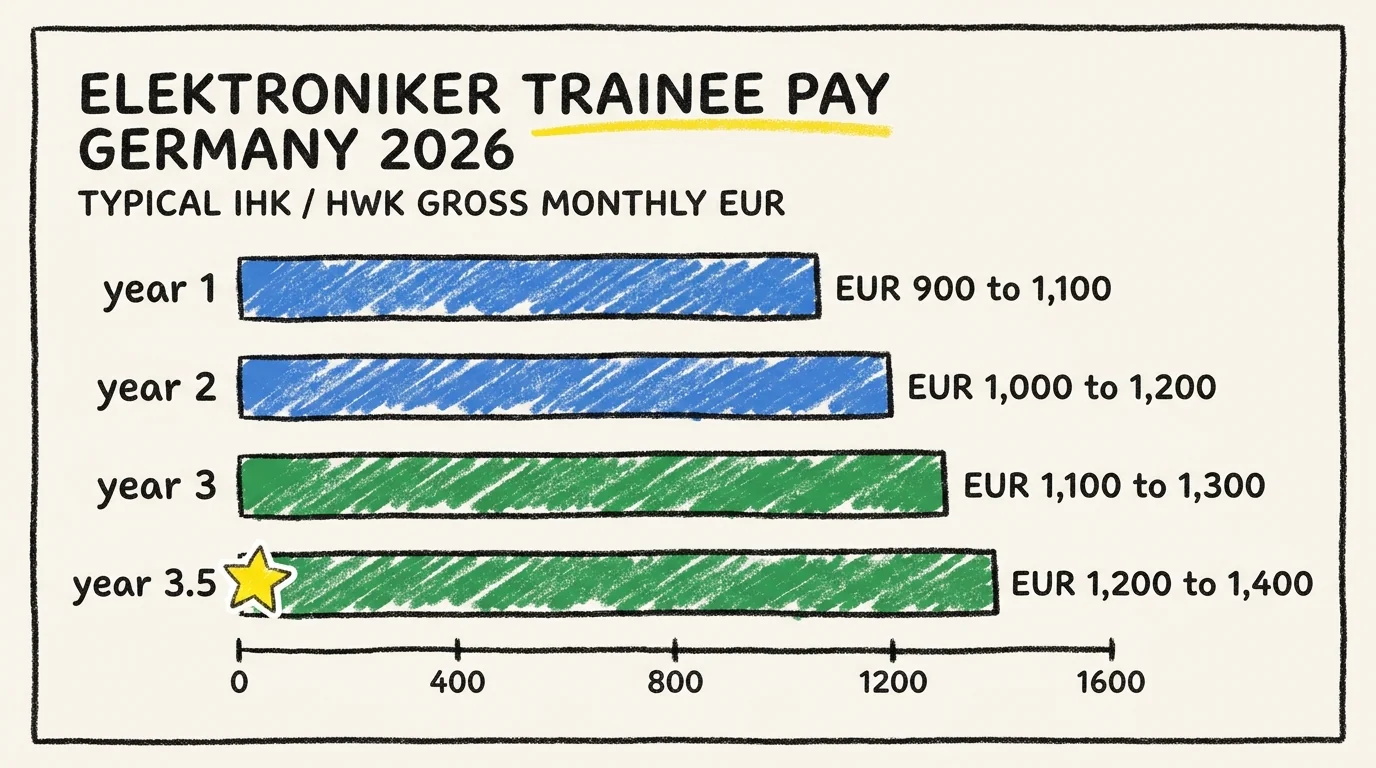
Trainee pay (Ausbildungsvergütung) is set by collective agreement (Tarifvertrag) per industry and region. The figures below are the 2026 IHK / HWK ranges most international trainees see in their contracts:
| Year | Monthly gross (EUR) |
|---|---|
| Year 1 | 900 to 1,100 |
| Year 2 | 1,000 to 1,200 |
| Year 3 | 1,100 to 1,300 |
| Year 3.5 (last 6 months) | 1,200 to 1,400 |
Industrial employers (Automatisierungstechnik, Geräte und Systeme tracks) typically pay the upper end of these bands. Handwerk firms doing Energie- und Gebäudetechnik pay the lower end, but offer better hands-on variety and faster path to running your own jobs. Gross numbers translate into roughly EUR 750 to 1,100 net after tax and social contributions for a single, childless trainee.
Combine this with the Deutschland-Ticket at EUR 58 per month for unlimited regional transport and the typical Ausbildung trainee can cover their own living costs in most German cities outside Munich, Frankfurt, and Hamburg.
Post-Ausbildung salaries and career path
Once you pass the Gesellenprüfung Teil 2 (final exam) you become a Geselle / Facharbeiter and start full-time work. Entry-level salaries in 2026:
| Stage | Gross monthly (EUR) | Notes |
|---|---|---|
| Fresh Facharbeiter (year 1 to 2) | 2,500 to 3,200 | Higher in industrial sector and metropolitan areas |
| Experienced Elektroniker (3 to 5 years) | 3,000 to 3,800 | Specialization premium for Automatisierungstechnik |
| Industriemeister Elektrotechnik (after Meister exam) | 4,000 to 5,200 | Roughly 2 years part-time evening study after Ausbildung |
| Bachelor Professional / Techniker / engineering top-up | 4,500 to 6,000+ | Several routes: HWK Meister, Techniker, or Berufsbegleitendes Bachelor |
The career ladder is well-defined and credentialed at every step. You can stop at Geselle and earn a comfortable living, or stack qualifications: Meister opens self-employment (you can run your own electrical firm only with a Meisterbrief in Energie- und Gebäudetechnik), Techniker opens industrial-engineering roles, and a part-time Bachelor opens project-management and design positions. Many large employers (Siemens, Bosch, Phoenix Contact, ABB) sponsor the Meister or Techniker fees for high-performing employees.
For a side-by-side with the Bachelor's track, see our Ausbildung vs Bachelor's comparison.
How the application process actually works
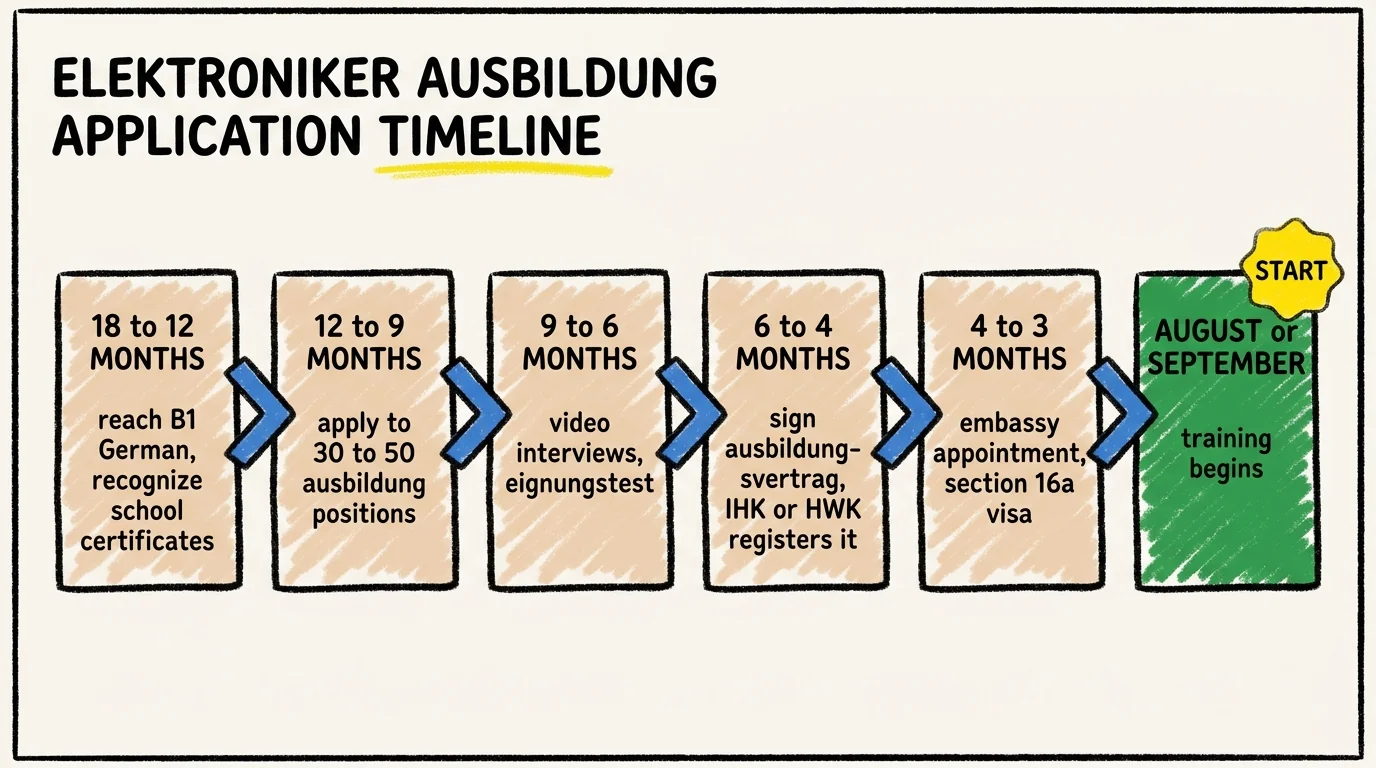
Most international applicants underestimate the lead time. Realistic timeline:
- 18 to 12 months before start: reach B1 German (Goethe, telc, or equivalent). Get school certificates evaluated on Anabin or by ZAB if your country is not listed at H+ level. Translate and apostille all certificates.
- 12 to 9 months before start: identify 30 to 50 Ausbildungsplatz openings on ausbildung.de, ihk-lehrstellenboerse.de, jobboerse.arbeitsagentur.de, and individual employer career pages. Apply with a German-language CV (tabular, one page), cover letter (Anschreiben, one page), school certificates, and language proof.
- 9 to 6 months before start: do video interviews. Most German employers screen on language, motivation, and basic technical-aptitude questions. Some require a Eignungstest (aptitude test) in math and logic.
- 6 to 4 months before start: sign Ausbildungsvertrag. The employer registers it with the IHK or HWK (this happens automatically; you do not need to do anything).
- 4 to 3 months before start: book embassy appointment for section 16a Ausbildung visa. Submit contract, school recognition, B1 certificate, health insurance proof, and accommodation letter.
- 2 to 1 months before start: visa decision. Travel to Germany. Register at the Bürgeramt (Anmeldung) within 14 days of arrival.
- August or September: training starts. The first month is usually orientation plus Berufsschule onboarding.
Skip any of these steps and the visa appointment becomes the bottleneck. Embassy slots in Pakistan, India, Vietnam, and the Philippines book out 8 to 12 weeks ahead.
Recognition, language, and the path to permanent residency
Two questions trip up most candidates:
Recognition of foreign schooling. The German embassy and the Auslaenderbehoerde need to see that your school qualifications are equivalent. Anabin lists most countries' systems by status (H+, H+/-, H-). H+ means automatically accepted; H+/- means individual review; H- means likely rejected. If your certificate is H- or unlisted, request a Zeugnisbewertung from the ZAB (kmk.org/zab) at least 6 months before the visa appointment. It costs EUR 200 and takes 6 to 8 weeks.
Language proof. Section 16a requires B1, but in practice you want B2 by month 6 of your Ausbildung. The Berufsschule grades your written exams in German and you cannot pass without solid reading and writing skills. Budget for a B1 to B2 intensive course in your home country, then continue with evening classes in Germany. Many employers reimburse language-course fees during the Ausbildung.
Permanent residency timeline. This is where Elektroniker beats most other professions. After completing your Ausbildung and working 2 years in a qualified Elektroniker role in Germany, you can apply for an unbefristete Niederlassungserlaubnis (permanent residency) under section 18c paragraph 1 Aufenthaltsgesetz. You need:
- 24 months of pension contributions
- B1 German (often already satisfied)
- A current Elektroniker employment contract
- No reliance on social benefits
Total time from arrival to permanent residency: roughly 5.5 years (3.5 Ausbildung plus 2 work). This is faster than the 5-year track for non-Blue-Card visa holders and on par with the EU Blue Card fast-track. Citizenship eligibility kicks in at 5 years total residence, with dual nationality allowed since June 2024. For more on the post-Ausbildung visa route, see Skilled Worker Visa section 18a vs 18b.
Common mistakes to avoid
- Picking a specialization based on salary alone. Automatisierungstechnik pays best, but it is the most academic of the five. If you struggle with abstract programming, you will struggle with PLC logic. Match the specialization to your actual aptitude.
- Treating B1 as the finish line. B1 gets you the visa. B2 keeps you in the Berufsschule. Plan continuous study from day one.
- Applying only to large industrial employers. Smaller Handwerk firms in towns like Bielefeld, Heilbronn, and Rosenheim hire international trainees aggressively, pay competitively, and offer faster responsibility.
- Ignoring the Eignungstest. Many companies use TestAS-style cognitive screens. Practice math and pattern-recognition tests in German for at least a month before applications.
- Skipping the in-person Bürgeramt registration. No Anmeldung means no tax ID, no bank account, no SIM card. Book the appointment before you fly.
- Underestimating the cost of moving. Plan for EUR 2,000 to 3,000 of upfront costs (deposit, first month rent, blocked-account top-up if required, basic furniture). Trainee salary covers living costs but does not fund the move.
Frequently Asked Questions
Can I do an Elektroniker Ausbildung in English?
No. The Berufsschule curriculum, IHK and HWK exams, safety standards, and trade documentation are all in German. A handful of large industrial employers offer English-language onboarding for the first 3 months, but the formal training and exams remain German-only. B2 by the end of year 1 is the practical threshold.
How much do international Elektroniker trainees earn after tax?
Roughly EUR 750 to 1,100 net per month during training (single, childless, tax class I). After Ausbildung, fresh Facharbeiter take home EUR 1,800 to 2,300 net per month at the EUR 2,500 to 3,200 gross level. Use our salary calculator for your specific city and tax class.
Which Elektroniker specialization is easiest to find an employer for?
Energie- und Gebäudetechnik. Every German town has electrical-installation firms looking for trainees, and the demand crosses all federal states. Automatisierungstechnik and Geräte und Systeme are concentrated in industrial regions (Baden-Württemberg, Bavaria, North Rhine-Westphalia), so geographic flexibility matters more.
Do I need a German employer to sign the contract before applying for the visa?
Yes. The signed Ausbildungsvertrag is the foundational document for the section 16a visa. The German embassy will not process the application without it. This is the longest part of the timeline and where most candidates spend 4 to 6 months.
Is the Elektroniker Ausbildung on the German shortage occupations list?
Yes, all five Elektroniker tracks appear on the Engpassberufe / Fachkräfteengpass list maintained by the Bundesagentur für Arbeit. This means faster visa processing under section 16a, lower scrutiny of recognition documents, and a faster path to permanent residency under section 18c after Ausbildung completion.
Can I switch from Elektroniker to electrical engineering studies later?
Yes. After completing Ausbildung you can enroll in a Fachhochschule for an Ingenieur (B.Eng.) degree without an Abitur, often with credit for parts of the curriculum. Several universities offer berufsbegleitende (part-time) Bachelor programs specifically for working Facharbeiter. Hochschule Esslingen, OTH Regensburg, and FH Aachen are popular routes.
What happens if I do not pass the final exam?
You can repeat the Gesellenprüfung Teil 2 once (some chambers allow twice). Failed exams do not invalidate your visa immediately, but you must be re-enrolled or in a related qualifying job within the visa renewal cycle. Pass rates are around 85% for first-time takers across all five specializations.
Where to next
- Ausbildung visa Germany 2026 guide: the visa application from start to finish
- IT Specialist (Fachinformatiker) Ausbildung: the technology-track sister profession with similar earning potential
- KFZ-Mechatroniker (automotive) Ausbildung: the auto-trade sister profession, also Section 16a, B1 entry
- Ausbildung vs Bachelor's compared: cost, salary trajectory, and PR timeline side by side
- Skilled Worker Visa section 18a vs 18b: the visa you will move to after Ausbildung
- Tools: salary calculator, visa eligibility checker, German grade calculator
Continue reading
Ausbildung·14 min read
Ausbildung vs Bachelor's in Germany: Cost, salary trajectory, PR timeline compared
Compare Ausbildung and Bachelor's in Germany on 2026 cost, year-by-year salary trajectory, EU Blue Card vs Niederlassungserlaubnis timelines.
Read articleAusbildung·12 min read
How to find an Ausbildung company in Germany from abroad: Portals, agencies, direct outreach
Find an Ausbildung training company in Germany from abroad. Official portals, free private boards, government recruitment schemes, agencies, and direct employer outreach.
Read articleAusbildung·12 min read
German B1 vs B2 for Ausbildung: Which level you actually need by profession
B1 is the visa floor for the Ausbildung visa, B2 is what most employers want. Profession-by-profession breakdown for nursing, technical trades, hospitality, logistics, IT.
Read articleReady to plan your Germany journey?
Explore our tools and resources to find the perfect university and program for your academic goals.