Ausbildung vs Bachelor's in Germany: Cost, salary trajectory, PR timeline compared
Compare Ausbildung and Bachelor's in Germany on 2026 cost, year-by-year salary trajectory, EU Blue Card vs Niederlassungserlaubnis timelines.

Table of contents
Last updated: May 2026
TL;DR: Ausbildung pays you between EUR 724 and EUR 1,300 a month while you train and gets you to permanent residency in two years. A Bachelor's degree costs you nothing or up to EUR 1,500 a semester for three years and lands you in jobs that reach permanent residency in 21 months via the EU Blue Card. The cheaper, faster route to settling depends on whether you want to be a Facharbeiter or a Hochschulabsolvent, not on which one is "better."
If you are a school-leaver weighing two ways into Germany, this is the question that matters: should you get on a plane and start an Ausbildung, or apply for a Bachelor's? Both lead to skilled-worker status. Both qualify for permanent residency. But the cost, the time, the salary curve, and the visa story are different enough that picking the wrong one will cost you years. We have compared them on five axes that actually move the needle: out-of-pocket cost, salary in years 1 to 5, time to permanent residency, visa requirements, and what happens if you change your mind. The pillar comparison page at Ausbildung vs Bachelor's covers the headline differences. This post drills into the numbers.
Ausbildung vs Bachelor's: the short answer
An Ausbildung is a paid, employer-led, three-year (sometimes two or three-and-a-half year) vocational training contract. You sign with a German company, work three or four days a week, attend Berufsschule one or two days, and walk out with an IHK-certified Facharbeiter qualification. Salary is paid throughout. The 2026 statutory minimum is EUR 724 in year one, EUR 854 in year two, EUR 977 in year three (BIBB, 2026). Many trades and most large employers pay 20 to 40 percent above that.
A Bachelor's degree is a three-year (180 ECTS) academic programme at a German university or Hochschule. You pay nothing in tuition at most public universities. You pay a semester contribution of EUR 100 to EUR 400 (this covers the Semesterticket and student services). Baden-Württemberg charges non-EU students EUR 1,500 per semester on top, and a handful of programmes at private universities run from EUR 5,000 to EUR 20,000 a year. You earn no salary; you live on savings, blocked-account proof, scholarships, or a part-time student job (capped at 140 days a year for non-EU students).
Five years out, the picture flips. The Ausbildung graduate is a Facharbeiter on roughly EUR 36,000 to EUR 48,000 gross, with two to three years of work experience and likely permanent residency. The Bachelor's graduate is one to two years into a graduate-track job at EUR 45,000 to EUR 65,000 gross (higher in IT, engineering, finance), still on a residence permit, but on a faster track to PR if they qualify for the EU Blue Card.
What an Ausbildung actually is
Ausbildung is the German dual-training system. You are an employee, not a student. Your contract is between you and the firm; the Berufsschule is the public counterpart. You get paid leave (24 to 30 days), social insurance, and a proper employment record from day one. Roughly 327 recognised training occupations exist, from Mechatroniker to Bankkaufmann to Pflegefachmann to Fachinformatiker. Most run three years; a few run two or three-and-a-half.
The trade-off: you pick a profession at age 18 to 22 and you stick with it. Switching tracks later is possible but costly. International students can do an Ausbildung on a §16a residence permit, typically requiring B1 German (B2 for nursing), proof of an Ausbildungsvertrag with a German company, and recognition of your school certificates. We cover the catalogue and entry routes in our top Ausbildung courses for international students breakdown.
What a Bachelor's actually is in Germany
A Bachelor's in Germany is a 180 ECTS academic degree, awarded by Universitäten (research-heavy, theoretical) or Hochschulen für Angewandte Wissenschaften (applied, often with mandatory internships). Public universities are tuition-free for almost all programmes; the exception is Baden-Württemberg's EUR 1,500 per semester for non-EU students. The semester contribution at every public uni runs EUR 100 to EUR 400 and includes a public-transport pass for the city or sometimes the whole state.
Entry is competitive. You need a Higher Education Entrance Qualification (HZB) recognised by the German embassy, an APS certificate (for India, China, and Vietnam), German at B2 to C1 (or English at B2 to C1 if the programme is taught in English), and you typically apply through Uni-Assist. Some programmes have NC (Numerus Clausus) cutoffs based on your converted grade. Many universities also require a TestAS aptitude test score from non-EU Bachelor's applicants. We cover the full mechanics in admission requirements for Bachelor's in Germany.
Cost: who pays whom
The single biggest framing mistake is treating Ausbildung as the "cheap" option and Bachelor's as the "expensive" one. They are differently expensive. An Ausbildung pays you; a Bachelor's costs you living expenses for three years.
| Cost component | Ausbildung (3 years) | Bachelor's at public uni (3 years) |
|---|---|---|
| Tuition / programme fee | EUR 0 (employer pays) | EUR 0 in 14 of 16 Bundesländer; EUR 9,000 total in Baden-Württemberg for non-EU |
| Semester contribution | n/a | EUR 600 to EUR 2,400 over 3 years |
| Living costs in modest city | Roughly covered by salary | EUR 36,000 to EUR 50,000 over 3 years |
| Blocked account requirement at visa | Not required | EUR 11,904 for 2026 (one year upfront) |
| Salary you receive | EUR 19,800 to EUR 36,000 over 3 years | EUR 0 (limited part-time work allowed) |
| Net financial position after 3 years | Plus EUR 15,000 to EUR 30,000 (after living costs) | Minus EUR 36,000 to EUR 60,000 |
So in year-three terms, a Bachelor's graduate is typically EUR 50,000 to EUR 90,000 worse off financially than an Ausbildung graduate, before either has taken their first "real" job. The Bachelor's pathway closes that gap with a higher salary curve. The question is how fast.
For a deeper dive into Bachelor's-specific living and study costs, see our cost of studying Bachelor's in Germany breakdown.
Salary trajectory: years 1 to 10
Numbers below are gross monthly equivalents in 2026 EUR, drawn from BIBB minimum-wage tables, IHK collective agreements, Bundesagentur für Arbeit Entgeltatlas, and Stepstone Gehaltsreport 2025/2026. They are typical mid-range; outliers in IT, engineering, and finance run 20 to 40 percent higher; care and hospitality run 10 to 20 percent lower.
| Year | Ausbildung path | Bachelor's path |
|---|---|---|
| Year 1 | EUR 724 to 1,100 (apprentice) | EUR 0 (studying) |
| Year 2 | EUR 854 to 1,200 (apprentice) | EUR 0 (studying) |
| Year 3 | EUR 977 to 1,300 (apprentice) | EUR 0 (studying) |
| Year 4 | EUR 2,800 to 3,800 (Facharbeiter year 1) | EUR 3,200 to 4,500 (entry-level graduate) |
| Year 5 | EUR 3,000 to 4,000 (Facharbeiter year 2) | EUR 3,500 to 5,000 (graduate year 2) |
| Year 7 | EUR 3,400 to 4,600 (Geselle / experienced Facharbeiter) | EUR 4,200 to 6,500 (mid-level, possibly with Master's) |
| Year 10 | EUR 4,000 to 5,500 (foreman, Meister track, specialist) | EUR 5,000 to 8,500 (senior, manager, lead) |
The Bachelor's path overtakes the Ausbildung path around year 4 to 5 and the gap widens from there, especially in IT, engineering, finance, consulting, and pharma. Inside trades like electrical, mechatronics, and skilled manufacturing, a Meister-qualified Facharbeiter at year 8 to 10 can match a graduate's salary, particularly outside the big metro areas where rent eats the city premium. Care, retail, and hospitality stay below the academic curve at every stage.
For graduate-track salary breakdowns by field and city, our job opportunities after a Bachelor's in Germany post has the field-by-field numbers.
PR timeline: which route gets you Niederlassungserlaubnis faster
This is where the comparison turns counter-intuitive. The Ausbildung path is faster on paper than a regular Bachelor's plus standard work permit. The fastest route overall is a Bachelor's plus EU Blue Card with B1 German, but only graduates earning above the Blue Card threshold qualify.
Per Section 18c of the Aufenthaltsgesetz (AufenthG) and the Make-it-in-Germany federal portal:
| Pathway | Residence required | Pension months | German level | Total elapsed time from arrival |
|---|---|---|---|---|
| Ausbildung graduate working in trained field | 2 years post-training | 24 | B1 | 5 years (3 years training + 2 years work) |
| Bachelor's graduate, regular work permit | 2 years post-graduation | 24 | B1 | 5 years (3 years study + 2 years work) |
| Bachelor's graduate with EU Blue Card, B1 | 21 months | 21 | B1 | About 4 years 9 months |
| Bachelor's graduate with EU Blue Card, A1 | 27 months | 27 | A1 | About 5 years 3 months |
| Standard skilled worker (general route) | 3 years | 36 | B1 | Typically 6 years from arrival |
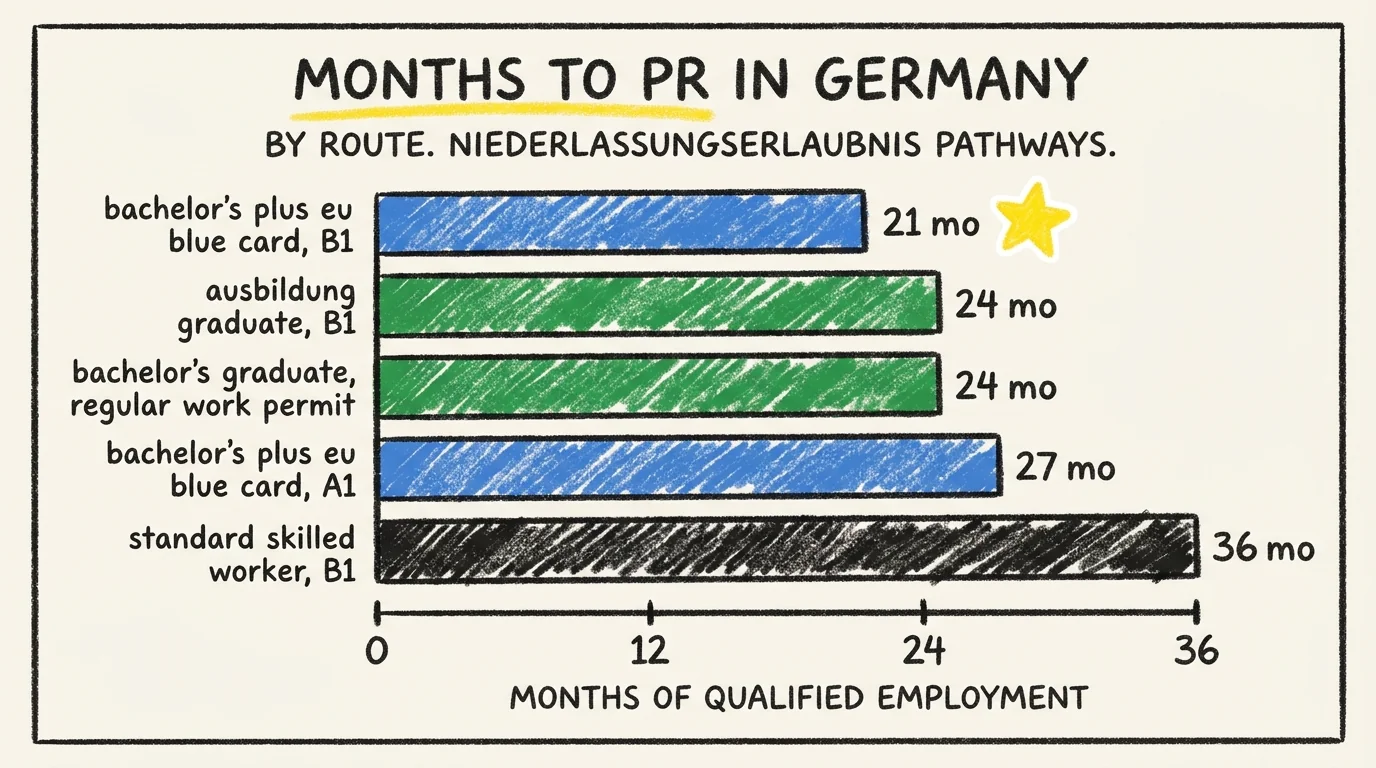
The Ausbildung route reaches PR around the same time as a Bachelor's plus regular work permit, both via the post-vocational/post-academic 2-year fast-track in §18c (1) and (2) AufenthG. The Bachelor's plus Blue Card route shaves three to six months off if the graduate lands a salary above the Blue Card minimum (which most STEM and IT graduates clear comfortably) and certifies B1.
Citizenship is a separate timer. Under the 2024 reform, you can naturalise after 5 years of residence (3 with exceptional integration). Both pathways meet that timeline cleanly.
Visa, language, age: who actually qualifies
The qualification gap is real and underestimated. Eligibility breaks down differently for the two routes.
For an Ausbildung visa (§16a):
- B1 German required for almost every trade. B2 required for nursing (approbation requirement).
- A signed Ausbildungsvertrag with a German employer (not just an offer letter).
- School certificates equivalent to a German Realschulabschluss or higher; recognised by the Anerkennung in Deutschland portal.
- Age effectively capped under 35 by employer preference, though no statutory cap.
- Proof of funds: usually not required if Ausbildung salary is at least the minimum (EUR 724 in 2026).
For a Bachelor's study visa (§16b):
- Higher Education Entrance Qualification (HZB) recognised by the German embassy. APS for Indian, Chinese, Vietnamese applicants.
- B2 to C1 in the language of instruction (German for German-taught, English for English-taught).
- Proof of funds: blocked account with EUR 11,904 for 2026 covering one year, or scholarship, or sponsor declaration.
- University admission letter (Zulassung) before visa application.
- Programme NC requirements where applicable.
Plain-English summary: Ausbildung is gated by German language and finding an employer. Bachelor's is gated by academic credentials and money in the bank. If you have neither EUR 12,000 nor strong school grades, Ausbildung is your route. If you have grades but B2 German is years away, an English-taught Bachelor's may fit better. If you have both, the choice comes down to whether you want to study or to start earning immediately.
Decision framework: which route fits you
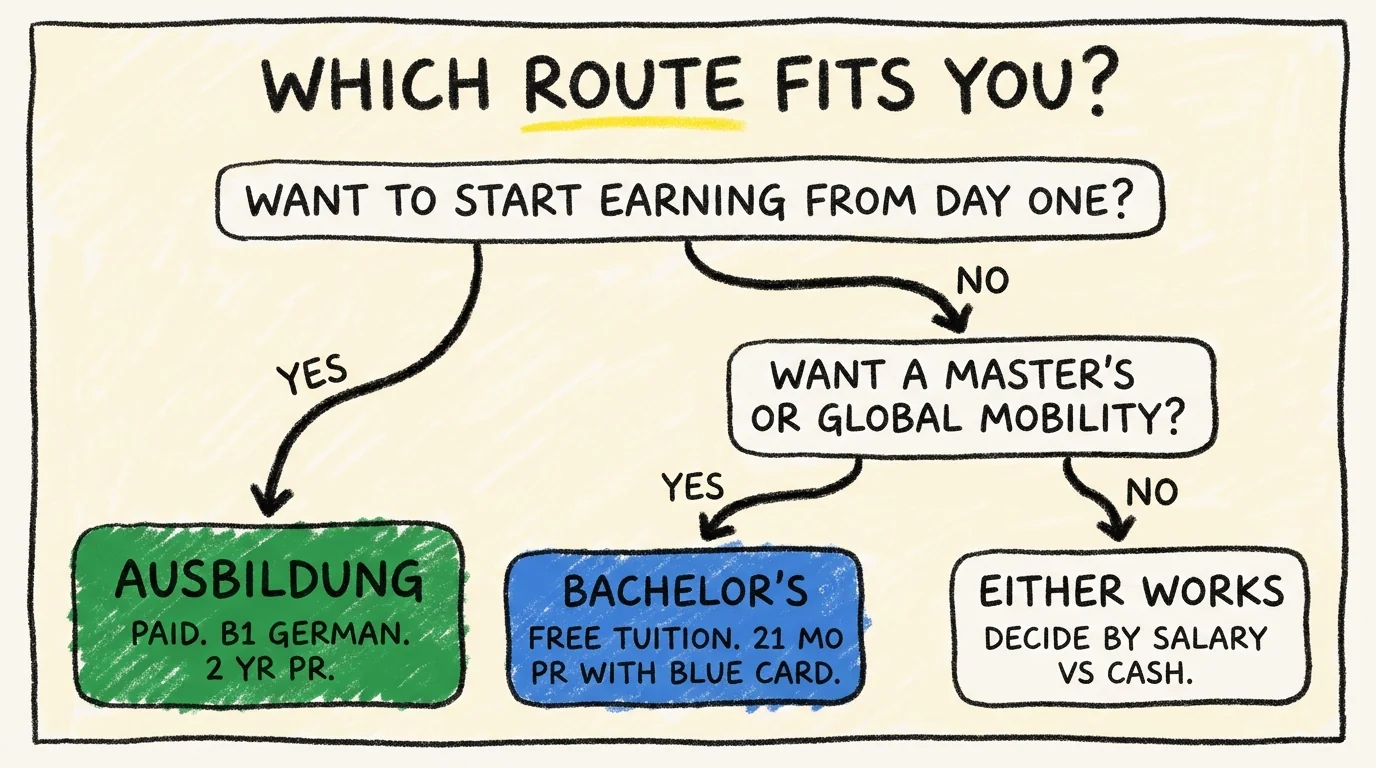
The right answer depends less on prestige and more on three honest questions: how much cash you can absorb in years 1 to 3, how confident you are about your career field at age 18 to 22, and whether you intend to stay in Germany for the long haul or treat it as a stepping stone.
If you want to settle in Germany, get to PR fast, and start earning before your peers do, Ausbildung is undervalued in international circles. It is the standard German middle-class entry. Two-thirds of Germans under 30 took this route. There is no social penalty for it inside the country. The catch: pick the trade carefully. We have a profession-by-profession breakdown in top 10 Ausbildung courses for international students.
If you want global mobility, an option to do a Master's, and access to the higher graduate-track salary curve, Bachelor's is the safer long-run bet. The cost-to-payoff equation makes more sense in a public university outside Baden-Württemberg. Plan for three to four years until you cross EUR 4,000 a month gross.
Common mistakes when choosing
Treating Ausbildung as second-tier. It is not. The German labour market values Facharbeiter qualifications as highly as a Bachelor's, often more in skilled trades. Outside Germany, the prestige gap is real. Inside, it disappears.
Assuming all Bachelor's degrees in Germany are tuition-free. They are not. Baden-Württemberg charges non-EU students EUR 1,500 per semester. A handful of private universities charge EUR 5,000 to EUR 20,000 a year. Read the small print before you commit.
Forgetting the 18-month job-seeker buffer for Ausbildung graduates. After completing the training, you get an 18-month residence permit to find work in your trained field. Bachelor's graduates get the same buffer. Neither is automatic; both require active applications.
Ignoring four years of foregone wages for a Bachelor's. That is real money. Even at a modest EUR 30,000 starting salary, three years of foregone earnings plus living costs is roughly EUR 100,000 of opportunity cost. The Bachelor's curve recovers that, but only over five to eight years.
Confusing Niederlassungserlaubnis with citizenship. PR (Niederlassungserlaubnis) is a permanent right to live and work. Citizenship is a passport. Both pathways reach PR in 4 to 5 years; citizenship takes 5 in either case under the 2024 rules. Do not conflate them.
Frequently asked questions
Is an Ausbildung worth it for international students compared to a Bachelor's?
For students who want to stay in Germany long-term and start earning quickly, yes. Ausbildung pays from day one, leads to skilled-worker status, and reaches permanent residency on the same timeline as a Bachelor's plus standard work permit. The catch is that you commit to a profession at age 18 to 22, and switching tracks later is harder than switching majors during a Bachelor's. For students who want a Master's option or international mobility, a Bachelor's is the safer bet.
Can I do a Master's after an Ausbildung?
Yes, with conditions. After completing an Ausbildung you can apply for a Master's if you also have either three years of relevant work experience plus a qualifying Hochschulzugangsberechtigung exam, or a Berufsmeister/Fachwirt qualification, depending on the state. It is not as direct as Bachelor-to-Master, and it usually requires another two years before you start the Master's.
Does a Bachelor's lead to permanent residency faster than an Ausbildung?
Only if you qualify for the EU Blue Card. A Bachelor's graduate on the EU Blue Card with B1 German reaches PR in 21 months of qualified employment, the fastest legal route. A Bachelor's graduate without Blue Card and an Ausbildung graduate both reach PR in 24 months under §18c (1) AufenthG. The difference is roughly three months, sometimes six.
How much German do I need for either route?
Ausbildung: B1 for almost every trade, B2 for nursing (a hard requirement for the approbation). Bachelor's: B2 to C1 if the programme is German-taught; B2 in English plus a basic A1 to A2 in German if the programme is English-taught. PR for both routes requires B1 plus the "Living in Germany" knowledge test.
Can I switch from Ausbildung to a Bachelor's later?
Yes, but it is a re-entry, not a transfer. After completing an Ausbildung, you typically need additional credentials (a Fachhochschulreife, three years of professional experience, or a Berufsmeister qualification) before applying to a university. Some Hochschulen für Angewandte Wissenschaften accept Ausbildung graduates directly into related Bachelor's programmes. Plan for an extra year or two of preparation either way.
Which earns more after 10 years:
Ausbildung or Bachelor's?
A Bachelor's graduate on the academic track typically earns more by year 10, especially in IT, engineering, finance, and consulting, where the gap can run EUR 1,500 to EUR 3,000 a month. Inside skilled trades, a Meister-qualified Facharbeiter (additional Meister exam after the Ausbildung) can match a graduate's salary in skilled manufacturing, electrical, and crafts. Care, retail, and hospitality Ausbildung graduates typically stay below the academic curve at every stage.
Can I bring my family on either visa?
Yes for both, with conditions. The §16a Ausbildung permit allows family reunification once your salary covers your dependents' living costs without state assistance, you have proof of suitable housing, and your spouse demonstrates basic German (A1 typically). The §16b student permit allows family reunification but spouses cannot work full-time on a derivative permit until you transition to a work permit. Once you switch to a §18a, §18b, or §18g (Blue Card) work permit, family rules ease significantly.
Where to next
Continue reading
Ausbildung·11 min read
Top 10 Ausbildung Courses in Germany for International Students
Discover the best Ausbildung courses in Germany for international students. Learn about top programs, career opportunities, and how to start your vocational training in one of Europe's strongest economies.
Read articleAusbildung·16 min read
Ausbildung visa Germany 2026: Complete application guide, documents, timeline
Step-by-step guide to the German Ausbildung visa under Section 16a AufenthG: who qualifies, documents, 2026 financial proof, processing time, and what happens after arrival.
Read articleAusbildung·15 min read
IT Specialist (Fachinformatiker) Ausbildung in Germany: Tracks, salary, post-Ausbildung jobs
Fachinformatiker IT Ausbildung in Germany. Four specialisation tracks, trainee and post-training salaries, B1 visa rules, application timeline.
Read articleReady to plan your Germany journey?
Explore our tools and resources to find the perfect university and program for your academic goals.