Nursing Ausbildung in Germany for international applicants: Visa, B2 requirement, salary, top recruiters
Nursing Ausbildung in Germany 2026 for international applicants: visa under Section 16a, B2 German requirement, monthly salary, top recruiters.

Table of contents
Last updated: May 2026
TL;DR: Nursing Ausbildung in Germany is a 3-year paid generalist training program (Pflegefachfrau / Pflegefachmann) open to international applicants on a Section 16a vocational training visa. You need B1 German for the visa and B2 to actually sign a hospital contract. Public-sector trainees earn roughly EUR 1,341 / 1,402 / 1,503 per month gross across years 1, 2, 3, and qualified nurses earn EUR 3,300 to 3,800 per month after passing the Staatsexamen.
Nursing is the single easiest skilled route into Germany for non-EU applicants in 2026. The shortage is structural, every state recognises the qualification, and the path from a B1 certificate in your home country to a permanent residence permit can be as short as five years. This guide walks through the visa, the language hurdle, the actual paycheque (with 2026 numbers), the recruiters worth applying through, and the permanent-residency math at the end.
If you are weighing nursing against other vocational tracks, also read our top 10 Ausbildung courses in Germany overview and the wider /train/professions hub. For the recognition side, see what ZAB does and why your foreign nursing degree needs it.
What is the Nursing Ausbildung in Germany?
Since 2020, the three traditional German nursing tracks (general nursing, paediatric nursing, geriatric care) have been merged into one generalist qualification under the Pflegeberufegesetz (PflBG). The job title you graduate with is Pflegefachfrau or Pflegefachmann, and that title is recognised across the EU under Directive 2005/36/EC.
Headline numbers from the law and the matching training regulation (PflAPrV):
- Duration: 3 years full-time, or 5 years part-time
- 2,100 hours of theory at a state-recognised nursing school (Pflegeschule)
- 2,500 hours of practical placements across hospitals, outpatient services, paediatric wards, and long-term care homes
- Concludes with a state examination (Staatsexamen), after which you receive a federal license (Berufserlaubnis) to work as a registered nurse anywhere in Germany
- Free training: you do not pay tuition. The hospital pays you a monthly Ausbildungsvergütung from day one
Source: Bundesgesundheitsministerium, Pflegeberufegesetz § 6 and the matching PflAPrV.
The visa route:
Section 16a Aufenthaltsgesetz
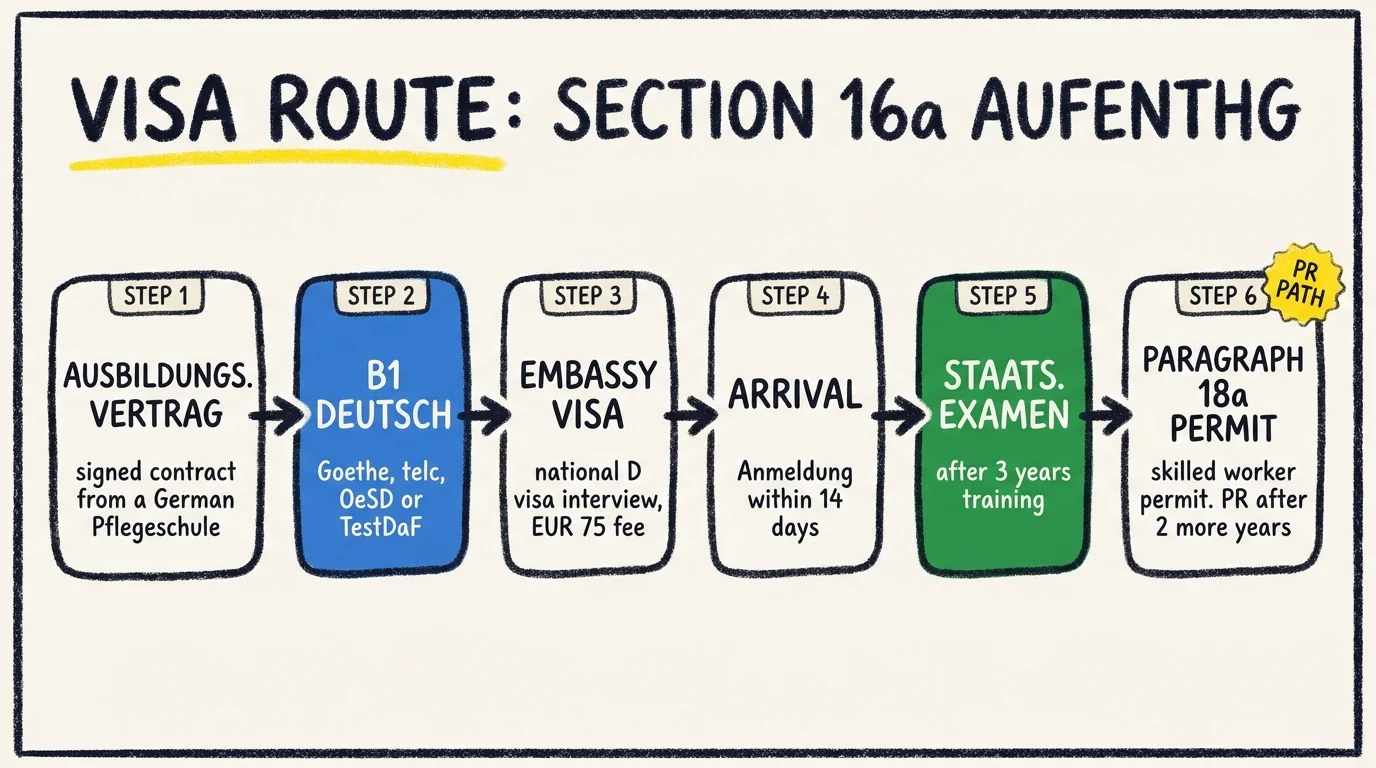
Non-EU applicants enter Germany on a National D visa for vocational training (Section 16a AufenthG). This is the same legal basis as every other Ausbildung visa, but in practice nursing has the most predictable approval rate because of the named-shortage status of the profession.
You can only apply for the visa after a German nursing school or hospital chain has issued a signed training contract (Ausbildungsvertrag). The contract is the document the embassy needs to see; without it the application will not be processed.
Documents the embassy will ask for
| Document | Notes |
|---|---|
| Valid passport | At least 12 months remaining |
| Signed Ausbildungsvertrag | From a state-approved Pflegeschule or hospital |
| School-leaving certificate (Zeugnis) | Must be equivalent to German Realschulabschluss or higher; APS for India / China / Vietnam applicants |
| German language certificate | B1 minimum (Goethe, telc, ÖSD, or TestDaF). B2 if the employer asked for it |
| Proof of financial means | Either a Sperrkonto (EUR 11,904 for the first 12 months) OR a formal employer cost-coverage letter (Verpflichtungserklärung) for trainees |
| Health insurance | Travel insurance for entry, switched to GKV student tariff after Anmeldung |
| Visa fee | EUR 75 |
After arrival you swap the entry visa for a residence permit for vocational training at the local Ausländerbehörde, valid for the duration of the program. Once you pass the Staatsexamen, you switch again, this time to a § 18a residence permit for skilled workers, which you renew every four years and which counts toward permanent residency.
The Bundesrat formally asked the federal government to fast-track this final switch in March 2026 (Drucksache 35/26), citing the months-long backlog at most Ausländerbehörden. The reform is not yet law, so plan for an 8-to-12 week wait between graduation and the new permit.
Language:
B1 gets you the visa, B2 gets you the contract
This is the part international applicants most often misjudge. The legal floor for the Ausbildungsvisum is B1 German, but every major hospital chain in Germany asks for B2 before signing the training contract, because the Pflegeschule curriculum (anatomy, pharmacology, ethics, documentation) is taught entirely in German and trainees who arrive on B1 routinely fail the first-year exams.
In practice:
- Triple Win and the Hand-in-Hand for International Talents programs cover free A1-to-B1 language training in your home country, then a top-up B2 course in Germany once you arrive
- Hospital chains like Helios, Asklepios and Vivantes run their own pre-employment B2 prep through Goethe-Institut partners
- Self-funded applicants typically spend EUR 1,500 to EUR 3,000 on a private B2 intensive at a Goethe-Institut or telc-accredited school
The accepted certificates are Goethe-Zertifikat B2, telc Deutsch B2, ÖSD B2, and TestDaF TDN 4 in all four sub-skills. Any of these is enough for any state. If you are still on B1, our German language path overview breaks down what each level actually tests.
What you earn during the Ausbildung (2026 figures)
Trainees at public hospitals are paid under the TVAöD-Pflege collective agreement, which sets the floor for the entire sector. The 2026 monthly gross figures for a generalist Pflegeausbildung are:
| Year | Monthly gross (TVAöD-Pflege public sector) | Monthly gross (private / non-collective floor) |
|---|---|---|
| Year 1 | EUR 1,341 | EUR 1,000 to EUR 1,200 |
| Year 2 | EUR 1,402 | EUR 1,100 to EUR 1,300 |
| Year 3 | EUR 1,503 | EUR 1,200 to EUR 1,400 |
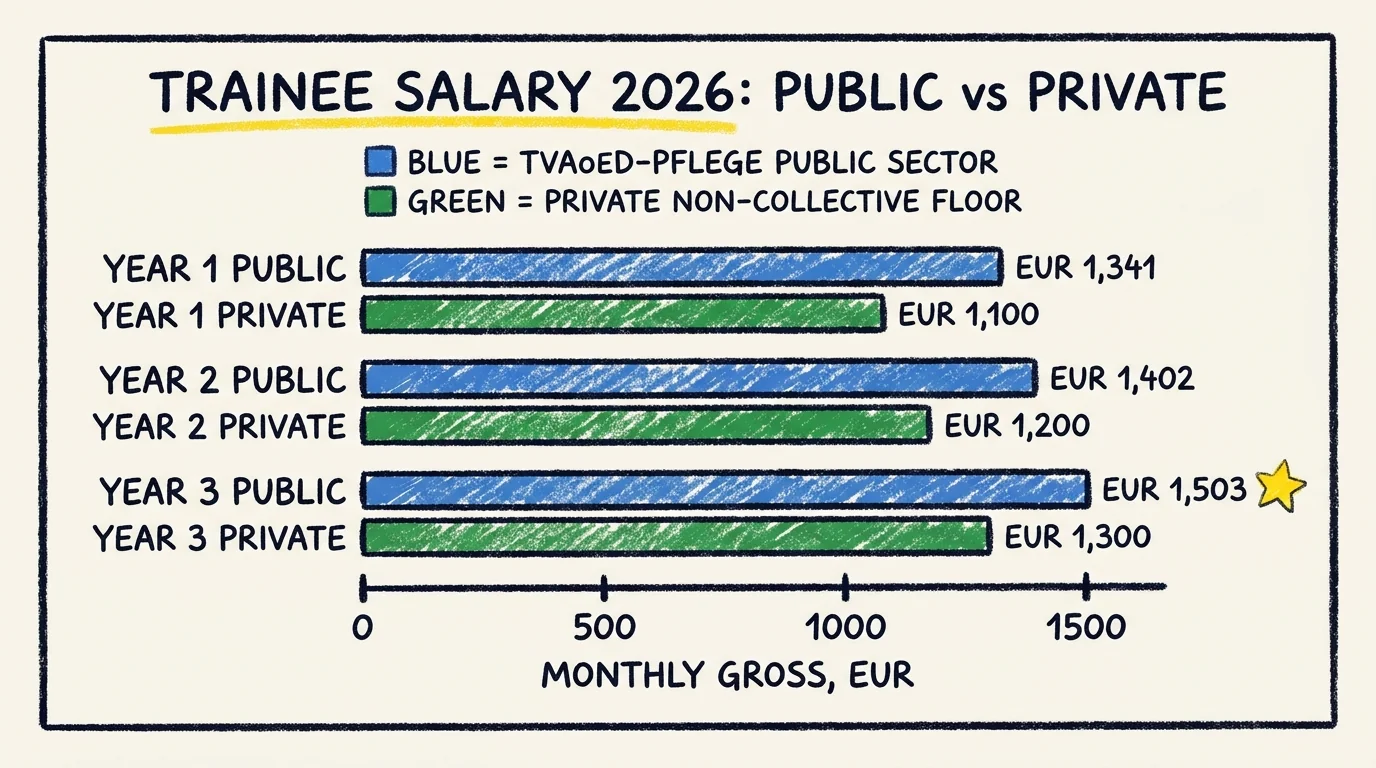
After tax and social contributions (roughly 18 to 22 percent for a single trainee in tax class 1), net take-home in year 1 is around EUR 1,080 and in year 3 around EUR 1,200. That is enough to cover rent in a shared flat (EUR 350 to EUR 500), the EUR 58 Deutschland-Ticket, food, and basic insurance in any city outside Munich, Frankfurt, and Hamburg. In the three priciest cities, expect to share a Wohngemeinschaft and watch your budget closely.
Three details applicants miss:
- Christmas bonus: Public-sector trainees get a 13th-month payment in December, worth roughly 90 percent of one monthly salary
- Shift premiums: Night, weekend, and holiday shifts are paid extra (typically 25 to 35 percent on top), even during the practical placements
- Annual leave: 30 working days per year, plus paid sick leave from day one
Salary after the Ausbildung
Once you pass the Staatsexamen and start as a registered Pflegefachfrau or Pflegefachmann, the public-sector pay scale jumps significantly. As of 2026, a starting Pflegefachkraft on TVöD-P 7 earns:
- Entry-level (TVöD-P 7, step 1): EUR 3,304 per month gross
- After 3 years (step 3): EUR 3,656 per month gross
- After 6+ years with specialisation: EUR 4,000 to EUR 4,400 per month gross
- Intensive care, OR, anaesthesia, or oncology specialisation: EUR 4,200 to EUR 4,800 per month gross plus shift premiums
Net take-home for a single nurse in tax class 1 starting in 2026 is roughly EUR 2,250 per month, plus an extra EUR 300 to EUR 600 from night and weekend premiums in a typical month.
Private hospitals (Helios, Asklepios, Sana) pay slightly above TVöD on average, and Caritas and Diakonie hospitals have their own collective agreements (AVR) that mirror TVöD closely. For a deeper salary breakdown across healthcare roles, see our healthcare jobs in Germany guide.
Top recruiters and programs to apply through
Five legitimate routes account for almost all international Pflege placements in 2026. Stick to these and avoid pay-to-recruit agencies that charge candidates upfront fees, which is illegal under German law (the employer always pays the placement, never the nurse).
1. Triple Win Program (BA + GIZ)
The flagship government-to-government program, run jointly by the Federal Employment Agency (Bundesagentur für Arbeit) and the GIZ (Deutsche Gesellschaft für Internationale Zusammenarbeit). Active partner countries in 2026: Bosnia and Herzegovina, Indonesia, the Philippines, Tunisia, and India (Kerala). Triple Win covers free A1-to-B1 German training, ethical recruitment, fair employment contracts, and ongoing on-site support after arrival. Apply through the employment agency in your home country.
Source: Triple Win Programm and GIZ factsheet.
2. Hand-in-Hand for International Talents
A newer Bundesagentur pilot for Indonesia, India, Vietnam, and Brazil. It targets nurses already qualified in their home country and routes them through a structured pre-employment German course before they sign with a German hospital. Smaller intake than Triple Win but a similar fee-free model.
3. Hospital chain direct-recruit programs
The largest German hospital networks all run their own international recruitment teams:
- Helios Kliniken (90+ hospitals across Germany)
- Asklepios Kliniken (170 facilities)
- Vivantes (Berlin, public)
- Charité Universitätsmedizin Berlin (one of Europe's largest teaching hospitals)
- Sana Kliniken and Schön Klinik (private, mid-sized)
Apply directly on each chain's career portal (search for "Pflegeausbildung international"). Most chains will fly you to Germany for the embassy interview if your B1 certificate is in hand.
4. Caritas / Diakonie networks
Catholic and Protestant hospital networks employ roughly one third of all German nurses. Their collective agreement (AVR) closely tracks TVöD, and they are the largest single employer of trainees in southern Germany. Apply through diocese-level career portals or via the Caritas international recruitment desk.
5. State employment agency portals
Search Make-it-in-Germany.com and the Bundesagentur für Arbeit Job-Börse with the keyword "Pflegeausbildung". Both portals list state-approved Pflegeschulen and verified employer contracts.
Permanent residency and citizenship after the Ausbildung
This is where the math gets interesting. Once you pass the Staatsexamen and switch to a § 18a skilled-worker residence permit, the clock starts on permanent residency.
| Milestone | Time required after Ausbildung |
|---|---|
| Permanent residence permit (Niederlassungserlaubnis) | 2 years of qualified employment |
| Eligibility for German citizenship | 5 years total stay (3 years with C1 German and special integration) |
| EU long-term residence | 5 years of legal residence |
Total time from your first day in Germany to permanent residency: 5 years (3 years Ausbildung + 2 years employment). Total time to a German passport: 5 years under the 2024 reform, with dual citizenship allowed since June 2024. For a deeper walkthrough see the fast-track PR guide for Germany.
Common mistakes international applicants make
- Applying with B1 to a hospital that requires B2. Read the contract listing carefully. If it asks for B2, your B1 will not pass the HR screen, no matter how strong the rest of your file is.
- Paying a recruitment fee. Any agent asking you for an upfront fee in exchange for a Pflegeausbildung placement is acting illegally. The employer pays the placement; you pay your own travel, language certificate, and translation costs only.
- Skipping the Anabin / ZAB check. If you already have a nursing degree from your home country, run it through Anabin first to see whether you qualify for the faster recognition path under the 2025 Anerkennungsgesetz reform, instead of starting a 3-year Ausbildung from scratch.
- Choosing the cheapest Pflegeschule. Not all schools have the same hospital partnerships, and your year-1 placement quality is set by the school's network. Ask for a list of partner hospitals before signing.
- Forgetting Anmeldung in the first 14 days. Without a Wohnungsgeberbestätigung and a registered address, you cannot open a bank account, get a tax ID, or activate your health insurance. Treat it as the first thing you do after landing.
Frequently asked questions
Is the Nursing Ausbildung free for international applicants?
Yes. The training itself is free, and the hospital pays you a monthly stipend from day one. You only pay your own travel, language certificate, document translation, and visa fee. Reputable recruitment programs (Triple Win, Hand-in-Hand) cover the language course as well.
Can I do the Pflegeausbildung in English?
No. There is no English-taught nursing Ausbildung in Germany. The curriculum, the state examination, and the day-to-day work on the ward are all in German. Plan on B2 before you arrive and C1 within two years of starting work.
What is the age limit for the Nursing Ausbildung?
There is no formal age limit. Most trainees are between 18 and 35, but applicants in their 40s and 50s are increasingly common. The 2026 visa reforms also opened easier paths for "silver" workers (50 plus) retraining into nursing.
Can I bring my family to Germany during the Ausbildung?
Family reunification is possible but stricter than for the Blue Card. You need to show stable income (the Ausbildungsvergütung counts), enough living space, and basic German skills for your spouse (A1). Children under 18 can usually join with the spouse. See our family reunification visa guide for the full document list.
What happens if I fail the Staatsexamen?
You get one repeat attempt for each part of the exam. Pflegeschulen run intensive prep modules in the months before the test, and the failure rate for trainees who completed all 5,100 hours is below 10 percent. If you fail twice, your residence permit ends and you must leave Germany unless you switch to another visa category.
Can I switch from a Pflegeausbildung to a different career path mid-training?
Yes, but only with employer consent and a new training contract. Most trainees who switch do so within the nursing field (e.g., from elderly care to paediatric specialisation) rather than out of nursing entirely. If you switch out, you also have to leave Germany within 6 months unless you secure a different qualifying contract.
Is there a fast-track route if I already have a nursing degree from my home country?
Yes. Under the 2025 Anerkennungsgesetz reform, foreign-trained nurses can apply for direct recognition through ZAB rather than starting a fresh Ausbildung. The recognition process takes 6 to 12 months and may include a 6-month adaptation course (Anpassungslehrgang) at a German hospital. This is faster than the 3-year Ausbildung if your home-country qualification is substantial.
Where to next
- Compare nursing against the other top vocational paths in our top 10 Ausbildung courses in Germany overview
- Run your existing nursing qualification through the ZAB recognition guide to see if you qualify for the faster route
- See full salary ranges for healthcare roles in our healthcare jobs in Germany breakdown
- Browse the full list of regulated Ausbildung professions on the /train/professions hub
- Calculate your post-Ausbildung salary and net pay using our Germany salary calculator
Continue reading
Ausbildung·16 min read
Ausbildung visa Germany 2026: Complete application guide, documents, timeline
Step-by-step guide to the German Ausbildung visa under Section 16a AufenthG: who qualifies, documents, 2026 financial proof, processing time, and what happens after arrival.
Read articleAusbildung·11 min read
Top 10 Ausbildung Courses in Germany for International Students
Discover the best Ausbildung courses in Germany for international students. Learn about top programs, career opportunities, and how to start your vocational training in one of Europe's strongest economies.
Read articleAusbildung·12 min read
How to find an Ausbildung company in Germany from abroad: Portals, agencies, direct outreach
Find an Ausbildung training company in Germany from abroad. Official portals, free private boards, government recruitment schemes, agencies, and direct employer outreach.
Read articleReady to plan your Germany journey?
Explore our tools and resources to find the perfect university and program for your academic goals.