How to find an Ausbildung company in Germany from abroad: Portals, agencies, direct outreach
Find an Ausbildung training company in Germany from abroad. Official portals, free private boards, government recruitment schemes, agencies, and direct employer outreach.

Table of contents
Last updated: May 2026
TL;DR: From abroad, you find an Ausbildung company in Germany through five channels: official government portals (Make-it-in-Germany, the BA Lehrstellenbörse, the IHK Lehrstellenbörse), free private job boards (Azubiyo, Aubi-plus, Ausbildung.de), government-to-government recruitment programs (Triple Win for nurses, ZAV for skilled worker placements), licensed private agencies, and direct outreach to employers via LinkedIn or company career pages. Most successful applicants combine three of these in parallel, allow 9 to 12 months for the search, and only pay a fee at the end of the pipeline (visa stamping), never upfront.
Finding a German training company is the real bottleneck for an Ausbildung from outside the EU. The visa under Section 16a Aufenthaltsgesetz cannot be filed until you hold a signed Ausbildungsvertrag, so the consulate slot, the language certificate, and the recognition letter are all downstream of one decision: a Berufsschule-linked employer in Germany agreeing to take you on. The training framework, the salary, the chamber, and the visa pathway are all standardised through the Bundesagentur für Arbeit and the local IHK or HWK. What is not standardised is how a company in Hamburg or Stuttgart hears about you while you are still in Pune, Lagos, or Manila. This guide maps the five channels that actually work in 2026, the order to use them, and where the scams cluster so you stop sending money to the wrong people.
If you are still deciding between routes into Germany, the pillar guide on how to apply for Ausbildung covers eligibility and timeline. Once you have a target profession (most international applicants pick from the top Ausbildung courses), the company-search work below begins.
Why finding a company is harder than the visa
The Ausbildung visa is one of the most permissive routes Germany offers. Section 16a allows you to enter, train for two to three and a half years, and apply for a residence permit for skilled workers afterwards. Salary during training is mandated by the IHK and BIBB at floor amounts that scale by year and sector. Chambers verify the contract before training starts. The state pays for the Berufsschule. Compared to the Bachelor's or Master's funnel, the regulatory machinery is mature and friendly to non-EU candidates.
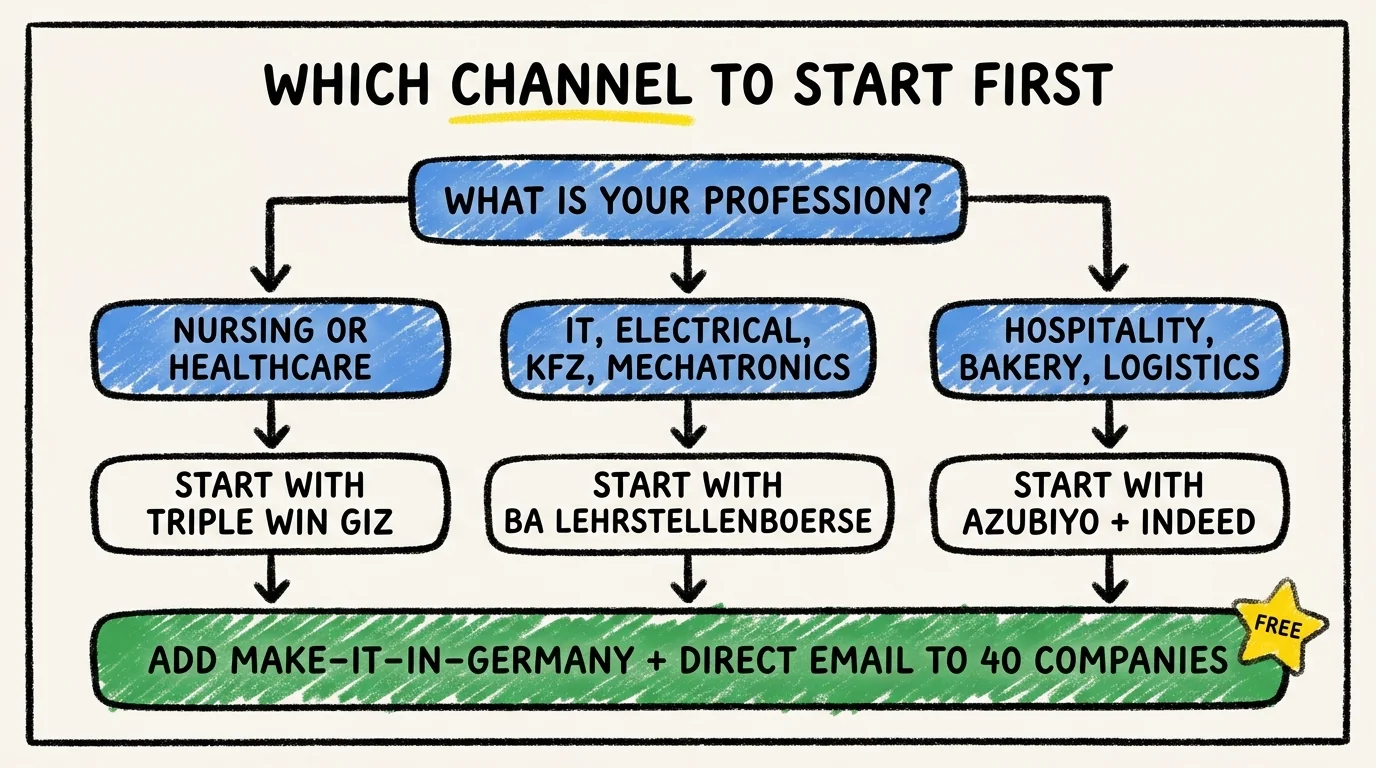
The hard part is upstream. There are roughly 480,000 advertised Ausbildung positions across Germany every year, but only a small share are open to applicants who do not yet live in Germany and require a visa. A Mittelstand workshop in Bavaria with three trainee slots will usually fill them from the local Realschule pipeline before considering an unknown profile from abroad. Your job is to find the share of employers who do think internationally, who have hired non-EU trainees before, who can read an English CV, and who know what a Section 16a application looks like. Those companies cluster in healthcare, hospitality, IT, electrical and electronic trades, KFZ, logistics, and gastronomy.
Channel 1:
Official government portals
These are free, vetted, and what the German embassy will reference back to you if you ask. Start here.
Make-it-in-Germany Quick Check and Job Listings
The Make-it-in-Germany portal is run by the Federal Ministry for Economic Affairs and the Bundesagentur. Its vocational training section maintains an English-language listing curated for international applicants, plus a Quick Check tool that screens you for visa eligibility before you waste time applying. Listings here are pre-filtered for employers willing to sponsor a Section 16a visa, which is the single biggest filter you need at this stage.
BA Lehrstellenbörse
The Bundesagentur für Arbeit job board is the largest free Ausbildung database in Germany. Search interface is in German but every listing is verified by a public agency. Use the filters for Beruf (profession), Ort (city), and Beginn (start month) to narrow down. You can apply directly through the listing in most cases. The BA also runs ZAV, the central foreign-placement service for skilled workers, which acts as a free public recruitment intermediary for select sectors.
IHK Lehrstellenbörse
The IHK Lehrstellenbörse is the chambers' own board, holding more than 100,000 advertised positions in commercial and industrial trades. Postings come straight from chamber-registered training companies, so every position carries a guaranteed framework contract and chamber oversight. For technical and IT-side professions, this is the densest concentration of legitimate slots in the country.
Channel 2:
Free private job portals
These exist in parallel to the public boards and often have more advanced filters or English UI layers.
| Portal | What it is | Best for | Language |
|---|---|---|---|
| Azubiyo | Largest commercial Ausbildung board, includes a profession-fit Berufstest | Wide search across all sectors | German with limited English |
| Aubi-plus | Curated by sector with strong filtering | Craft, technical, service trades | German with some English content |
| Ausbildung.de | StepStone-owned listing aggregator | Volume search, employer pages | German |
| StepStone Ausbildung | Generalist job board with a dedicated Ausbildung tab | Larger employers, English-speaking firms | German with English filters |
| Indeed Ausbildung | Aggregator pulling from many sources | Cross-checking listings, English search | English available |
Most of these portals are free for applicants. None require you to pay, ever. If a portal asks for a registration fee, walk away.
The practical workflow is to set up a saved search on Azubiyo for your target profession plus three or four cities, repeat the same search on the BA Lehrstellenbörse, and check Make-it-in-Germany weekly. The same employer will not always post on every channel, so duplicating the search across three portals raises your visible job pool by 40 to 60 percent.
Channel 3:
Government-to-government recruitment programs
For specific sectors, German federal agencies run direct recruitment pipelines from named partner countries. These pay for your German language training and place you in a contracted employer.
Triple Win for nurses
Triple Win is a joint program of the GIZ and the ZAV. It recruits nurses (Pflegefachkraft) and care trainees from Bosnia and Herzegovina, the Philippines, Tunisia, Indonesia, and Kerala in India, places them with German hospitals and care facilities, and covers German language training to B2 plus relocation costs. Triple Win does not charge applicants. The program is the canonical legitimate route for healthcare workers from these countries; if a recruiter offers you a "Triple Win partnership" but charges fees, they are not Triple Win. See the nursing Ausbildung guide for what the application path looks like.
ZAV-direct placements for shortage occupations
The Zentrale Auslands- und Fachvermittlung runs smaller direct-placement projects for hospitality, electrical, and culinary professions in named partner countries. Coverage rotates by year and bilateral agreement, so check the active project list rather than relying on a list from 2024.
Channel 4:
Private agencies, used carefully
Private placement agencies exist in a real grey market. Some are legitimate, registered with the Bundesagentur, hold an AVGS (Aktivierungs- und Vermittlungsgutschein) authorisation, and place real candidates with real companies. Many are not. The legitimate ones share a pattern:
- They charge the German employer, not the candidate. Under the AVGS framework the employer or the BA pays the placement fee; the candidate pays nothing for the placement itself.
- Reasonable, capped fees for ancillary services (German language coaching, document translation, visa filing) at market rates. Translation should cost under EUR 30 per page; no agency should charge thousands for "training package" bundles upfront.
- Named, reachable partner companies you can cross-check on Northdata or the company's own website before signing anything.
- A written contract in your language plus German, with cancellation clauses.
The scam pattern, conversely, is consistent across every report we have seen: large upfront fees of EUR 5,000 to EUR 15,000 paid before any company is named, a guaranteed Germany Ausbildung "without B1 German" promise (impossible at most chambers), no AVGS code, no verifiable employer list, and high-pressure timelines. If a recruiter cannot show you their AVGS authorisation number on the Bundesagentur registry, treat the offer as unverified.
Channel 5:
Direct outreach to employers
The most underused channel from abroad is the simplest: contact companies directly. International applicants assume employers will not consider an unknown candidate from outside Germany; in practice many small and mid-sized firms have never received a structured English application and respond positively when one lands.
The mechanics are unglamorous:
- Build a list of 40 to 60 companies in your target profession and target region using the IHK directory or the BA company register. Mittelstand firms (50 to 500 employees) respond at higher rates than DAX corporations because their HR is leaner and more decision-driven.
- Prepare an English CV in German format (Lebenslauf) plus a one-page Anschreiben in German if you can manage it, English if you cannot. The CV preparation service and the letter of motivation guide cover format expectations.
- Email the HR contact directly with a clear subject line ("Bewerbung um einen Ausbildungsplatz als [Beruf] ab [Monat] [Jahr]"), three sentences of context, your CV attached, and your German level (A2, B1, B2) stated explicitly.
- Follow up by LinkedIn or Xing after seven to ten days if no reply.
Hit rates are honest at 5 to 10 percent of contacted companies replying, of which a smaller share will progress to interview. That sounds low; it is identical to local applicant numbers. Volume is the lever.
How long the company search actually takes
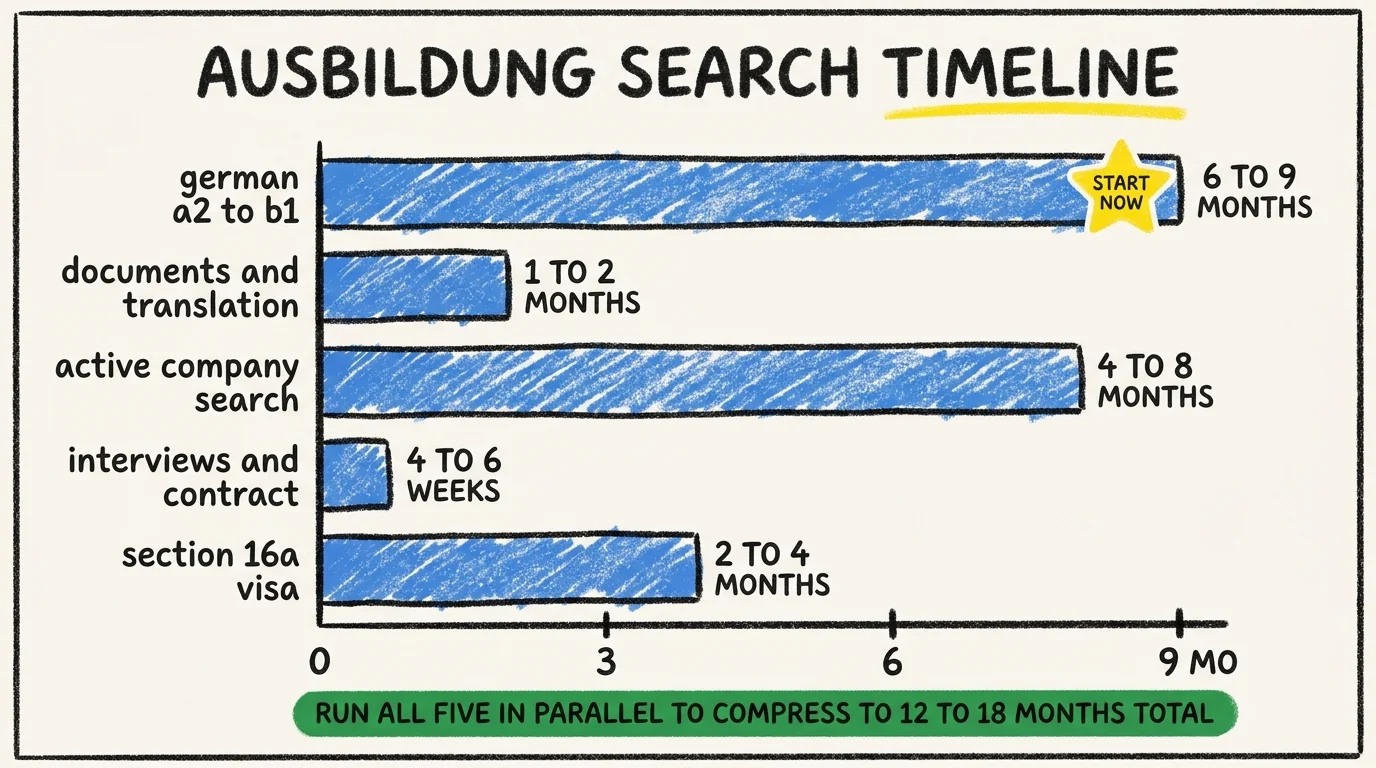
Plan for 6 to 12 months from first application to signed Ausbildungsvertrag, plus 2 to 3 months for the visa filing window after the contract lands. The realistic full timeline from "I want to do an Ausbildung" to "I am in Berufsschule" is 12 to 18 months, dominated by language preparation and the search itself.
| Stage | Realistic duration |
|---|---|
| German A2 to B1 | 6 to 9 months self-paced, 3 to 5 months intensive |
| Document preparation and translation | 1 to 2 months |
| Active company search | 4 to 8 months |
| Interview rounds and contract signing | 4 to 6 weeks |
| Section 16a visa filing and approval | 2 to 4 months |
Compress by running language learning, document prep, and company applications in parallel rather than sequentially.
Common mistakes to avoid
- Paying any agency more than EUR 500 before a contract is signed. Legitimate placement fees come due at signing, not before.
- Skipping German below B1 and assuming an English-friendly company will overlook it. Healthcare requires B2 by chamber rule; technical trades expect B1; only a small number of multinational hospitality and IT employers accept A2 with a B1 commitment by start of training.
- Applying with a single CV format to every employer. Generic mass applications underperform tailored ones at well below industry baseline rates.
- Believing "guaranteed Ausbildung" advertising. No legitimate party can guarantee an outcome that depends on chamber approval, employer choice, and consular processing.
- Letting a bilateral recruitment scheme sit unused. If your country is on the Triple Win partner list and you are a nurse, the program is materially the highest-conversion route available.
FAQ
Do I need a German B1 or B2 certificate before applying?
For most non-healthcare Ausbildungen, B1 (Goethe, telc, ÖSD, or TestDaF equivalent) is the practical floor and many chambers will not approve a contract below this level. Healthcare professions formally require B2. A small number of bilingual technical and hospitality employers will sign a contract at A2 if you commit to reaching B1 before the school year starts. The Goethe versus telc versus DSH guide explains which exam to take.
Can I apply for an Ausbildung visa without a signed contract?
No. Section 16a Aufenthaltsgesetz requires a verified Ausbildungsvertrag with a chamber-registered training company before the visa application is accepted at any German consulate. The contract is a precondition, not a parallel step.
How many companies should I apply to?
Plan for 30 to 60 active applications spread over 4 to 8 months. Successful applicants typically reach interview at 3 to 6 companies and receive 1 to 2 final offers. The volume looks high because international application response rates are slightly below the local baseline.
Are placement agencies in India, the Philippines, or Vietnam regulated?
Some are licensed by their own national emigration authorities (POEA in the Philippines, MEA-registered Recruiting Agents in India). That licensing protects you under local labour law but does not certify them as legitimate Ausbildung placement partners in Germany. Cross-check any agency claim against the Bundesagentur AVGS register before signing or paying anything.
Can I switch companies after starting an Ausbildung?
Yes. Trainees in Germany can change Ausbildungsbetrieb during the program, subject to the new company applying for a chamber-recognised training contract and the old contract being terminated within probation rules. The visa typically transfers with the new contract once the chamber registers it. Probation is normally 1 to 4 months at the start.
What if my profession is not on the BA shortage list?
The shortage list (Engpassberufe) determines fast-track residence permit eligibility after the Ausbildung, not whether you can apply. You can pursue any chamber-recognised Ausbildung regardless of shortage status, but professions on the list have the highest hire-from-abroad probability and the smoothest post-training PR pathway.
How much should agency fees be in 2026?
Genuinely no fee for placement under the AVGS framework, paid by the employer or the BA. For ancillary services (translation, language coaching, visa filing assistance) expect total ancillary fees in the EUR 1,000 to EUR 2,500 range across the full pipeline. Anything substantially above that, especially demanded upfront, is a red flag.
Where to next
- Ausbildung visa Germany 2026 for what to file once a contract is in hand.
- Top 10 Ausbildung courses for picking the profession before starting the company search.
- Ausbildung versus Bachelor's compared if you are still weighing routes.
- Pillar: how to apply for Ausbildung for the full step-by-step process.
- CV preparation service and document translation for the application package.
Continue reading
Ausbildung·16 min read
Ausbildung visa Germany 2026: Complete application guide, documents, timeline
Step-by-step guide to the German Ausbildung visa under Section 16a AufenthG: who qualifies, documents, 2026 financial proof, processing time, and what happens after arrival.
Read articleAusbildung·12 min read
Nursing Ausbildung in Germany for international applicants: Visa, B2 requirement, salary, top recruiters
Nursing Ausbildung in Germany 2026 for international applicants: visa under Section 16a, B2 German requirement, monthly salary, top recruiters.
Read articleAusbildung·14 min read
Ausbildung vs Bachelor's in Germany: Cost, salary trajectory, PR timeline compared
Compare Ausbildung and Bachelor's in Germany on 2026 cost, year-by-year salary trajectory, EU Blue Card vs Niederlassungserlaubnis timelines.
Read articleReady to plan your Germany journey?
Explore our tools and resources to find the perfect university and program for your academic goals.