Automotive Mechatronics (KFZ-Mechatroniker) Ausbildung in Germany
The KFZ-Mechatroniker Ausbildung is a 3.5-year automotive apprenticeship in Germany. Pay, language requirements, visa, and post-training salary in 2026.

Table of contents
Last updated: May 2026
TL;DR: The KFZ-Mechatroniker Ausbildung is a 3.5-year dual-system apprenticeship that trains you to diagnose, repair, and service modern vehicles. From January 2026 the federal minimum training pay is EUR 724/month in year one, and the KFZ trade tariff pushes it up to EUR 1,040 in well-paid regions. Non-EU applicants enter on the Section 16a vocational training visa and need at least B1 German.
The KFZ-Mechatroniker (Automotive Mechatronics Technician) Ausbildung is one of Germany's flagship vocational programs. It is also frequently confused with the generic Mechatronics Ausbildung, which is a different occupation under a different chamber. Both sit inside the Train pillar and both lead to skilled-worker status, but the KFZ version is workshop-floor automotive: you fix cars, vans, trucks, and increasingly, high-voltage electric vehicles.
If you are weighing this against other vocational tracks, see our overview of the top Ausbildung courses in Germany.
What is the KFZ-Mechatroniker Ausbildung
KFZ stands for Kraftfahrzeug, the German word for motor vehicle. Mechatroniker means a hybrid mechanical-and-electronic technician. The role replaced the older split between Kfz-Mechaniker and Kfz-Elektriker in 2003, because modern vehicles are now equally mechanical and electronic. You will spend roughly two-thirds of your week in a workshop (Betrieb) and one-third in vocational school (Berufsschule), learning everything from brake hydraulics and engine timing to CAN-bus diagnostics, ADAS calibration, and high-voltage battery service.
The training is regulated by the federal Trade and Crafts Code (Handwerksordnung) and supervised by the Kfz-Innung (the local KFZ guild) and the Handwerkskammer (chamber of crafts). It always lasts 3.5 years (42 months). Strong students with prior schooling can shorten it to 3 years; the chamber decides case by case.
The five specializations: pick one
You apply into the general program and pick a Schwerpunkt (specialization) in year three. Each one comes with its own final exam (Gesellenprüfung Teil 2). Not every workshop trains every specialization, so confirm before you sign the contract.
| Specialization | Focus | Typical employer |
|---|---|---|
| Personenkraftwagentechnik | Passenger cars: diagnosis, service, repair | Independent garages, brand workshops |
| Nutzfahrzeugtechnik | Commercial vehicles, trucks, buses | Mercedes-Benz Trucks, MAN, Volvo dealers |
| System- und Hochvolttechnik | Electronics, ADAS, EV high-voltage systems | EV-heavy brands like Tesla, BMW i, VW Group |
| Karosserietechnik | Body, frame, paint prep | Body shops, accident repair chains |
| Motorradtechnik | Motorcycles | BMW Motorrad, KTM, independent shops |
The System- und Hochvolttechnik track is the fastest-growing path because every brand is electrifying its lineup. If you have any inclination toward electronics, this is the most future-proof option.
How much does the Ausbildung pay in 2026
Germany has two pay layers for trainees: a federal floor and a higher trade-specific tariff.
Federal minimum (BIBB, effective 1 January 2026) for trainees outside any tariff: EUR 724 in year 1, EUR 854 in year 2, EUR 977 in year 3, EUR 1,014 in year 4. This is the legal floor for any company without a collective agreement.
KFZ trade tariff (Tarifvertrag) for chambered KFZ workshops covered by the trade agreement, monthly gross:
| Year | Standard tariff | High-pay regions |
|---|---|---|
| 1 | EUR 864 to 1,040 | Up to EUR 1,198 |
| 2 | EUR 904 to 1,070 | Up to EUR 1,250 |
| 3 | EUR 1,000 to 1,140 | Up to EUR 1,330 |
| 4 (half) | EUR 1,050 to 1,200 | Up to EUR 1,400 |
Numbers vary by Bundesland. South German workshops (Baden-Württemberg, Bavaria) and the big brand dealers tend to pay near the top; Berlin, Brandenburg, and Saxony tend to be at the lower end.
Beyond pay, trainees in Germany get full statutory health insurance, pension contributions, 24 to 30 paid leave days, and most workshops cover at least part of the Berufsschule travel costs.
Who can apply: language and qualifications
There is no formal entry diploma required by law. In practice, three filters decide who gets a contract:
- German language: B1 is the minimum every employer requires; B2 is increasingly the realistic bar, because the Berufsschule curriculum is taught in German and the Gesellenprüfung is written in German. If you arrive at A2, plan a 6 to 9 month bridging course before applying.
- School certificate: a Hauptschulabschluss (lower secondary) is the technical floor, but most workshops want a Realschulabschluss (mid-secondary) or higher. International applicants need certificate recognition through the Anabin database. Indian 10+2 typically maps to Realschulabschluss equivalent, sometimes higher.
- Mechanical aptitude: workshops increasingly use 1-day trial shifts (Schnupperpraktikum) before signing. Show up curious, ask sensible questions, and treat the trial as the interview.
How non-EU applicants enter Germany
Two routes matter:
Section 16a Residence Act, the vocational training visa. This is the standard apprenticeship visa. You need a signed Ausbildungsvertrag from a German workshop, B1 German proof, and proof of financial means (Sperrkonto for the gap year, or a salary commitment from the employer). The visa is granted for the full duration of the apprenticeship plus a buffer. Issuance has tightened since 2024; budget 8 to 14 weeks at most German consulates.
Section 17 Residence Act, the apprenticeship-search visa. A 9-month visa for non-EU applicants who have B2 German and a recognized school certificate but have not yet found a workshop. You enter Germany, attend interviews, sign a contract, then convert to a 16a residence permit at the local Ausländerbehörde.
The Bundesrat in March 2026 formally asked Berlin to fast-track the post-Ausbildung work permit, so non-EU graduates can convert to skilled-worker status immediately on graduation rather than re-applying. The proposal is still in legislative process; the standard rule today is still: graduate, get a job offer, apply for a Section 18a Skilled Worker permit.
How to apply from outside Germany, step by step
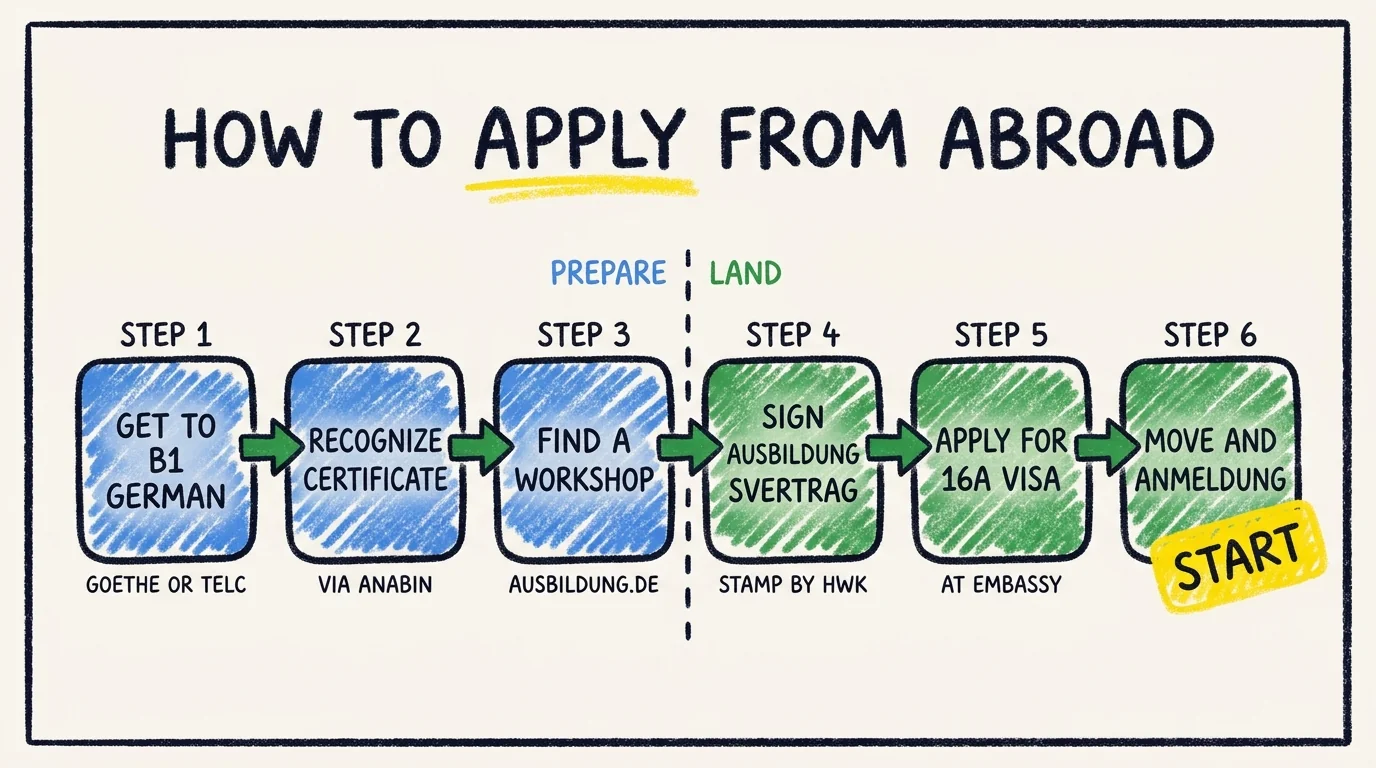
- Get to B1 German, ideally B2. Goethe and telc certificates are universally recognized.
- Recognize your school certificate via Anabin or the Zentralstelle für ausländisches Bildungswesen. Get this in writing before you apply, because workshops will ask.
- Search for vacancies on ausbildung.de, the Bundesagentur für Arbeit jobboerse, and the local Handwerkskammer job portals. Big-brand dealers (BMW, Mercedes-Benz, VW Group) post directly on their corporate sites.
- Apply 9 to 12 months early. The Ausbildungsjahr starts on 1 August or 1 September every year. By February the popular slots are gone.
- Sign the Ausbildungsvertrag and get it stamped by the Handwerkskammer.
- Apply for the Section 16a visa at your nearest German mission. The contract, the Anabin recognition, and the language certificate are the three documents that get you out of the screening queue.
- Move to Germany, register (Anmeldung), open a German bank account, and start.
After the Ausbildung: jobs, salary, residency
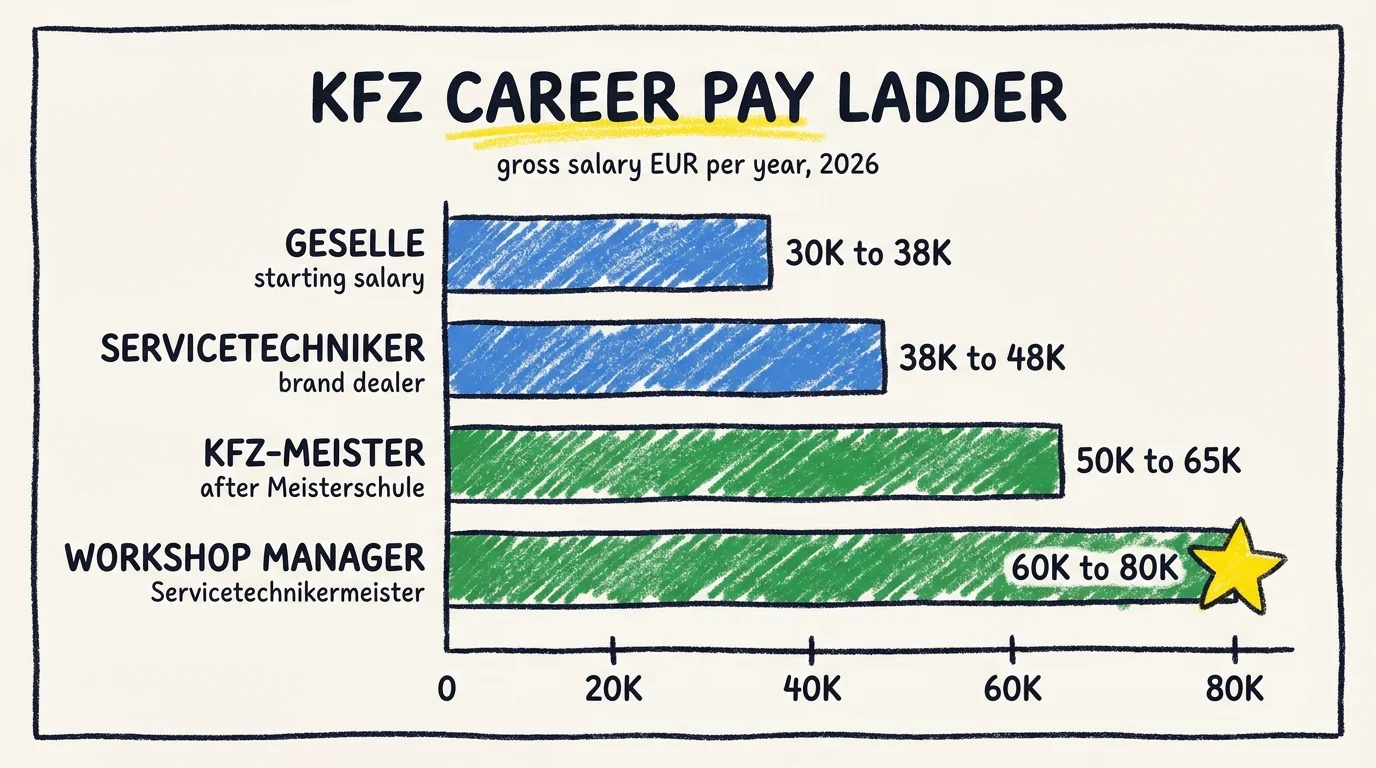
A trained Geselle (journeyman) KFZ-Mechatroniker earns roughly EUR 30,000 to 38,000 gross per year as a starting salary in 2026. Specializations shift this: System- und Hochvolttechnik commands a premium, while Karosserietechnik in independent shops sits at the lower end.
Career steps from there:
- Servicetechniker at a brand dealer: EUR 38,000 to 48,000.
- Kfz-Meister (master craftsman, after a 1-year Meisterschule): EUR 50,000 to 65,000, plus the right to open your own workshop and to train apprentices.
- Servicetechnikermeister or workshop manager: EUR 60,000 to 80,000.
For permanent residency, after 2 years of qualified work post-Ausbildung you can apply for a Niederlassungserlaubnis. The Ausbildung itself counts toward the residence period that builds toward citizenship.
Common mistakes to avoid
- Applying with A2 German and hoping to learn on the job. Workshops reject this on the first email. Get to B1 first.
- Confusing KFZ-Mechatroniker with Industriemechatroniker or generic Mechatroniker. Different chambers, different exams, different visa wording. Be precise on the application.
- Signing a contract with a workshop not registered with the Handwerkskammer. It will not satisfy the visa requirement.
- Picking the specialization in year one. You pick at the start of year three. Use years one and two to figure out which track matches the workshop's actual work.
- Ignoring the Berufsschule. It is part of the contract, you must attend, and the marks count toward the final exam.
FAQ
How long is the KFZ-Mechatroniker Ausbildung?
Three and a half years (42 months) by default. Strong students with prior education or relevant work history can request a shortening to 3 years; the Handwerkskammer signs off case by case.
Do I need German to start?
Yes. B1 is the minimum every workshop requires for the contract; B2 is the realistic bar to pass the Berufsschule and the Gesellenprüfung. If you are at A2, budget 6 to 9 months of full-time language preparation before you apply.
What does it pay in 2026?
Federal minimum is EUR 724 in year one rising to EUR 1,014 in year four. KFZ trade tariff pays EUR 864 to 1,198 in year one depending on region, scaling up each year. South Germany and big-brand dealers pay near the top.
Can I bring my family on a Section 16a visa?
Family reunification on the trainee visa is restrictive. Spouses can join in principle but need to prove financial means above the trainee pay, which is rarely possible on Ausbildung income alone. Plan family reunification for after the Ausbildung when you convert to a skilled-worker permit.
What happens if I fail the final exam?
The Gesellenprüfung has two attempts. If you fail Teil 2, you can re-sit within the next exam cycle. Workshops typically extend the contract for the re-sit period.
Is the high-voltage (EV) specialization worth picking?
Yes if you have any electronics inclination. Every German automaker is electrifying its lineup; trained EV technicians are the single biggest skills gap in the trade today, and pay reflects it.
Where to next
- Mechatronics Ausbildung programs in Germany for international students, the industrial-mechatronics sibling track
- Top 10 Ausbildung courses in Germany to see how KFZ compares with IT, Pflege, and Industriemechaniker
- Train pillar overview, with every Ausbildung route plus visa, language, and post-training residency rules
Continue reading
Ausbildung·14 min read
Ausbildung vs Bachelor's in Germany: Cost, salary trajectory, PR timeline compared
Compare Ausbildung and Bachelor's in Germany on 2026 cost, year-by-year salary trajectory, EU Blue Card vs Niederlassungserlaubnis timelines.
Read articleAusbildung·12 min read
How to find an Ausbildung company in Germany from abroad: Portals, agencies, direct outreach
Find an Ausbildung training company in Germany from abroad. Official portals, free private boards, government recruitment schemes, agencies, and direct employer outreach.
Read articleAusbildung·12 min read
German B1 vs B2 for Ausbildung: Which level you actually need by profession
B1 is the visa floor for the Ausbildung visa, B2 is what most employers want. Profession-by-profession breakdown for nursing, technical trades, hospitality, logistics, IT.
Read articleReady to plan your Germany journey?
Explore our tools and resources to find the perfect university and program for your academic goals.