Ausbildung visa Germany 2026: Complete application guide, documents, timeline
Step-by-step guide to the German Ausbildung visa under Section 16a AufenthG: who qualifies, documents, 2026 financial proof, processing time, and what happens after arrival.

Table of contents
Last updated: May 2026
TL;DR: Non-EU citizens need an Ausbildung visa under Section 16a of the Residence Act (AufenthG) to start vocational training in Germany. You apply at the German mission in your country with a signed Ausbildungsvertrag, B1 German proof, recognized school certificates, and proof you can cover living costs. Standard processing takes 4 to 12 weeks; budget 4 to 6 months end to end. If you do not yet have a training contract, a separate Section 17 visa lets you come to Germany for up to 9 months to search for one.
The Ausbildung visa is not the same as the German student visa. It runs on its own legal basis (Section 16a AufenthG for in-company or school-based training, Section 17 AufenthG for the training-place search), it has its own financial-proof thresholds, and it goes through a separate consular workflow that often involves the Federal Employment Agency (BA). If you are heading to Germany for vocational training, this is the visa you need.
This guide walks through both routes, the documents the embassy will check, the 2026 financial-proof figures, and the realistic timeline from "I have a contract" to "I have a residence permit in hand". For the broader picture of the Ausbildung pathway and how the visa fits into it, start with our training visa pillar and the top Ausbildung courses for international applicants.
What the Ausbildung visa actually is
The Ausbildung visa is a national long-stay visa (D-visa) that lets non-EU citizens enter Germany to start a vocational training programme. It is issued under Section 16a of the Residence Act (Aufenthaltsgesetz, AufenthG). Once you arrive, you exchange the visa for a residence permit (Aufenthaltserlaubnis) at the local Ausländerbehörde, valid for the duration of your training.
EU, EEA, and Swiss citizens do not need this visa. Citizens of Australia, Canada, Israel, Japan, New Zealand, South Korea, the United Kingdom, and the United States can enter Germany visa-free and apply for the residence permit from inside the country, but they still need the same documents. Everyone else applies before flying.
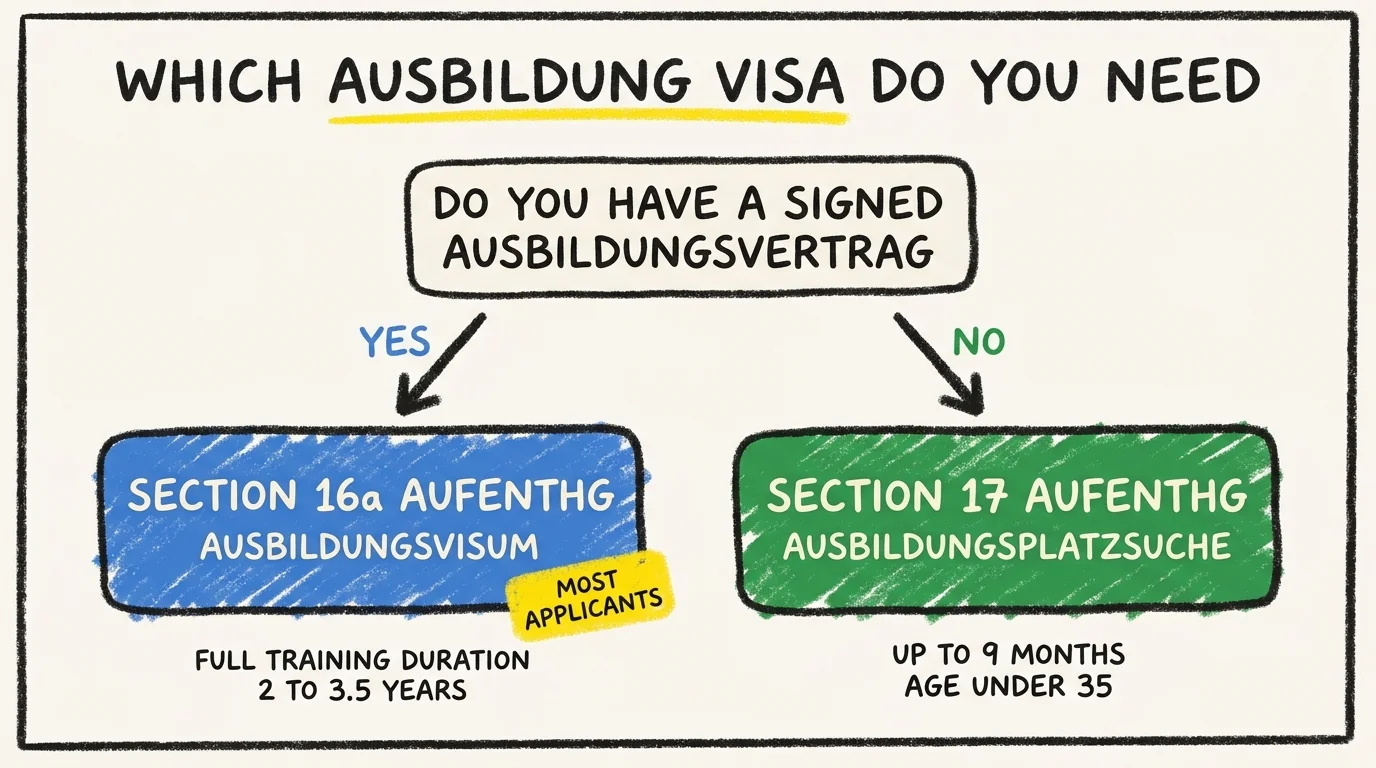
The visa has two flavours that often get confused:
| Visa | Section | When you use it | Stay length |
|---|---|---|---|
| Ausbildungsvisum | 16a AufenthG | You already have a signed Ausbildungsvertrag with a German company or school | Duration of the training (usually 2 to 3.5 years) |
| Ausbildungsplatzsuche | 17 AufenthG | You do not yet have a contract and want to come to Germany to find one | Up to 9 months, single entry |
Pick the right one before you start the application. The two routes have different financial-proof rules and different document checklists.
Two visa pathways: signed contract vs training-place search
Section 16a: when you already have a contract
This is the standard route. You found a German company (or a state-recognized vocational school) that offered you a place, you signed an Ausbildungsvertrag, and now you need the visa to enter the country and begin. Most international applicants land here because German employers want a confirmed candidate before they will sponsor anything.
Two things to check before applying:
- The contract must be from a recognized training body: an Industrie- und Handelskammer (IHK) member, a Handwerkskammer (HWK) member, or a state-recognized Berufsfachschule. The embassy will verify this; an "internship" or "trainee" offer that does not lead to a Berufsabschluss (vocational qualification) does not qualify under Section 16a.
- For company-based training, the Federal Employment Agency must approve the contract. This happens internally during visa processing, so you do not file anything separately, but it adds time. The BA checks that you will be employed under the same conditions as German apprentices on the same programme.
Section 17: when you don't yet
If you are still hunting for a training place, Section 17 is the parallel route. It lets you come to Germany for up to 9 months to apply, attend interviews, and complete up to two weeks of trial work (Probearbeit). You can also work a 20-hour-per-week side job during the search.
The trade-off: stricter eligibility. You must be under 35, have a school-leaving certificate that gives you access to higher education in your country, prove B1 German, and show €1,091 per month in a blocked account (the 2026 figure for the training-place-seeker visa, equivalent to roughly €9,819 for nine months). If you find a contract during the 9 months, you switch to a Section 16a residence permit at the Ausländerbehörde without leaving Germany.
Most readers will use Section 16a. The rest of this guide covers that route in detail; Section 17 differs only in the contract requirement and the higher blocked-account figure.
Who qualifies for the Ausbildung visa
You are eligible for a Section 16a visa if you can satisfy four conditions:
| Requirement | What the embassy expects |
|---|---|
| Confirmed training place | Signed Ausbildungsvertrag from an IHK/HWK-recognized company or a state-recognized vocational school |
| German language proficiency | Generally B1 CEFR, certified by Goethe-Institut, telc, ÖSD, or TestDaF. Some healthcare regulators want B2; some technical trades will accept A2 if you commit to reaching B1 during training |
| Recognized school qualification | Your secondary school certificate must be assessed via the Anabin database or the ZAB (Zentralstelle für ausländisches Bildungswesen) as equivalent to a German Hauptschulabschluss or higher |
| Proof of livelihood | Either a training salary above the minimum threshold, a blocked account, a Verpflichtungserklärung (declaration of commitment) from a German resident, or a scholarship |
Note: there is no general age cap on the Section 16a visa. The under-35 rule applies only to the Section 17 (training-place-seeker) visa. Healthcare and care professions often have their own Anerkennung (recognition) procedure layered on top, especially for nursing. Check the regional Anerkennungsstelle for your target Bundesland.
Documents you need
Bring originals plus two sets of photocopies. The embassy returns originals after sighting; the consulate keeps the copies. The exact list varies slightly by country, so confirm with your local German mission, but the core set is:
- Two completed visa application forms, signed, including the declaration under Section 54 AufenthG
- Three biometric passport photos (35 x 45 mm, white background, taken within the last 6 months)
- Valid passport, with at least 12 months of remaining validity and two blank pages
- Signed Ausbildungsvertrag with the German employer or vocational school
- Proof of B1 German, original certificate from Goethe-Institut, telc, ÖSD, or TestDaF
- Recognized school-leaving certificate, with notarized translation into German
- Proof of financial means, choose one:
- Training salary above €1,048 gross or €822 net per month (no top-up needed)
- Training salary below the threshold, plus a blocked account or Verpflichtungserklärung covering the gap
- Blocked account of €959 net per month (school-based training, no salary)
- Scholarship confirmation, if applicable
- Health insurance proof, valid from the day you enter Germany. Public statutory insurance kicks in once your training salary starts; for the gap before that, an incoming travel-health policy from a German insurer works
- Cover letter in German explaining your training plan, the company, and your career goal
- CV in German in tabular Europass format
- Visa fee, currently €75 for adults, paid in local currency at the appointment
Healthcare or care-profession applicants also need the Anerkennungsbescheid (recognition decision) from the relevant state authority before the embassy will accept the application.
Financial proof for 2026
The Ausländerbehörde and the Auswärtiges Amt update the Ausbildung financial-proof thresholds every year. For 2026, the figures are:
| Scenario | 2026 minimum |
|---|---|
| Company-based training, training salary alone | €1,048 gross or €822 net per month |
| School-based training, blocked account | €959 net per month |
| Section 17 training-place-seeker visa, blocked account | €1,091 per month for the full 9 months (about €9,819 total) |
| Top-up if training salary falls short | The shortfall, held in a blocked account or covered by Verpflichtungserklärung |
Most German Ausbildung salaries comfortably clear the €1,048 gross threshold. Healthcare, automotive, IT, and electrical trades pay €1,000 to €1,300 per month in the first year and rise each year. Hospitality and retail apprenticeships sometimes start lower. If your contract pays €900 gross and you have rent in Munich, the embassy will ask you to top up the gap with a blocked account.
Open the blocked account before booking the visa appointment. Providers like Expatrio, Fintiba, and Deutsche Bank will issue a Sperrkonto-Bestätigung (blocked-account confirmation) within 5 to 10 working days once your funds clear; the embassy needs this confirmation in your application file.
Application process step by step
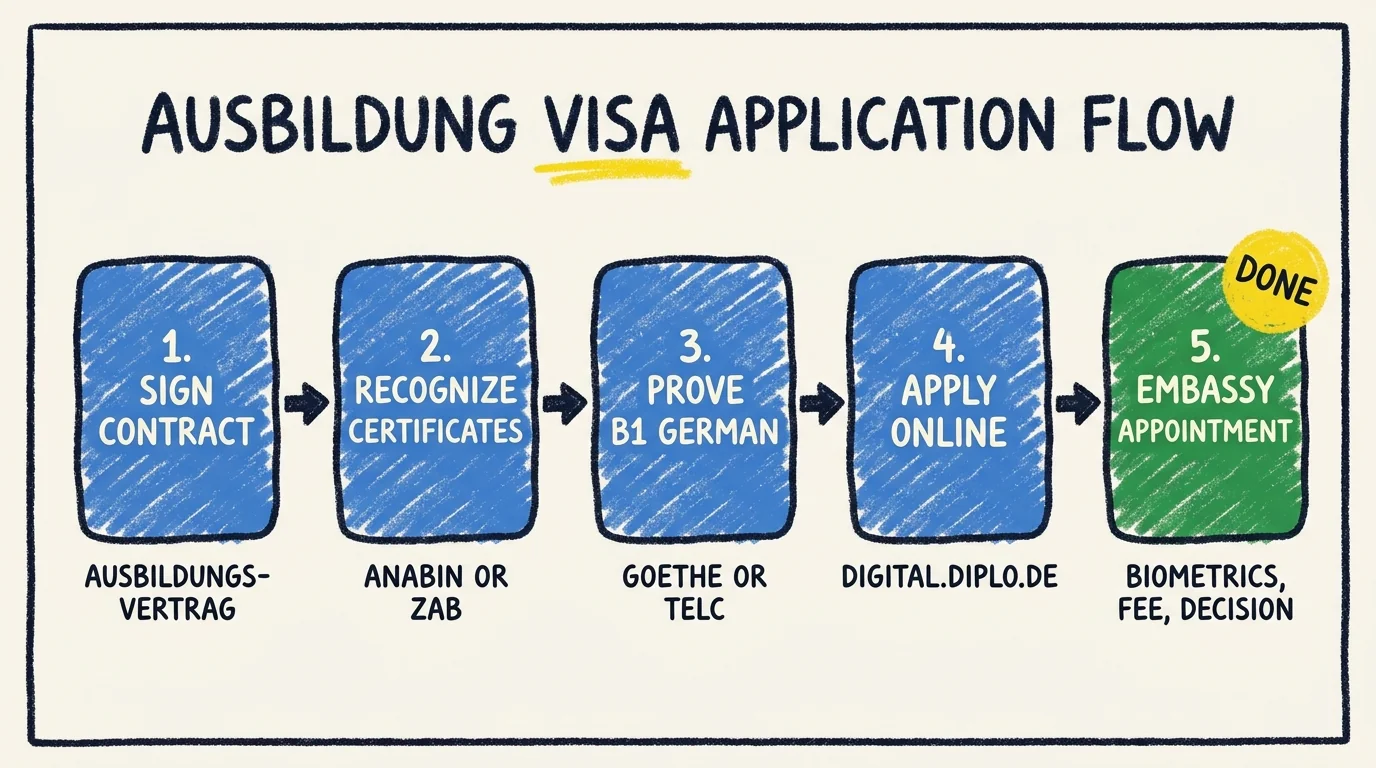
- Sign the Ausbildungsvertrag with your German employer or vocational school. Without this, the Section 16a application cannot start.
- Get your school certificates assessed via Anabin (anabin.kmk.org) or order a ZAB Statement of Comparability (zeugnisbewertung.de) if your degree is not in the database. Allow 4 to 12 weeks.
- Reach B1 German and book the official exam. Goethe and telc certificates are universally accepted; allow 8 to 16 weeks of preparation if you are at A2.
- Open a blocked account or arrange a Verpflichtungserklärung if your training salary alone does not clear the threshold.
- Buy incoming travel-health insurance for the first 90 days after arrival.
- Book the visa appointment through the Consular Services Portal (digital.diplo.de). For the full three-stage upload checklist, see our digital.diplo.de portal walkthrough. Most Indian, Pakistani, Nigerian, Vietnamese, and Filipino consulates have wait times of 4 to 12 weeks for the appointment slot itself.
- Submit your application in person at the German mission. Bring originals plus two sets of copies, pay the €75 fee, and provide biometrics.
- Federal Employment Agency review runs in parallel. You do not action this; the consulate forwards your contract and the BA replies within 2 to 4 weeks.
- Visa issued. The consulate places a 90-day D-visa sticker in your passport, valid for entry to Germany. Your formal residence permit (eAT card) is issued after arrival at the local Ausländerbehörde.
For a deeper look at the appointment workflow, see the German visa appointment booking and cancellation process.
Processing time and realistic timeline
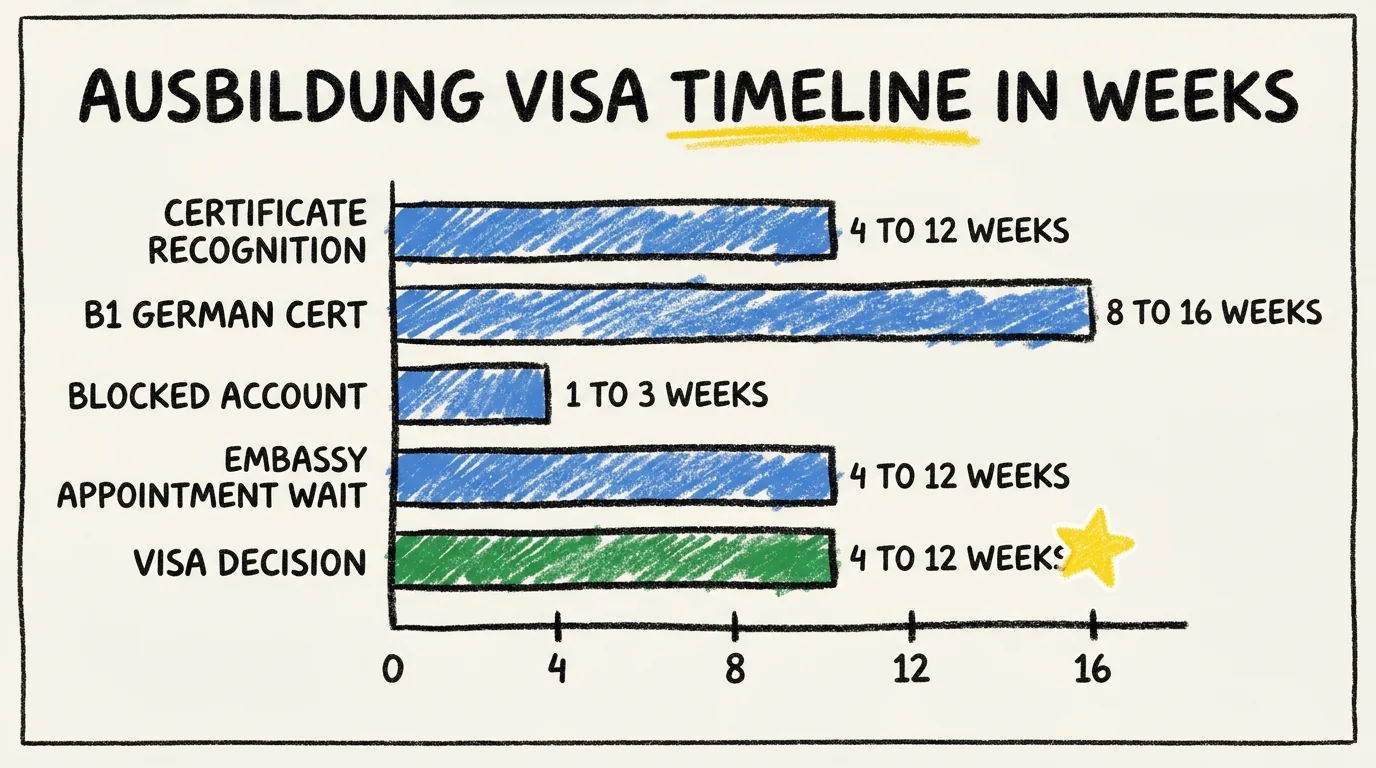
The Auswärtiges Amt quotes 4 weeks as a minimum, but real-world processing is longer because of the BA approval step plus consulate-specific backlogs. Plan for these phases:
| Phase | Realistic duration |
|---|---|
| School certificate recognition (Anabin or ZAB) | 4 to 12 weeks |
| German B1 certification (from A2 to certified B1) | 8 to 16 weeks |
| Blocked account opening and funding | 1 to 3 weeks |
| Visa appointment wait | 4 to 12 weeks |
| Visa decision after submission | 4 to 12 weeks |
| End-to-end, conservative | 5 to 8 months |
Translation: if your training starts on 1 September, start the visa workstream by 1 March at the latest. Trainees from India, Pakistan, the Philippines, Vietnam, and Nigeria often hit consulate slot shortages during peak season (April to July), so an earlier start helps.
After arrival: residence permit, side jobs, language course
The D-visa in your passport is a 90-day entry permit. Within those 90 days, you must:
- Register your address at the local Bürgeramt (Anmeldung). Bring your Mietvertrag and the landlord's Wohnungsgeberbestätigung.
- Open a Girokonto (current account) so your training salary can be paid in.
- Switch your travel-health insurance to statutory or private German cover. Statutory insurance (TK, AOK, Barmer, DAK) is automatic once your training salary is reported; the company HR usually triggers this.
- Apply for the residence permit at the Ausländerbehörde. They issue the eAT card (electronic residence title) for the duration of your training, typically 2 to 3.5 years.
During training, you can work up to 20 hours per week in any job that is independent of your Ausbildung. Students often do this in catering or retail to supplement income. You are also entitled to attend a preparatory German language course under Section 16a (1) sentence 4, either a publicly funded vocational language course (Berufssprachkurs) or a privately arranged one.
After Ausbildung: job search and permanent residency
The visa story does not end on the day you pass your final exam. Section 20 (1) no. 3 AufenthG gives you an 18-month residence permit to look for a qualified job in Germany after completing your training. You can work in any role during the search, not just in your trade. This is the bridge between the training visa and full skilled-worker status.
If you trained as a nursing or care assistant, the search permit is shorter at 12 months but extendable once for 6 months.
Once you find a qualified job and have worked for two years in Germany, you can apply for the Niederlassungserlaubnis (settlement permit, equivalent to permanent residency) under Section 18c (1) sentence 2 AufenthG. The other conditions are the standard ones: proof of B1 German, contributions to the pension scheme during the two working years, secured livelihood, and adequate housing.
For the wider picture of how training visas connect to permanent residency, see the visa types overview and the post-study work visa guide (the post-Ausbildung permit follows the same logic).
Common mistakes to avoid
- Applying with an internship contract instead of an Ausbildungsvertrag. An "internship" or "Praktikum" does not qualify under Section 16a, even if it is at a famous company. The contract must be a registered vocational training agreement.
- Submitting an English CV. German consulates expect a German Lebenslauf in tabular format. An English CV is grounds for rejection or extra processing time.
- Forgetting health insurance for the gap. Statutory insurance starts when your training salary starts, which can be days or weeks after you land. The visa requires unbroken coverage from arrival; buy a 90-day incoming travel-health policy from a German insurer.
- Underestimating the BA review. The Federal Employment Agency check adds 2 to 4 weeks beyond the consulate's own processing. Build it into your timeline.
- Booking flights before the visa is in your passport. The D-visa sticker is the only proof you can board. A confirmed appointment is not a visa.
- Mixing up Section 16a and Section 17. They are different visas with different financial requirements. If you have a contract, do not apply for Section 17; if you do not, do not pretend you do.
Frequently asked questions
Do I need German language proof for the Ausbildung visa?
Yes, in almost every case. The standard is B1 on the CEFR scale, certified by Goethe-Institut, telc, ÖSD, or TestDaF. Some technical trades accept A2 if you commit to reaching B1 within the first year of training, but you should treat B1 as the working baseline. Healthcare and care professions usually want B2 because of the patient-communication requirement. Check the rules for our take on which exam to pick: Goethe vs TestDaF vs DSH.
How long does the Ausbildung visa take to process?
The Auswärtiges Amt minimum is 4 weeks, but realistic end-to-end processing is 4 to 12 weeks after submission, often longer in countries with consulate backlogs. The Federal Employment Agency review adds 2 to 4 weeks of that total. Plan 5 to 8 months from "I have a signed contract" to "I have a visa", including school-recognition and language-certification time before the appointment.
Can I switch employers during my Ausbildung?
Yes, but it requires the Ausländerbehörde's consent. Your residence permit is tied to the original training contract; if you change employers, the new company must offer a comparable Ausbildungsvertrag and the foreigners' authority issues an updated permit. The new employer goes through the same BA approval. Do not start at a new company before the permit is reissued.
What happens if my Ausbildung visa is rejected?
You receive a written decision with the reason. The two most common rejections are insufficient German language proof and unrecognized school qualifications. You have one month to file a remonstration (formal objection) at no extra cost, or you can fix the issue and reapply. For broader visa-rejection guidance, see overcoming a German student visa rejection; the same principles apply to the Ausbildung version.
Can my spouse or children come with me on the Ausbildung visa?
Family reunification is possible during Ausbildung but conditional. You need to prove sufficient living space, sufficient income to support the family without state benefits, and basic A1 German for your spouse. In practice, the income requirement is hard to meet on a first-year training salary alone, so most trainees bring family only after they finish training and start qualified employment. The spouse can also enter on a separate Section 17 or Job Seeker Visa if eligible.
Is the Ausbildung visa the same as the German student visa?
No. The student visa runs under Section 16b AufenthG and applies to academic study at a Hochschule. The Ausbildung visa is Section 16a and applies to vocational training at a company or Berufsschule. Different financial thresholds, different document set, different residence-permit duration. If you are deciding between the two paths, our comparison piece is at Ausbildung vs Bachelor's.
Can I stay in Germany after completing my Ausbildung?
Yes. Section 20 (1) no. 3 AufenthG gives you 18 months to find a qualified job in your trade (12 months for healthcare assistants, extendable by 6 months). Once you find a job and work for two years, you can apply for permanent residency under Section 18c (1) sentence 2 AufenthG. After 5 years of total residence you can apply for German citizenship, with dual citizenship now allowed since June 2024.
Where to next
- The hub: training visa overview for the full Ausbildung pathway
- For the application stage: German visa appointment booking and cancellation process
- For language proof: Goethe vs TestDaF vs DSH language exams
- For trade choice: top 10 Ausbildung courses in Germany and mechatronics Ausbildung programs
- For after training: post-study work visa Germany guide
Continue reading
Ausbildung·14 min read
Ausbildung vs Bachelor's in Germany: Cost, salary trajectory, PR timeline compared
Compare Ausbildung and Bachelor's in Germany on 2026 cost, year-by-year salary trajectory, EU Blue Card vs Niederlassungserlaubnis timelines.
Read articleAusbildung·12 min read
Nursing Ausbildung in Germany for international applicants: Visa, B2 requirement, salary, top recruiters
Nursing Ausbildung in Germany 2026 for international applicants: visa under Section 16a, B2 German requirement, monthly salary, top recruiters.
Read articleAusbildung·11 min read
Top 10 Ausbildung Courses in Germany for International Students
Discover the best Ausbildung courses in Germany for international students. Learn about top programs, career opportunities, and how to start your vocational training in one of Europe's strongest economies.
Read articleReady to plan your Germany journey?
Explore our tools and resources to find the perfect university and program for your academic goals.