IT Specialist (Fachinformatiker) Ausbildung in Germany: Tracks, salary, post-Ausbildung jobs
Fachinformatiker IT Ausbildung in Germany. Four specialisation tracks, trainee and post-training salaries, B1 visa rules, application timeline.

Table of contents
Last updated: May 2026
TL;DR: Fachinformatiker is Germany's federally recognised IT Ausbildung. Three years, four specialisation tracks (Anwendungsentwicklung, Systemintegration, Daten- und Prozessanalyse, Digitale Vernetzung), paid trainee salary of roughly EUR 1,100 to EUR 1,260 per month, and post-qualification gross of EUR 3,200 to EUR 4,200 per month. Bitkom counts about 109,000 unfilled IT roles in 2026, so qualified Fachinformatiker leave training into a hiring market that wants them.
If you want a tech career in Germany without paying for a four-year university degree, the Fachinformatiker Ausbildung is the federal route built for exactly that. It pays you while you train, gives you a country-wide recognised qualification, and lands you in the same hiring pool the IT-Bachelor graduates compete in. For applicants from outside the EU, it is one of the cleanest pathways: a single training contract qualifies you for a vocational training residence permit, and a B1 German certificate is enough to start.
This guide covers what the Ausbildung actually is in 2026, the four specialisation tracks (two of which only exist after the August 2020 reform), what trainees and post-Ausbildung professionals earn, who can apply from abroad, and how to convert the contract into permanent residency. If you are still deciding between this and other vocational routes, our top Ausbildung courses guide compares the field, and the mechatronics Ausbildung deep-dive shows how a sister technical track is structured.
What is the Fachinformatiker Ausbildung?
Fachinformatiker is the official title, regulated under the German Berufsbildungsgesetz (BBiG), for the country's three-year dual IT vocational training. "Dual" means you split your week between a sponsoring company (the Betrieb) and a public vocational school (the Berufsschule). The company pays you a monthly Ausbildungsvergütung the entire time. At the end you sit a national exam through the Industrie- und Handelskammer (IHK) and earn a federally recognised qualification valid in every German state.
The format dates back decades, but the IT version was restructured on 1 August 2020. The old programme had two tracks. The reform expanded it to four, added programming and data-pipeline content to every track, and made the qualification more aligned with what hiring managers actually want in 2026. Roughly 28,000 trainees were enrolled across the four Fachinformatiker tracks in the 2024 IHK cohort, and Bitkom's 2025 figures still show 109,000 unfilled IT roles across the German economy. The supply gap is the entire reason the programme is open to international applicants on a fast visa track.
The four Fachinformatiker specialisation tracks
The four tracks share a common first year and then diverge. You pick the specialisation when you apply (the company decides what track they are training for; you align your application to that). All four take three years and lead to the same federal qualification with the specialisation noted on the certificate.
| Track | What you actually do | Who hires | Typical post-Ausbildung role |
|---|---|---|---|
| Anwendungsentwicklung | Build software. Java, Python, JavaScript, .NET. Web apps, mobile apps, internal tools. | SAP, software houses, Mittelstand product companies, banks, insurance, public-sector IT | Junior software developer, junior backend engineer |
| Systemintegration | Run infrastructure. Servers, networks, Active Directory, Linux admin, Microsoft 365, on-prem to cloud migration. | Bosch, Siemens, MSPs, hospitals, public administration, almost every large company | Junior sysadmin, IT support engineer, junior cloud engineer |
| Daten- und Prozessanalyse | Analyse process data. SQL, Python pandas, BI tools, KPI dashboards, process mining. New since 2020. | Industrial firms, consultancies, logistics companies, healthcare providers | Junior data analyst, junior BI consultant, junior process analyst |
| Digitale Vernetzung | Industrial IoT. Connect machines, sensors, MES systems. OT/IT integration, Industry 4.0. New since 2020. | Bosch, Siemens, Bertrandt, automotive suppliers, manufacturing | Junior IoT engineer, junior automation specialist |
Anwendungsentwicklung and Systemintegration are the two oldest tracks and have the largest cohort sizes; Daten- und Prozessanalyse and Digitale Vernetzung are growing fast because the 2020 reform was specifically designed to fill industrial-data and IoT roles where the labour shortage is sharpest.
How much do Fachinformatiker trainees earn?
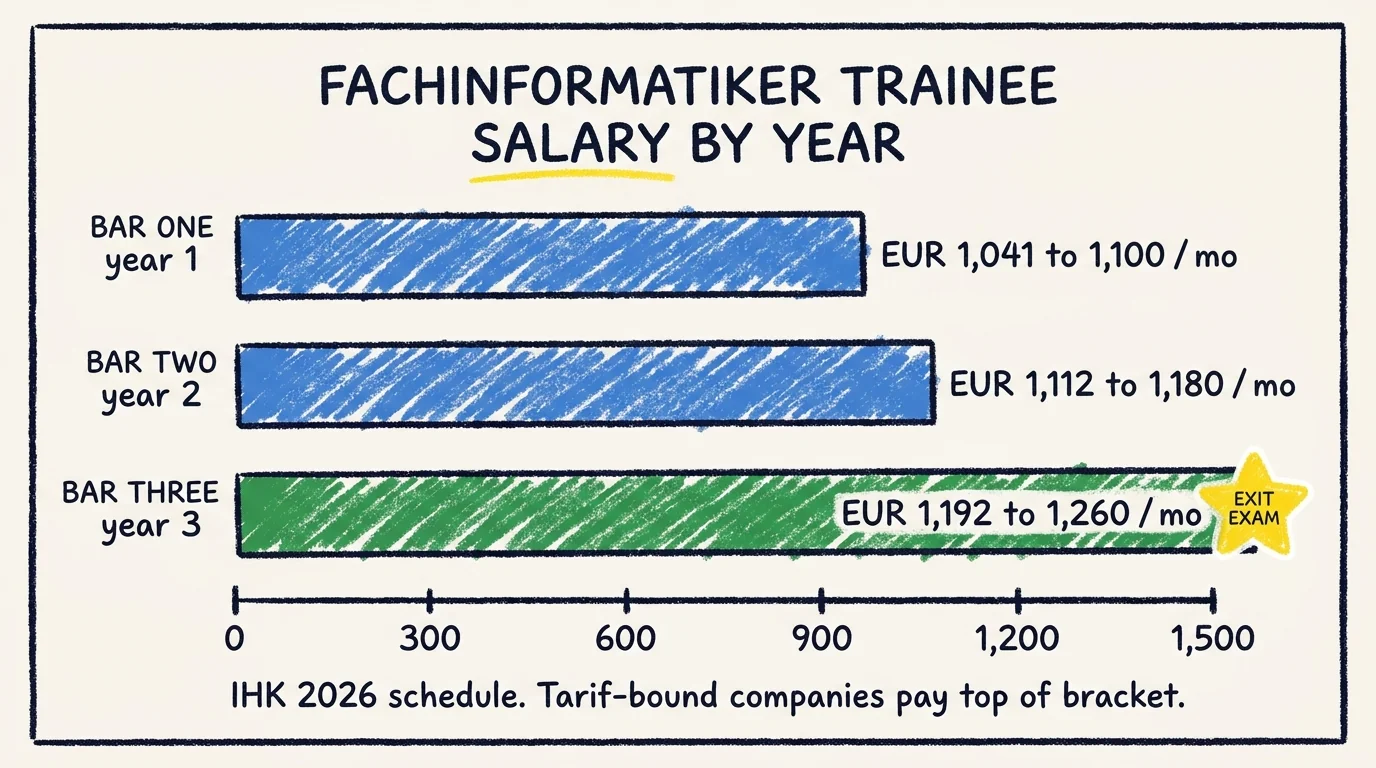
You are paid every month from day one of the Ausbildung. The Ausbildungsvergütung (trainee compensation) rises in three steps as you progress through the three years. The 2026 IHK schedule for IT trainees, weighted average across tarif-bound and non-tarif-bound companies:
| Year | Monthly gross (typical) | Notes |
|---|---|---|
| Year 1 | EUR 1,041 to EUR 1,100 | Lower end at small Mittelstand; higher at IG Metall companies |
| Year 2 | EUR 1,112 to EUR 1,180 | Roughly 7 percent annual increment |
| Year 3 | EUR 1,192 to EUR 1,260 | Final year before the exit exam |
Outliers exist on both sides. Public-sector and large industrial employers under TVöD or IG Metall collective agreements pay closer to EUR 1,200 in year one and break EUR 1,300 by year three. Smaller IT services companies without a Tarifvertrag can sit at the EUR 800 to EUR 950 floor in year one. Big tech (SAP, Bosch, Siemens, Deutsche Telekom, IBM Germany) usually pay top-of-bracket and offer the strongest progression.
Translate this to take-home: in Steuerklasse 1, with no other income, a year-three Ausbildungsvergütung of EUR 1,260 lands at roughly EUR 1,030 net after tax and social contributions. That covers a single-room flat in a mid-tier German city plus a modest budget once your Krankenversicherung is paid. It is liveable; it is not a working professional's salary, and you will not save aggressively during the three years.
What does a Fachinformatiker earn after the Ausbildung?
The post-qualification jump is the part the salary tables hide. Once you pass the IHK exam and sign on as a junior at the same company (or a competitor), you move from trainee scale to professional scale. Entry-level Fachinformatiker gross salary in 2026 is roughly EUR 3,200 to EUR 4,200 per month, depending on track, region, and employer.
| Stage | Monthly gross | Annual gross | Source |
|---|---|---|---|
| Trainee year 3 | EUR 1,200 to EUR 1,260 | EUR 14,400 to EUR 15,120 | IHK 2026 schedule |
| Junior, post-Ausbildung | EUR 3,200 to EUR 4,200 | EUR 38,400 to EUR 50,400 | Glassdoor Germany 2025 |
| Senior, 5 years experience | EUR 4,500 to EUR 5,800 | EUR 54,000 to EUR 69,600 | Glassdoor Germany 2025 |
| Specialist or lead, 8 plus years | EUR 5,800 to EUR 7,500 | EUR 69,600 to EUR 90,000 | StepStone Germany 2025 |
Anwendungsentwicklung specialists tend to sit at the top of the bracket because software development pays a market premium. Systemintegration is broader and more stable; salaries are a touch lower but the role count is many times larger. Daten- und Prozessanalyse graduates often move into BI consulting, where the entry brackets overlap with junior consultant scales and can hit EUR 5,000 in year two.
Compare this to the alternative path (a three-year IT Bachelor's at a German university): the degree starts at roughly EUR 4,000 to EUR 4,800 per month in entry roles, so about EUR 800 higher at start. But the Ausbildung trainee earned roughly EUR 40,000 across three years while the Bachelor's student paid living costs out of pocket. By year five of working life the two paths converge in earnings; the Ausbildung route gets there with zero student debt and three years of professional experience.
Who can apply from outside the EU
The Ausbildung is one of the most international-friendly vocational routes in Germany. The 2024 Skilled Immigration Act (SIA 2.0) lowered the bar further: B1 German is now sufficient for a vocational training visa under §16a Aufenthaltsgesetz, where B2 used to be the practical norm.
Documents you need before applying for the visa:
- A signed Ausbildungsvertrag (training contract) with a German company that is registered with the IHK
- Your school-leaving certificate, recognised through Anabin or the company's HR (most companies handle this internally)
- B1 German certificate from Goethe, telc, ÖSD, or TestDaF. Our language exam comparison guide walks through which test makes sense for which timeline.
- Proof of financial subsistence (the Ausbildungsvergütung itself usually counts; if it falls below the threshold, a top-up via Sperrkonto or sponsor may be needed)
- Valid passport with at least 12 months validity beyond the visa start
Health insurance kicks in automatically once the contract starts: your sponsoring company registers you with a public Krankenkasse and the contributions are deducted from your trainee salary. You do not arrange your own coverage during the Ausbildung.
The age cap most countries imposed is gone. There is no formal upper age limit on the Ausbildungsvisum, though companies tend to favour applicants under 30. If you are over 30, focus on companies that explicitly hire career-change candidates (Quereinsteiger).
How to land a Fachinformatiker training contract from abroad
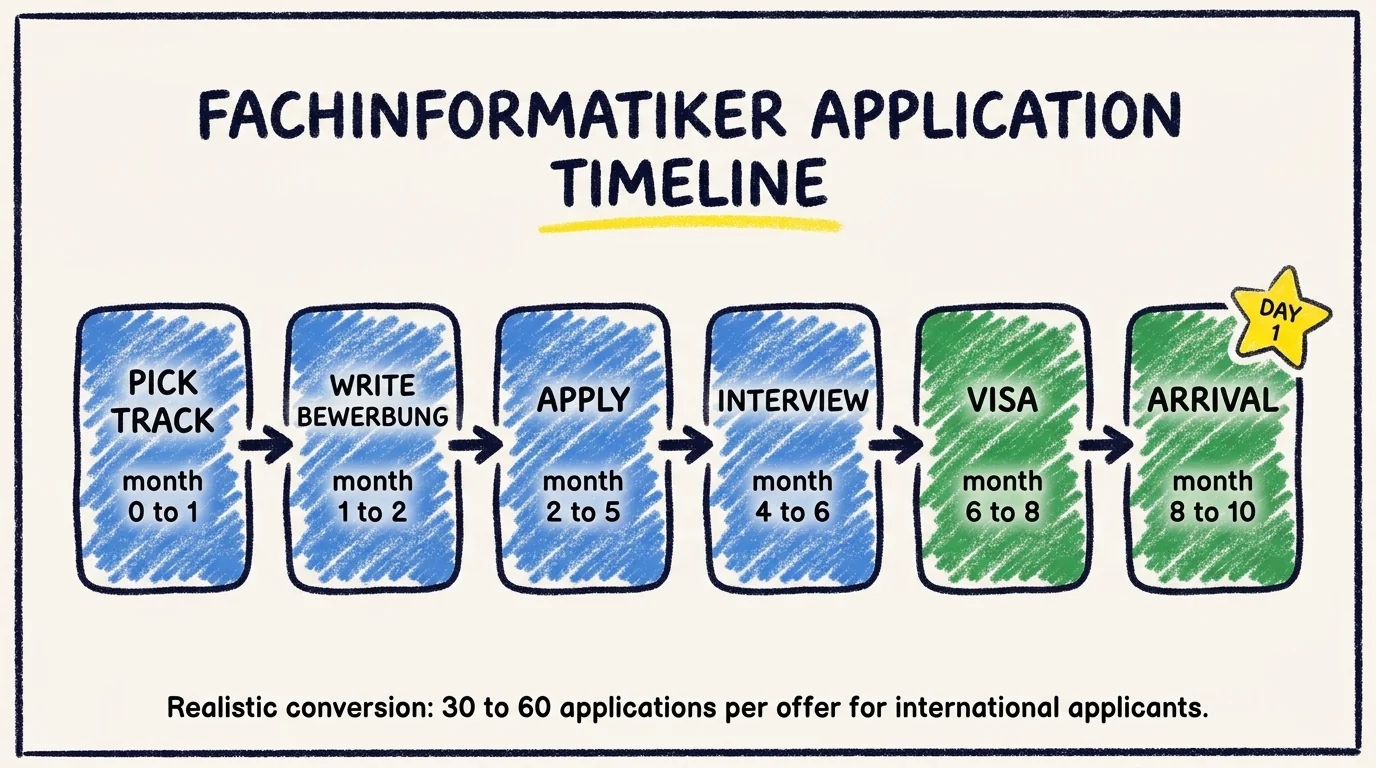
The contract is the bottleneck. The visa is straightforward; the application from outside Germany is the hard part. A realistic timeline:
- Pick your track and target list (months 0 to 1). Decide between the four specialisations based on what you want to do post-Ausbildung. Build a list of 25 to 40 companies that hire international Fachinformatiker trainees. Use ausbildung.de, azubiyo.de, the IHK Lehrstellenboerse, and the company career pages of SAP, Bosch, Siemens, Deutsche Telekom, IBM Germany, Bertrandt, and any large Mittelstand IT employer in your target city.
- Write a German Bewerbung (months 1 to 2). German applications follow a strict format: Anschreiben (cover letter, one page), Lebenslauf (CV, one page), school certificates, and any work or language certificates. The Anschreiben must be in German even if the eventual workplace is English-speaking. Most companies will reject a translated English CV.
- Apply 9 to 12 months ahead of the August or September start (months 2 to 5). The German Ausbildung year typically starts 1 August or 1 September. Most applications open in September of the previous year. Apply early; large companies fill seats by January.
- Do the interview in German (months 4 to 6). Often a video call. Most large employers also run a written aptitude test (Einstellungstest) which you take online. Smaller companies skip the test and go straight to interview.
- Sign the contract and start the visa (months 6 to 8). Once you have a signed Ausbildungsvertrag, book a national visa appointment at your nearest German embassy or consulate. Processing time is currently 4 to 12 weeks depending on country.
- Arrive and complete Anmeldung (months 8 to 10). Within 14 days of arrival, register your address at the local Bürgeramt, open a German bank account, and pick up your eAT residence permit card. The company onboards you on day one of the Ausbildung.
Realistic conversion rate: international applicants without prior Germany experience need to send roughly 30 to 60 applications to land one offer. The ratio improves dramatically once you have B1 certified, a clean German CV, and one or two German-side referrals.
After the Ausbildung: residence permit, PR, and citizenship
The Fachinformatiker Ausbildung is also a fast track to permanent residency. The path:
- Year 0 to 3: Ausbildung visa under §16a. Tied to the training contract.
- Year 3 to 5: Skilled worker residence permit under §18a or §18b. As soon as you pass the IHK exam, you can sign a regular employment contract and switch to a skilled-worker permit. The Ausbildung qualification counts as the required vocational qualification under SIA 2.0.
- Year 5: Niederlassungserlaubnis (permanent residency). After two years of qualified work post-Ausbildung (so five years total in Germany), you can apply for permanent residency. You need B1 German plus a clean record of social-insurance contributions. Our fast-track PR guide walks through the documentation in detail.
- Year 5 to 8: Citizenship. Under the 2024 reform, you can apply for German citizenship after five years of residence (three years if you reach C1 and demonstrate exceptional integration). Dual citizenship is now allowed for everyone, not just EU and Swiss nationals.
For applicants whose end-goal is the EU Blue Card pathway, the Fachinformatiker route gets you there indirectly: complete the Ausbildung, work two years in a qualifying IT role at the salary threshold, and apply for the Blue Card directly. Most international Fachinformatiker, however, find the standard skilled-worker permit faster and more flexible.
Common mistakes international applicants make
- Applying in English-only when the company posts in German. German employers read this as "not ready for the Berufsschule classroom." Always apply in German, even if the role works in English.
- Skipping the language certificate. B1 is the legal floor, not a soft preference. Companies stop reading applications without an attached Goethe or telc certificate.
- Picking the track based on prestige instead of fit. Anwendungsentwicklung is not "the best" track. Systemintegration has more open seats and broader hiring across smaller cities. Pick by what you actually want to do, not by ranking.
- Targeting only Berlin and Munich. The labour shortage is acute in mid-sized cities (Stuttgart, Hannover, Nürnberg, Dortmund, Leipzig). Acceptance rates are higher and rents are lower.
- Treating the trainee salary as "low pay" instead of "training stipend." The Ausbildungsvergütung is not market salary. It is a paid apprenticeship. The post-Ausbildung jump is where the financial case is made.
- Forgetting that the Berufsschule classes are in German. Even if your company speaks English internally, your vocational school does not. B1 minimum, B2 if you can manage it, makes year one survivable.
FAQ
What is the difference between Fachinformatiker and an IT degree from a German university?
The Ausbildung is a three-year paid vocational programme leading to a federal qualification (kein Studium, kein Abschluss). A Bachelor of Science Informatik is a three- or four-year university degree. Salaries converge by year five of working life; the Ausbildung route is faster, paid, and has no tuition costs. The Bachelor's is preferred if you want to move into research, doctoral study, or specific corporate roles that require a degree.
Which Fachinformatiker track has the best job market?
Systemintegration has the highest absolute number of open junior roles in 2026 because every German company runs IT infrastructure. Anwendungsentwicklung pays slightly more on average. Daten- und Prozessanalyse and Digitale Vernetzung are smaller cohorts but grew fastest in 2024 to 2026; competition for trained graduates is intense in industrial regions.
Do I need German B2 or is B1 enough?
B1 is the legal minimum for the §16a vocational training visa under the 2024 SIA 2.0 reform. In practice, B1 is enough for systems and infrastructure tracks; software development companies (especially smaller ones) often informally expect B2 for the interview itself. If you can plan for B2 before applying, it materially raises your offer rate.
Can I do a Fachinformatiker Ausbildung in English?
The Berufsschule curriculum is delivered in German across the entire country. The workplace component can be English-speaking at international employers (SAP, IBM Germany, parts of Bosch and Siemens, most consultancies). You cannot do the Ausbildung end-to-end in English. The vocational school exam is in German.
What happens if I do not pass the IHK final exam?
You can retake the exam twice. Most companies extend the contract by six to twelve months while you prepare for the retake; the trainee salary continues during this period. Pass rates for international Fachinformatiker trainees are above 85 percent.
Is the Ausbildung salary enough to live on in Germany?
In year three, after tax and social contributions, you take home roughly EUR 1,000 to EUR 1,050 net per month. That covers a single-room WG (shared flat) plus essentials in most German cities outside Munich and Frankfurt. It is tight; it is not unsustainable. Many trainees take on a small Werkstudent or part-time side role to expand the budget, which is allowed under the §16a permit.
Can I bring my family on the Ausbildungsvisum?
Family reunification under §16a is restricted. Your spouse can join only if the Ausbildung is longer than 24 months (which all four Fachinformatiker tracks are) and you can prove sufficient income, which the trainee salary alone usually does not meet. Most international Fachinformatiker bring family only after the Ausbildung ends and they switch to a skilled-worker permit.
What is the application deadline for the August 2026 cohort?
Most companies started accepting applications in September 2025 for the August 2026 start and will close their first round by January or February 2026. Some employers run a second round in March to May 2026 to fill remaining seats. Apply by January at the latest if you are coming from outside the EU; the visa adds 4 to 12 weeks on top of the offer.
Where to next
- Top 10 Ausbildung courses in Germany, which compares Fachinformatiker against the other vocational routes.
- Mechatronics Ausbildung programs, the sister technical track if you want hardware plus IT.
- KFZ-Mechatroniker Ausbildung, the automotive cousin of the mechatronics track with EUR 724 to 1,198 trainee pay and Section 16a visa.
- German language exam comparison: Goethe, TestDaF, DSH, to pick the right B1 or B2 test for your visa application.
- Fast-track to permanent residency in Germany, the post-Ausbildung path to PR and citizenship.
- The Train pillar lists every recognised vocational profession in Germany with current intake data.
Continue reading
Ausbildung·11 min read
Top 10 Ausbildung Courses in Germany for International Students
Discover the best Ausbildung courses in Germany for international students. Learn about top programs, career opportunities, and how to start your vocational training in one of Europe's strongest economies.
Read articleAusbildung·14 min read
Ausbildung vs Bachelor's in Germany: Cost, salary trajectory, PR timeline compared
Compare Ausbildung and Bachelor's in Germany on 2026 cost, year-by-year salary trajectory, EU Blue Card vs Niederlassungserlaubnis timelines.
Read articleAusbildung·16 min read
Ausbildung visa Germany 2026: Complete application guide, documents, timeline
Step-by-step guide to the German Ausbildung visa under Section 16a AufenthG: who qualifies, documents, 2026 financial proof, processing time, and what happens after arrival.
Read articleReady to plan your Germany journey?
Explore our tools and resources to find the perfect university and program for your academic goals.