
On this page
What you actually need to get into a German Master's
The five requirements every program checks, counted across 2,655 Master's programs, and the two that decide whether you can apply at all.

At a glance
Five things decide a German Master's application: a bachelor's degree that Germany recognises, enough credits in the right subject, a language score, the documents the program asks for, and for applicants who studied in India, China or Vietnam an APS certificate. Across the 2,655 Master's programs in our catalogue, 2,294 ask for IELTS or an equivalent English score, 897 need German at the point of application, and 1,148 need an APS certificate before you can even submit.
- Need an APS certificate
- 1,148 (43%)
- Taught in English
- 1,733 (65%)
- Ask for a CV
- 1,100
- Ask for a motivation letter
- 921
- Ask for a GRE score
- 73 (3%)
- Catalogue queried
- 27 July 2026
First: is your bachelor’s degree recognised at all
This is the gate before every other gate. A German university will not read your application if it does not accept the degree you already hold. Two separate checks decide it, and people usually only find out about the second one after they have been rejected.
Check 1: is your university recognised
Germany keeps a public database called anabin, run by the Central Office for Foreign Education (ZAB) under the Standing Conference of Education Ministers. It lists foreign institutions and how German authorities classify them. Universities are graded H+, H+/- or H-. An H+ classification means the institution is recognised. Per the DAAD admission database, checked 27 July 2026, the evaluation of foreign certificates in Germany is based on information published by the Standing Conference of Education Ministers in the anabin database.
Do this check first and do it for free. If your university is not classified H+, everything after this point changes, so there is no sense in booking a language test before you know.
Check 2: is your degree long enough
German Master’s programs state how many ECTS credits your previous degree must carry. This is where a three-year bachelor’s runs into trouble, because some programs want the equivalent of four years.
| Credits required | Programs | Universities | What it means |
|---|---|---|---|
| 180 ECTS | 921 | 174 | A three-year bachelor’s fits |
| 210 ECTS | 295 | 94 | You need more than three years |
So roughly three quarters of the programs that state a credit requirement will accept a standard three-year bachelor’s degree. 78 universities run programs on both sides of that line, which is why the answer has to be checked per program and not per university. Our guide on German universities that accept a three-year bachelor’s covers what to do if yours falls short, and the ECTS credit calculator converts your own transcript.
Second: the language score
Almost every program asks for proof of language. Which language depends on the program, not on the country.
| Requirement | Programs | Share |
|---|---|---|
| Taught in English | 1,733 | 65% |
| Taught in German | 495 | 19% |
| Bilingual | 287 | 11% |
| English or German | 129 | 5% |
2,294 programs, which is 86%, require an English test score. The most common IELTS band asked for is 6.5, required by 700 programs. 582 ask for 6.0, 556 ask for 5.5 and 383 ask for 7.0. So a 6.5 overall opens most doors and a 7.0 opens nearly all of them.
897 programs need German at the point of application and 777 need it by the time you enrol. If a program is taught in German you will usually need TestDaF, DSH or a comparable certificate, and reaching that level from zero takes about a year of serious study, not a few weeks.
One shortcut is worth knowing about. Some universities accept a Medium of Instruction letter from your bachelor’s university instead of a test score. In our catalogue 264 programs accept one and 372 explicitly do not, so it is worth checking but never worth assuming.
Third: the APS certificate, if you studied in India
If you did your degree in India, China or Vietnam, there is an extra verification step called APS. It checks that your certificates are genuine before a German university or the visa section will accept them.
1,148 Master’s programs in our catalogue require the APS certificate at the point of application. That is 43% of the catalogue, and it includes many of the programs people most want. This is the slowest step in the whole process and it runs on its own timetable, not yours, so start it before anything else.
Per the German Missions in India student visa checklist, dated 16 February 2026 and checked 8 October 2026, applicants who obtained their school-leaving certificate, studied semesters or obtained a degree in India almost always need an APS certificate. The exemptions are:
- You intend to do PhD or PostDoc studies in Germany
- You receive a stipend from German or EU public funds
- You intend to obtain a non-German degree
- You hold a foreign degree that is not Indian, such as a British or US degree
- You hold an international Indian school leaving certificate or degree, such as the International Baccalaureate
The new dMAT test
Per APS India’s dMAT page, checked 8 October 2026, a Digital Master Test becomes part of the APS documentation in India for Master’s applicants whose previous degree is in Engineering, in Commerce, Accounting, Finance or Economics, or in Business or Management, for the Summer Semester 2027 intake and later. You are exempt if you completed your APS online registration before 29 June 2026, shipped your complete APS documents before that date, or have already completed APS and received your certificate. Students in officially confirmed exchange, double-degree or university partnership programs are exempt too, as are bachelor’s students who have not yet completed 5 semesters of a 3-year degree or 7 semesters of a 4-year degree; APS India classifies mixed subjects using its official list of affected fields and your degree documents. The registration, shipping and certificate exemptions cover that one APS procedure; a new APS application later follows the rules in force then. The first test date was 26 September 2026 and certificates are due from 12 October 2026; the page lists no later sitting yet. It is run by g.a.s.t., not by APS India.
Two details save you weeks. You may submit your APS documents before the dMAT certificate exists, so verification starts in advance. And a low dMAT score does not automatically lead to a refusal of the APS certificate. Check whether it applies to you with our dMAT eligibility check, and read the full process in our APS guide.
Fourth: the documents, and what almost nobody asks for
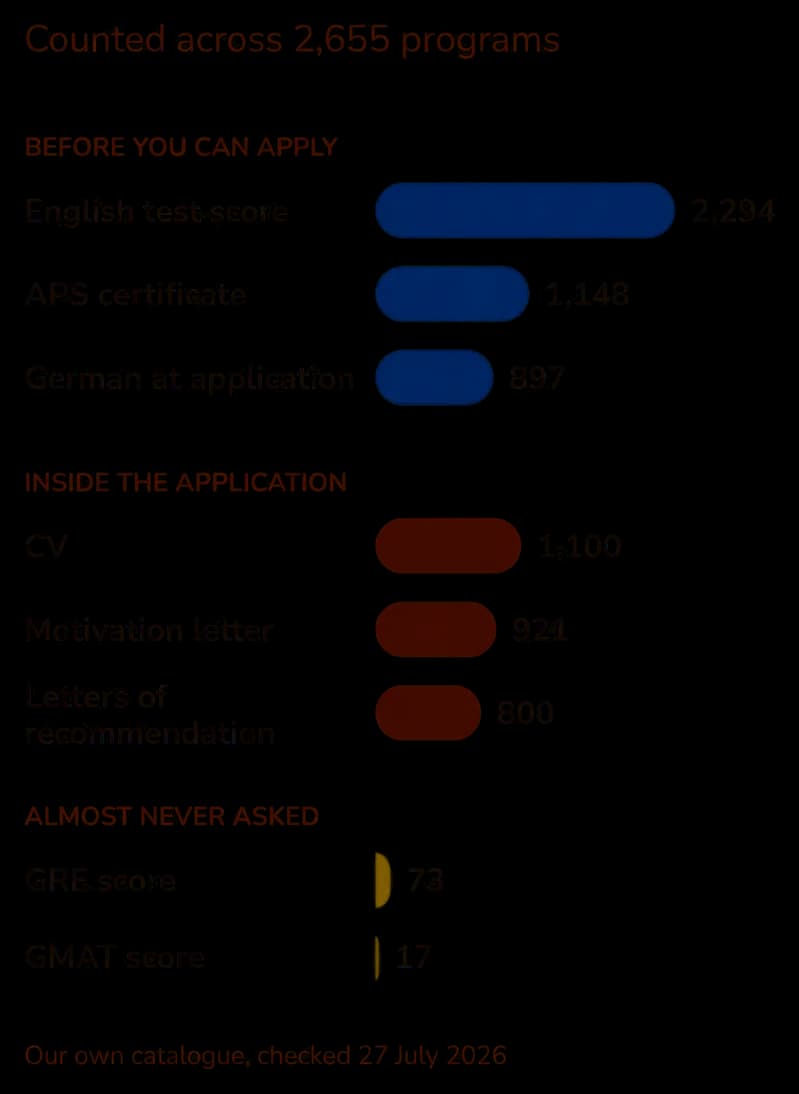
Once you clear the degree and the language, the application itself is a document exercise. Here is what German Master’s programs actually ask for, counted.
| Document | Programs that require it | Programs that say it is not needed |
|---|---|---|
| CV | 1,100 | 12 |
| Motivation letter or statement of purpose | 921 | 73 |
| Letters of recommendation | 800 | 128 |
| GRE score | 73 | 878 |
| GMAT score | 17 | 954 |
The GRE and GMAT numbers are the ones worth reading twice. Only 73 Master’s programs in our catalogue require the GRE and only 17 require the GMAT. Ten times as many state plainly that they do not need it. Germany is not the United States on this point, and a lot of money gets spent on tests that the target programs never asked for. Check your own shortlist before you book.
The other numbers that shape your plan:
- 917 programs have restricted admission (NC), which means places are limited and your grade is compared against other applicants. 1,701 do not.
- 1,562 programs charge no application fee. 1,093 charge one, most often through uni-assist.
- The semester contribution is unavoidable even when tuition is free. The median across our catalogue is 300 EUR per semester and the middle half sits between about 104 and 379 EUR.
And the money proof for the visa
Admission is one thing, the visa is another. Per the German Missions in India student visa checklist, checked 27 July 2026, you must show funds for your first year of study, currently 11,904 EUR, with confirmation that no more than 992 EUR per month can be withdrawn. Note that the DAAD’s own requirements overview page, checked the same day, still shows an older figure of 10,332 EUR while its proof of financial resources page shows 11,904 EUR. When official sources disagree, use the figure on your own mission’s checklist, because that is the office that decides your case.
Where these numbers come from
Every count is from our own catalogue of active, published Master’s programs, queried on 27 July 2026. Requirements change and the program page is always the final word, so confirm before you submit. Full detail is in our admission requirements guide.
Related tool
ECTS credit calculator
Convert your own transcript
Next steps
Frequently asked questions
Ready to plan your Germany journey?
Create a free account to save courses, track deadlines and see your next step.