On this page
German universities that accept a 3-year bachelor's degree
Why no university has a blanket yes or no, the 921 programs that accept 180 credits, and what to do when yours is not enough.

At a glance
No German university has a single policy on three-year bachelor's degrees. The decision is made per program by two separate gates: whether your university is listed as recognised in anabin, and whether that program accepts 180 ECTS credits. Across the 1,216 Master's programs in our catalogue that publish a credit requirement, 921 at 174 universities accept 180 ECTS, which is what a standard three-year bachelor's gives. 295 at 94 universities require 210. 78 universities run programs on both sides of that line.
- Universities requiring 210 somewhere
- 94
- Universities on both sides
- 78
- Share that accepts 180 ECTS
- 76%
- Programs publishing a credit rule
- 1,216 of 2,655
- Catalogue queried
- 27 July 2026
Why the question has no university-level answer
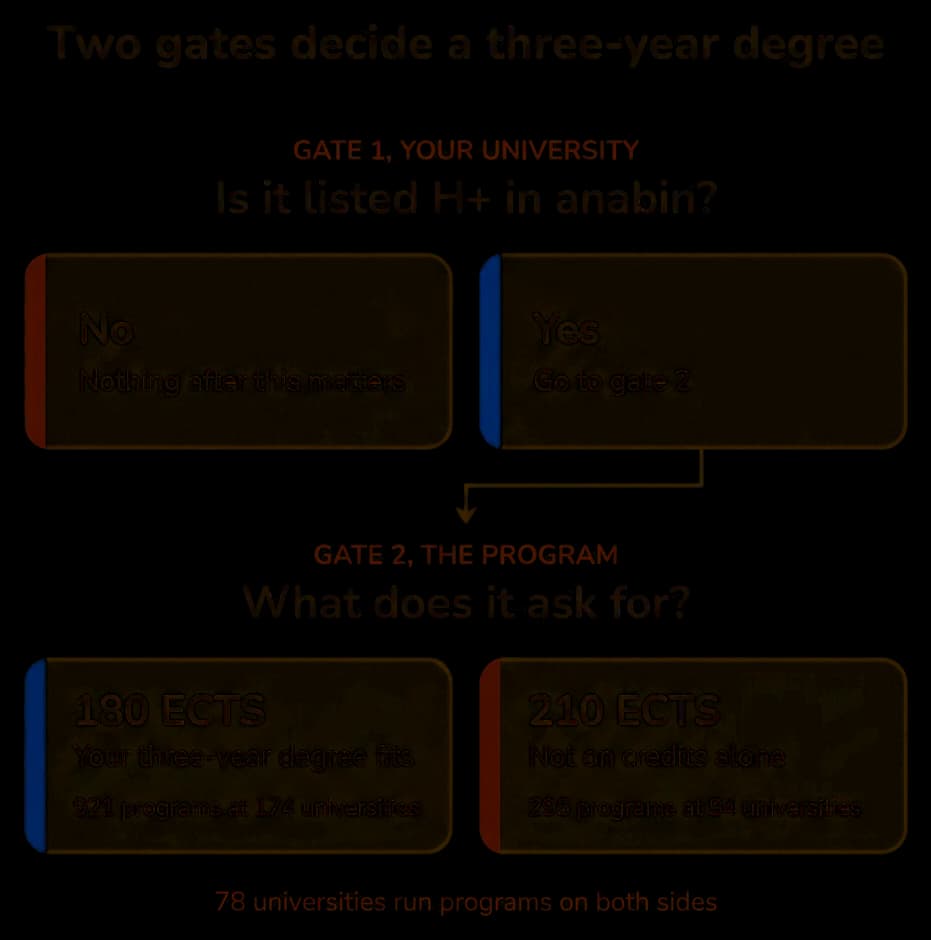
Search results promise a list of universities that accept a three-year bachelor’s. That list cannot be accurate, because acceptance is not decided at university level. It is decided at program level, by two gates that work independently of each other.
Gate 1: is your university recognised in anabin
Germany classifies foreign institutions in a public database called anabin, maintained by the Central Office for Foreign Education under the Standing Conference of Education Ministers. Institutions are graded H+, H+/- or H-. Per the DAAD admission database, checked 27 July 2026, the evaluation of foreign certificates in Germany is based on information published by the Standing Conference of Education Ministers in anabin.
This gate is about your institution, not about how many years you studied. A four-year degree from an unrecognised university fails here, and a three-year degree from an H+ university passes.
Gate 2: does the program accept your credits
Each program states how long the previous degree must be. uni-assist, checked 27 July 2026, puts it directly:
Depending on the course of study you are interested in, your initial degree course will need to be equivalent to a German bachelor course with a duration of 3, 3.5 or 4 years.
That sentence is the whole problem. German bachelor’s degrees are not all the same length. A three-year German bachelor’s carries 180 ECTS. A three-and-a-half or four-year one carries 210 or 240. A program built as a follow-on to a 210-credit degree will ask for 210 credits, and a standard Indian, Pakistani or Bangladeshi three-year bachelor’s usually does not reach that.
So the honest answer to "does this university accept my three-year degree" is another question: which program, and what does its page say.
The programs that do accept 180 credits
Out of 2,655 active Master’s programs in our catalogue, 1,216 publish a specific credit requirement. Here is how they split.
| Credits required | Programs | Universities | Share | Three-year bachelor’s |
|---|---|---|---|---|
| 180 ECTS | 921 | 174 | 76% | Fits |
| 210 ECTS | 295 | 94 | 24% | Does not fit on credits alone |
Three quarters of the programs that publish a rule accept 180 credits. That is the number to hold on to, because the common fear is that a three-year degree closes Germany off. It does not. It closes off about a quarter of the programs that state a requirement.
Where the 180-credit programs are concentrated
| University | Programs accepting 180 ECTS |
|---|---|
| Justus Liebig University Giessen | 34 |
| Bielefeld University | 29 |
| Kiel University | 26 |
| University of Oldenburg | 23 |
| University of Hohenheim | 19 |
| University of Gottingen | 17 |
| University of Tubingen | 15 |
| University of Bremen | 15 |
| Julius Maximilian University of Wurzburg | 15 |
The famous names people actually search for
The concentration list above is not the list people type into Google, so here are the big names from our catalogue, same query, same day. LMU Munich states a 180 ECTS requirement on 13 Master’s programs and 210 on none. RWTH Aachen: 10 programs at 180, none at 210. TU Munich: 10 at 180, one at 210. Humboldt: 9 at 180, none at 210. Cologne: 8 at 180, none at 210. Freiburg: 6 at 180, two at 210. Heidelberg: 4 at 180, one at 210. Two cautions ride with that: many programs at these universities publish no credit rule at all, and where none is stated the program page decides. But where the famous research universities do state a rule, it is almost always 180. The 210 demands live somewhere else entirely, which is the next table.
Where the 210-credit rule shows up
The universities that most often ask for 210 credits look different. In our catalogue the top of that list is HAW Hamburg with 21 programs, TH Ingolstadt with 15 and TH Deggendorf with 14. Almost all of the names near the top are Universities of Applied Sciences, whose own bachelor’s degrees commonly run to 210 credits including a practical semester. Their Master’s programs are built to follow that.
And the point that stops people wasting applications: 78 of the 190 universities in this comparison run programs on both sides of the line. TU Munich, Tubingen, Reutlingen, TH Deggendorf and TH Ingolstadt all appear in both groups. Being told "that university does not accept three-year degrees" is almost always wrong. A specific program does not.
What to do if your degree falls short
If your three-year degree does not meet a program’s credit requirement, you have real options. They are not equally good, so take them in this order.
1. Apply to the 921 programs that accept 180 credits
This is the obvious move that people skip because they fixed on one university first. Filter our course catalogue by your subject and read the credit requirement on each program page. There are 921 of them across 174 universities, which is not a consolation prize.
2. Count your credits properly before assuming
Indian degrees are not always what people assume. A four-year B.Tech or B.E. usually converts to about 240 ECTS and clears every requirement here. A three-year B.Sc, B.Com or BA usually converts to about 180. A degree with an extra year, a project year or an integrated qualification can sit higher than you think. Work it out with our ECTS credit calculator before you rule anything out.
3. Ask the program in writing
Email the program coordinator, state your degree, your university, your total credits and your subject, and ask whether you are eligible. Do this before you pay a uni-assist fee. German universities answer this kind of question, and a written yes is worth more than any list on the internet.
4. Get a Statement of Comparability if a university asks for one
The Central Office for Foreign Education issues a document that states what your foreign degree corresponds to in Germany. Per ZAB, checked 27 July 2026, a Statement of Comparability officially confirms the educational level your university degree corresponds to in Germany, and each university defines its own admission requirements, so a university may request one. Note the wording: it is requested by some universities, not required by all. Do not order one before somebody asks.
5. Add the missing credits
If you are 30 or 60 credits short of a program you really want, the gap can sometimes be closed with a further qualification in the same field. This is the slowest route and it only makes sense for one specific target program, so confirm in writing that the university will count what you are about to study before you enrol in it.
What does not work
Applying anyway and hoping the committee makes an exception. Credit requirements are formal admission rules, not preferences, and an application that misses one is normally filtered out before a human reads it. Spend that application fee on a program that fits.
Where these numbers come from
Every count is from our own catalogue of active, published Master’s programs, queried on 27 July 2026, using the credit requirement each program publishes. 1,439 programs do not publish one, so their requirement must be read on the university’s own page. Rules change, and the program page is always the final word. Our admission requirements guide covers the rest of the checks.
The three-year degree and the German student visa
One more gate sits after admission, and it is worth knowing before you celebrate an offer.
Admission and the visa are decided by different offices. A university can accept your three-year degree while the visa section still checks that the degree itself is recognised. Applicants who studied in India also go through APS, which verifies that their academic documents are genuine and plausible; it is a separate step from the anabin recognition check. Per the German Missions in India student visa checklist, dated 16 February 2026 and checked 8 October 2026, applicants who obtained their school-leaving certificate, studied semesters or obtained a degree in India almost always need an APS certificate apart from a few listed exceptions, and 1,148 of the Master’s programs in our catalogue require it at the point of application.
The practical order, then, is this:
- Check your university in anabin. Free, and it decides everything after it.
- Convert your own credits, so you know which side of the 180 line you are on.
- Filter for programs whose stated requirement you meet.
- Start APS, because it is the slowest step and it does not wait for you.
- Apply, with a written eligibility confirmation where the credit situation was unclear.
One change to step four is new. Per APS India’s dMAT page, checked 8 October 2026, a Digital Master Test becomes part of the APS documentation in India for the Summer Semester 2027 intake and later, for Master’s applicants whose previous degree is in Engineering, in Commerce, Accounting, Finance or Economics, or in Business or Management. You are exempt if you completed your APS online registration before 29 June 2026, shipped your complete APS documents before that date, or have already completed APS and received your certificate. Students in officially confirmed exchange, double-degree or university partnership programs are exempt too, as are bachelor’s students who have not yet completed 5 semesters of a 3-year degree or 7 semesters of a 4-year degree; APS India classifies mixed subjects using its official list of affected fields and your degree documents. The registration, shipping and certificate exemptions cover that one APS procedure; a new APS application later follows the rules in force then. The first test date was 26 September 2026, and the page lists no later sitting yet. Many three-year degrees this page is about, B.Com. and BBA among them, sit in those fields, so check whether it applies to you with our dMAT eligibility check before you plan the APS timeline.
Our APS guide covers step four, and the application process guide covers the whole sequence.
Related tools
ECTS credit calculator
Convert your own transcript
German grade calculator
Your grade on the German scale
dMAT eligibility check
Does the new test apply to you
Next steps
Frequently asked questions
Ready to plan your Germany journey?
Create a free account to save courses, track deadlines and see your next step.